
Introduction
Thank you for reading this post, don't forget to subscribe!In today’s digital world, website speed is not just a technical factor—it is a direct revenue driver. Businesses often focus on design, content, and marketing, but ignore one critical element: website performance.
As a developer, I can confidently say that speed is not optional anymore—it is essential for conversions, SEO rankings, and user satisfaction.
A slow website doesn’t just frustrate users—it actively loses sales. In contrast, a fast website builds trust, improves engagement, and increases revenue.
In this blog, we will explore how fast websites increase sales from a developer’s perspective, backed by real-world logic, user behavior, and performance optimization principles.
Why Website Speed Matters More Than Ever
Modern users expect instant results. Studies show that:
- Users leave if a website takes more than 3 seconds to load
- Mobile users are even less patient than desktop users
- Google uses page speed as a ranking factor
From a development perspective, speed impacts three major areas:
- User Experience (UX)
- Search Engine Optimization (SEO)
- Conversion Rate Optimization (CRO)
If any one of these fails, sales are directly affected.
The Psychology Behind Fast Websites and Higher Sales
Speed influences human psychology more than most businesses realize.
When a website loads quickly:
- Users feel the brand is professional and trustworthy
- Navigation feels smooth and effortless
- Decision-making becomes faster
When a website is slow:
- Users feel frustration
- Trust decreases instantly
- They abandon the site before taking action
In short:
Fast websites create confidence. Slow websites create doubt.
And in digital business, confidence = conversions.
How Website Speed Directly Affects Sales
Let’s break down how performance translates into revenue.
- Lower Bounce Rate = More Opportunities to Sell
A slow website increases bounce rate. Users leave before exploring products or services.
A fast website keeps users engaged longer, increasing:
- Page views
- Product discovery
- Chances of conversion
Even a 1-second improvement in load time can significantly reduce bounce rate.
- Higher Conversion Rates
Conversion rate is the percentage of users who take action (buy, sign up, or contact).
Speed improvements directly increase conversions:
- Faster checkout pages reduce cart abandonment
- Faster forms increase submissions
- Faster landing pages increase lead generation
Example:
If an eCommerce site earns $10,000/day, even a 1% improvement in conversion rate = $100 extra per day = $36,500 per year.
- Improved SEO Rankings
Google rewards fast websites.
Core Web Vitals metrics include:
- Largest Contentful Paint (LCP)
- First Input Delay (FID)
- Cumulative Layout Shift (CLS)
Better speed = better ranking = more organic traffic = more sales.
- Better Mobile Performance
More than 60% of users browse on mobile devices.
Slow mobile websites cause:
- High abandonment rates
- Poor engagement
- Lost local business leads
Fast mobile optimization ensures:
- Smooth browsing
- Faster checkout
- Higher mobile conversions
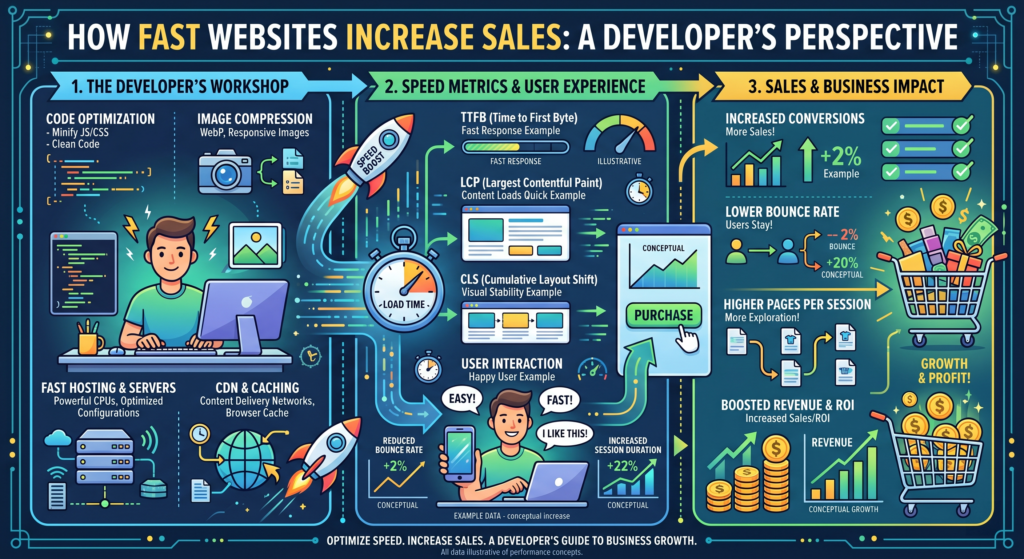
Developer’s Perspective: What Makes a Website Fast?
From a technical standpoint, website speed depends on several factors.
- Optimized Code Structure
Clean, efficient code reduces load time.
Best practices include:
- Removing unnecessary scripts
- Minimizing CSS and JavaScript
- Using modular architecture
- Image Optimization
Large images are one of the biggest speed killers.
Developers use:
- WebP format
- Lazy loading
- Compression tools
Result: Faster page load without losing quality.
- Caching Strategies
Caching stores website data so it loads faster on repeat visits.
Types of caching:
- Browser caching
- Server-side caching
- CDN caching
- Content Delivery Network (CDN)
A CDN distributes website data globally.
Benefits:
- Faster load times worldwide
- Reduced server load
- Better reliability
- Hosting Quality
Cheap hosting often leads to slow websites.
High-performance hosting provides:
- Faster server response time
- Better uptime
- Scalability for traffic spikes
Real Business Impact of Website Speed
Let’s look at real-world impact scenarios.
E-commerce Store Example
- Before optimization: 5-second load time
- After optimization: 2-second load time
Results:
- 30% increase in conversions
- 20% lower bounce rate
- Higher customer satisfaction
Service-Based Business Example
A law firm or software company with a slow website may lose potential clients instantly.
After optimization:
- More inquiries via contact forms
- Increased trust
- Better Google rankings
Mobile Speed: The Hidden Revenue Factor
Mobile speed is often ignored but extremely important.
Key facts:
- Mobile users are impatient
- 1-second delay can reduce conversions by up to 20%
- Google prioritizes mobile-first indexing
Developers focus on:
- Responsive design
- Lightweight frameworks
- Optimized mobile UI
Common Mistakes That Slow Down Websites
Many businesses unknowingly hurt their own performance.
- Heavy Themes and Plugins
Too many plugins slow down WordPress websites.
- Unoptimized Images
Uploading raw images without compression.
- Poor Hosting Choice
Shared hosting with limited resources.
- Excessive Animations
Overuse of JavaScript animations affects performance.
- No Caching System
Every visit reloads everything from scratch.
How Fast Websites Build Brand Trust
Speed is also a branding factor.
A fast website communicates:
- Professionalism
- Reliability
- Technical strength
A slow website communicates:
- Outdated systems
- Poor management
- Lack of care
Users often judge a business within seconds based on performance.
SEO Perspective: Why Google Loves Fast Websites
Google’s algorithm prioritizes user experience.
Fast websites benefit from:
- Higher crawl efficiency
- Better indexing
- Lower bounce rates
This results in:
Higher rankings → More traffic → More sales
Future of Website Speed in 2026 and Beyond
With increasing competition, speed will become even more critical.
Future trends include:
- AI-powered optimization
- Instant-loading websites (pre-rendering)
- Edge computing for ultra-fast delivery
- Lightweight frameworks like Next.js and headless CMS systems
Businesses that ignore speed will fall behind.
Conclusion
From a developer’s perspective, website speed is not just a technical metric—it is a business growth engine.
A fast website:
- Increases conversions
- Improves SEO rankings
- Enhances user experience
- Builds brand trust
- Ultimately increases sales
If your website is slow, you are not just losing performance—you are losing customers and revenue every single day.
Investing in speed optimization is one of the highest ROI decisions a business can make in the digital era.
Final Thoughts
If you are running a business website or software platform, ask yourself:
“Is my website helping me earn money—or silently losing it?”
Because in most cases, speed is the difference between growth and stagnation.