In today’s fast-paced digital world, technology plays a critical role in the success of every business. Whether it is a startup, small business, or large enterprise, companies rely heavily on IT infrastructure to manage operations, communicate with customers, store data, and drive growth. However, managing complex IT systems internally can be expensive, time-consuming, and challenging.
Thank you for reading this post, don't forget to subscribe!This is where Managed IT Services come into play. Managed IT Services provide businesses with professional IT support, monitoring, maintenance, cybersecurity, and strategic technology planning without the need to maintain a large in-house IT department.
At ByteBrew Technologies, we understand the importance of reliable technology solutions for modern businesses. Managed IT Services help organizations reduce downtime, increase productivity, strengthen security, and focus on their core business objectives.
In this article, we will explore how Managed IT Services improve business efficiency, reduce operational costs, and create a competitive advantage in today’s technology-driven marketplace.
What Are Managed IT Services?
Managed IT Services refer to the practice of outsourcing IT management and support responsibilities to a specialized service provider known as a Managed Service Provider (MSP).
These services typically include:
- Network monitoring and management
- Cybersecurity protection
- Cloud services management
- Data backup and disaster recovery
- Help desk support
- Software updates and patch management
- Infrastructure management
- IT consulting and strategy
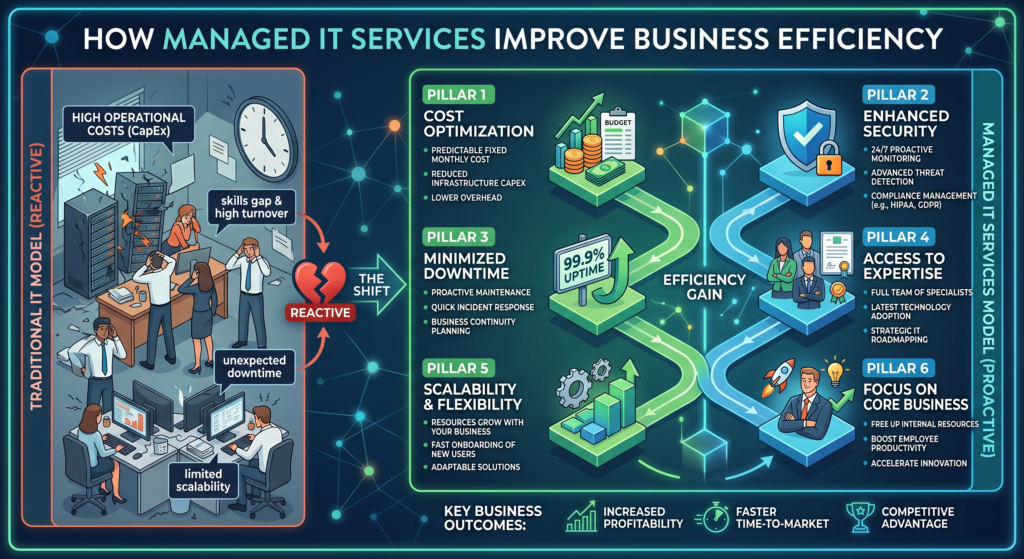
Rather than reacting to IT problems after they occur, Managed IT Services focus on proactive monitoring and maintenance to prevent issues before they impact business operations.
Why Business Efficiency Matters
Business efficiency is the ability of an organization to achieve maximum productivity with minimum wasted resources, time, and effort.
Efficient businesses typically experience:
- Higher productivity
- Lower operational costs
- Better customer satisfaction
- Faster growth
- Improved employee performance
- Greater profitability
Technology is one of the biggest factors affecting efficiency. Poorly managed IT systems can lead to downtime, security breaches, slow performance, and lost productivity.
Managed IT Services help businesses eliminate these obstacles and operate more efficiently.
Reduced Downtime and Improved Reliability
One of the most significant benefits of Managed IT Services is minimizing downtime.
System outages can result in:
- Lost revenue
- Reduced employee productivity
- Damaged reputation
- Poor customer experiences
Managed Service Providers continuously monitor networks, servers, and systems around the clock. Potential issues are identified and resolved before they become major problems.
Benefits include:
24/7 Monitoring
Continuous monitoring ensures systems remain operational at all times.
Proactive Maintenance
Regular updates and maintenance prevent failures and performance issues.
Rapid Issue Resolution
IT experts quickly address technical problems, reducing disruption.
As a result, businesses experience greater operational stability and uninterrupted productivity.
Enhanced Cybersecurity Protection
Cybersecurity threats continue to evolve every year. Businesses face risks such as:
- Malware attacks
- Ransomware infections
- Data breaches
- Phishing scams
- Insider threats
A successful cyberattack can lead to significant financial and reputational damage.
Managed IT Services strengthen security through:
Advanced Threat Detection
Continuous monitoring identifies suspicious activity before it causes harm.
Firewall Management
Firewalls protect networks from unauthorized access.
Endpoint Protection
Devices such as laptops, desktops, and mobile phones are secured against threats.
Security Updates
Software vulnerabilities are patched promptly to prevent exploitation.
Employee Security Training
Staff members learn how to recognize and avoid cyber threats.
By implementing robust cybersecurity measures, businesses reduce risk and maintain operational efficiency.
Increased Employee Productivity
Employees perform best when technology works seamlessly.
Common productivity issues include:
- Slow computers
- Network outages
- Software errors
- Login problems
- Hardware failures
Managed IT Services ensure that employees have reliable tools and support whenever they need assistance.
Faster Problem Resolution
Help desk support quickly resolves technical issues.
Optimized Systems
Regular maintenance keeps devices running efficiently.
Improved Collaboration
Cloud-based tools enhance communication and teamwork.
Better User Experience
Employees spend less time troubleshooting and more time focusing on productive tasks.
The result is a more efficient workforce capable of achieving higher performance levels.
Cost Savings and Predictable IT Expenses
Maintaining an in-house IT department can be expensive.
Businesses must cover:
- Salaries
- Benefits
- Training costs
- Equipment purchases
- Software licenses
Managed IT Services offer a cost-effective alternative.
Fixed Monthly Costs
Businesses pay predictable monthly fees rather than dealing with unexpected repair expenses.
Reduced Infrastructure Costs
Cloud solutions minimize hardware investments.
Lower Recruitment Costs
No need to hire multiple specialized IT professionals.
Improved Resource Allocation
Businesses can invest savings into growth initiatives.
Managed IT Services help organizations maximize their technology budgets while maintaining high-quality support.
Access to Experienced IT Professionals
Technology evolves rapidly, making it difficult for internal teams to stay current.
Managed Service Providers offer access to experts in:
- Cybersecurity
- Cloud computing
- Network engineering
- Data management
- Software development
- Compliance
Instead of relying on a limited internal team, businesses gain access to a diverse group of specialists.
This expertise ensures:
- Better decision-making
- Faster problem resolution
- Improved technology implementation
- Reduced operational risks
Having access to experienced professionals improves overall business efficiency and competitiveness.
Scalability for Business Growth
As businesses grow, their technology needs change.
Managed IT Services provide scalable solutions that adapt to organizational growth.
Examples include:
- Adding new users
- Expanding cloud storage
- Deploying new applications
- Supporting remote workers
- Upgrading infrastructure
Businesses can scale technology resources without major disruptions or expensive investments.
This flexibility allows organizations to grow confidently while maintaining operational efficiency.
Better Data Backup and Disaster Recovery
Data is one of the most valuable assets for any organization.
Businesses risk losing critical information due to:
- Hardware failures
- Cyberattacks
- Human error
- Natural disasters
Managed IT Services provide comprehensive backup and disaster recovery solutions.
Automated Backups
Critical data is backed up regularly and securely.
Rapid Recovery
Systems can be restored quickly after incidents.
Business Continuity
Operations continue with minimal disruption.
Reduced Financial Losses
Data recovery minimizes downtime and associated costs.
Effective disaster recovery planning helps businesses remain resilient and productive.
Improved Cloud Management
Cloud computing has transformed how businesses operate.
Managed IT providers assist organizations in leveraging cloud technologies effectively.
Cloud benefits include:
- Remote accessibility
- Enhanced collaboration
- Cost savings
- Increased flexibility
- Improved security
Managed IT Services help with:
- Cloud migration
- Cloud security
- Performance optimization
- User management
- Storage solutions
Businesses gain the benefits of cloud technology without the complexities of managing it internally.
Streamlined Business Operations
Technology should simplify business operations, not complicate them.
Managed IT Services optimize workflows by:
- Automating repetitive tasks
- Integrating business applications
- Enhancing communication systems
- Improving data management
- Eliminating inefficiencies
Examples include:
Automated Reporting
Reduce manual administrative work.
Integrated Software Systems
Improve information sharing between departments.
Workflow Automation
Accelerate routine processes.
These improvements allow businesses to operate more efficiently and focus on strategic objectives.
Support for Remote and Hybrid Workforces
Remote work has become a permanent part of many business models.
Managing remote employees presents challenges such as:
- Secure access
- Device management
- Communication
- Collaboration
Managed IT Services provide:
- Virtual Private Networks (VPNs)
- Secure cloud platforms
- Remote device monitoring
- Collaboration tools
- Technical support
Employees can work from anywhere while maintaining productivity and security.
Compliance and Risk Management
Many industries must comply with regulations related to:
- Data protection
- Privacy
- Security standards
Failure to comply can result in:
- Financial penalties
- Legal consequences
- Reputation damage
Managed IT providers help businesses maintain compliance by:
- Implementing security controls
- Monitoring systems
- Maintaining documentation
- Conducting audits
- Managing data protection policies
Compliance support reduces risk and improves operational confidence.
Strategic Technology Planning
Technology investments should align with business goals.
Managed IT Services provide strategic guidance through:
IT Assessments
Identify strengths and weaknesses in existing systems.
Technology Roadmaps
Plan future technology investments.
Digital Transformation Support
Implement innovative solutions that improve efficiency.
Business Growth Alignment
Ensure technology supports long-term objectives.
Strategic planning enables businesses to make informed decisions and maximize return on investment.
Competitive Advantage Through Technology
Businesses that leverage technology effectively gain a significant competitive advantage.
Managed IT Services help organizations:
- Respond quickly to market changes
- Improve customer experiences
- Enhance operational efficiency
- Reduce downtime
- Strengthen cybersecurity
With reliable technology infrastructure, businesses can innovate faster and outperform competitors.
Why Choose ByteBrew Technologies for Managed IT Services?
At ByteBrew Technologies, we provide comprehensive Managed IT Services designed to help businesses achieve operational excellence.
Our services include:
- 24/7 IT monitoring
- Cybersecurity solutions
- Cloud management
- IT consulting
- Network support
- Data backup and recovery
- Help desk services
- Infrastructure management
We focus on delivering proactive, scalable, and cost-effective technology solutions that improve efficiency and support business growth.
Whether you are a startup, small business, or enterprise organization, our team ensures your technology works seamlessly so you can focus on what matters most—growing your business.
Conclusion
Managed IT Services have become an essential component of modern business success. By outsourcing IT management to experienced professionals, organizations can reduce downtime, improve cybersecurity, increase productivity, control costs, and support long-term growth.
As technology continues to evolve, businesses need reliable partners who can manage complex IT environments and provide strategic guidance. Managed IT Services offer the expertise, tools, and support necessary to keep operations running smoothly and efficiently.
Companies that invest in Managed IT Services are better positioned to adapt to changing market conditions, meet customer expectations, and achieve sustainable growth.
If your business is looking to improve efficiency, reduce technology-related challenges, and gain a competitive advantage, ByteBrew Technologies is ready to help you transform your IT infrastructure and unlock your full potential.