
Introduction
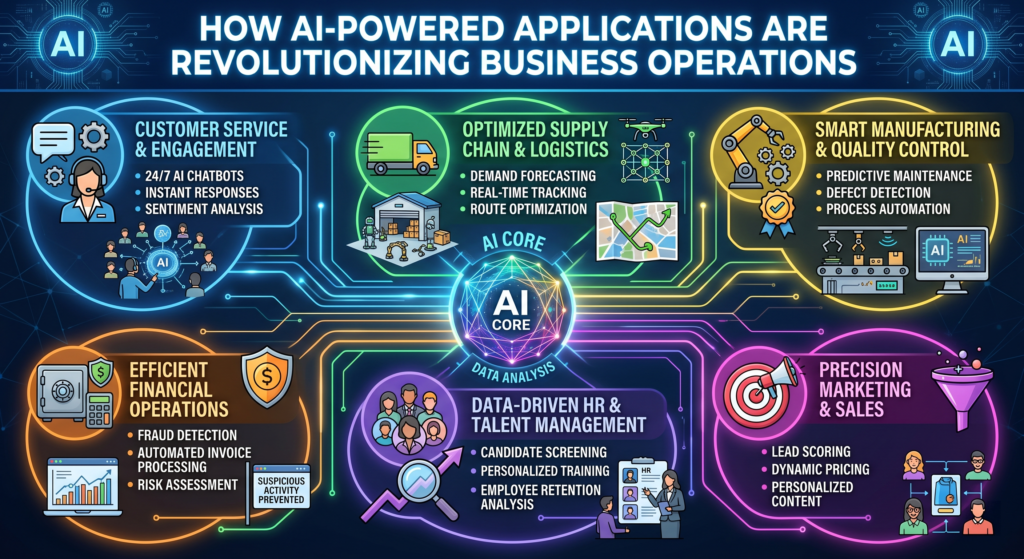
Thank you for reading this post, don't forget to subscribe!Artificial Intelligence (AI) is no longer a futuristic concept reserved for tech giants and research laboratories. Today, AI-powered applications are transforming businesses of all sizes across every industry. From automating repetitive tasks to enhancing customer experiences and enabling data-driven decision-making, AI has become a critical component of modern business operations.
Organizations worldwide are investing heavily in AI technologies to improve efficiency, reduce costs, increase productivity, and gain a competitive advantage. According to industry reports, businesses that successfully integrate AI into their operations often experience faster growth, improved customer satisfaction, and stronger profitability.
In this comprehensive guide, we’ll explore how AI-powered applications are revolutionizing business operations, the key benefits they offer, real-world use cases, implementation strategies, and what the future holds for AI-driven enterprises.
What Are AI-Powered Applications?
AI-powered applications are software solutions that utilize artificial intelligence technologies such as:
- Machine Learning (ML)
- Natural Language Processing (NLP)
- Computer Vision
- Predictive Analytics
- Robotic Process Automation (RPA)
- Deep Learning
- Generative AI
These applications can learn from data, identify patterns, make predictions, automate decisions, and continuously improve their performance without requiring constant human intervention.
Unlike traditional software that follows predefined rules, AI-powered applications adapt and evolve based on new information and user interactions.
Why Businesses Are Adopting AI Faster Than Ever
Several factors are driving rapid AI adoption:
Increased Data Availability
Businesses generate enormous amounts of data daily. AI applications can analyze this information quickly and extract valuable insights that humans may miss.
Competitive Pressure
Organizations are using AI to gain strategic advantages in customer service, marketing, operations, and innovation.
Improved Computing Power
Cloud computing and modern hardware have made advanced AI technologies more accessible and affordable.
Demand for Automation
Companies are seeking ways to automate repetitive tasks to improve efficiency and reduce operational costs.
Enhanced Customer Expectations
Modern consumers expect personalized experiences, instant responses, and seamless interactions—capabilities that AI delivers exceptionally well.
Key Ways AI Is Transforming Business Operations
- Automating Repetitive Tasks
One of the most significant impacts of AI is automation.
Businesses spend countless hours on routine administrative activities such as:
- Data entry
- Invoice processing
- Appointment scheduling
- Email management
- Report generation
- Inventory tracking
AI-powered systems can perform these tasks with greater speed and accuracy.
Benefits
- Reduced human errors
- Faster task completion
- Lower operational costs
- Increased employee productivity
Employees can focus on strategic initiatives rather than repetitive manual work.
- Improving Customer Service
Customer service has experienced a massive transformation through AI-powered applications.
AI Chatbots and Virtual Assistants
Modern AI chatbots can:
- Answer customer questions instantly
- Resolve common issues
- Process orders
- Schedule appointments
- Provide product recommendations
Unlike traditional support systems, AI-powered customer service operates 24/7.
Benefits
- Faster response times
- Reduced support costs
- Improved customer satisfaction
- Higher engagement levels
Businesses can deliver exceptional customer experiences without significantly increasing staffing costs.
- Enhancing Decision-Making Through Data Analytics
Business leaders often struggle to process massive volumes of information.
AI applications can analyze:
- Sales data
- Customer behavior
- Market trends
- Financial performance
- Operational metrics
These systems generate actionable insights that support better decision-making.
Example
An AI-powered analytics platform can identify:
- Emerging customer trends
- High-performing products
- Potential revenue opportunities
- Areas of operational inefficiency
This enables organizations to make smarter strategic decisions based on real-time data.
- Personalized Marketing at Scale
Modern marketing relies heavily on personalization.
AI enables businesses to create highly targeted campaigns by analyzing:
- Customer preferences
- Purchase history
- Website activity
- Social media engagement
- Demographic information
AI Marketing Capabilities
- Personalized email campaigns
- Product recommendations
- Dynamic website content
- Customer segmentation
- Predictive lead scoring
Results
Businesses can significantly improve:
- Conversion rates
- Customer retention
- Marketing ROI
- Brand loyalty
Personalized experiences often lead to stronger customer relationships and increased sales.
- Streamlining Human Resource Management
Human Resources departments are increasingly adopting AI solutions.
AI Applications in HR
- Resume screening
- Candidate matching
- Interview scheduling
- Employee onboarding
- Performance analysis
- Workforce planning
Recruitment Benefits
AI can quickly evaluate thousands of applications and identify the most qualified candidates.
This reduces hiring time while improving recruitment accuracy.
Employee Experience
AI-powered tools can also enhance employee engagement through personalized learning and development recommendations.
- Optimizing Supply Chain Management
Supply chain efficiency directly impacts profitability.
AI-powered applications help organizations:
- Forecast demand
- Monitor inventory
- Predict disruptions
- Optimize logistics
- Improve warehouse operations
Predictive Analytics
AI can analyze historical data and market conditions to forecast future demand accurately.
This reduces:
- Overstocking
- Stock shortages
- Waste
- Delivery delays
The result is a more efficient and cost-effective supply chain.
- Strengthening Cybersecurity
Cyber threats continue to evolve rapidly.
Traditional security systems often struggle to keep pace with sophisticated attacks.
AI-Powered Cybersecurity
AI systems can:
- Detect unusual activity
- Identify threats in real time
- Monitor network traffic
- Prevent fraud
- Automate incident responses
Business Benefits
- Reduced security risks
- Faster threat detection
- Improved compliance
- Lower financial losses
AI provides organizations with a proactive approach to cybersecurity.
- Improving Financial Management
Finance departments are using AI to streamline operations and improve accuracy.
Common Applications
- Fraud detection
- Financial forecasting
- Expense management
- Risk assessment
- Automated bookkeeping
AI-Powered Insights
Businesses can gain better visibility into:
- Cash flow trends
- Budget performance
- Investment opportunities
- Financial risks
This supports stronger financial planning and decision-making.
- Predictive Maintenance in Operations
For manufacturing and industrial businesses, equipment downtime can be extremely costly.
AI-powered predictive maintenance systems analyze:
- Equipment performance
- Sensor data
- Historical maintenance records
These systems can predict failures before they occur.
Benefits
- Reduced downtime
- Lower maintenance costs
- Improved equipment lifespan
- Increased productivity
Predictive maintenance helps businesses avoid unexpected disruptions.
- Enhancing Product Development
AI is accelerating innovation across industries.
Businesses can use AI to:
- Analyze customer feedback
- Identify market opportunities
- Test product concepts
- Optimize designs
- Predict consumer demand
This enables faster and more successful product launches.
Real-World Examples of AI in Business
E-Commerce
Online retailers use AI for:
- Product recommendations
- Dynamic pricing
- Inventory management
- Customer support
Result
Higher sales and improved customer experiences.
Healthcare
Healthcare organizations leverage AI for:
- Medical imaging analysis
- Patient monitoring
- Appointment scheduling
- Predictive diagnostics
Result
Improved patient outcomes and operational efficiency.
Banking and Finance
Financial institutions utilize AI for:
- Fraud detection
- Credit scoring
- Risk management
- Customer service automation
Result
Enhanced security and better financial services.
Manufacturing
Manufacturers deploy AI for:
- Quality control
- Predictive maintenance
- Production optimization
- Supply chain management
Result
Increased productivity and reduced costs.
Benefits of AI-Powered Applications
Businesses adopting AI often experience:
Increased Productivity
Automation reduces manual workloads and accelerates processes.
Cost Savings
Operational expenses decrease through efficiency improvements.
Better Customer Experiences
Personalized interactions improve satisfaction and loyalty.
Enhanced Accuracy
AI minimizes human errors in data processing and decision-making.
Competitive Advantage
Organizations can innovate faster and respond more effectively to market changes.
Scalability
AI solutions can handle growing business demands without proportional increases in staffing.
Challenges of AI Adoption
Despite its advantages, AI implementation comes with challenges.
Data Quality Issues
AI systems require accurate and high-quality data.
Poor data can produce unreliable outcomes.
Implementation Costs
Initial investments may include:
- Software development
- Infrastructure upgrades
- Employee training
Security and Privacy Concerns
Businesses must ensure responsible handling of sensitive data.
Change Management
Employees may require support and training to adapt to AI-powered workflows.
Best Practices for Implementing AI in Your Business
Start with Clear Objectives
Define specific business problems AI will solve.
Focus on High-Impact Areas
Begin with processes that offer the greatest return on investment.
Invest in Quality Data
Clean, accurate data is critical for AI success.
Train Your Workforce
Provide employees with the knowledge needed to work alongside AI systems.
Partner with Experienced Developers
Working with professional software development companies ensures successful implementation.
How ByteBrew Technologies Helps Businesses Leverage AI
At ByteBrew Technologies, we specialize in developing intelligent digital solutions that help businesses unlock the full potential of artificial intelligence.
Our AI development services include:
- Custom AI Application Development
- Machine Learning Solutions
- AI Chatbots and Virtual Assistants
- Business Process Automation
- Predictive Analytics Platforms
- AI-Powered CRM Systems
- Data Intelligence Solutions
- Cloud-Based AI Integration
Our team works closely with clients to create scalable, secure, and results-driven AI solutions tailored to their unique business needs.
Whether you’re looking to automate operations, improve customer experiences, or gain deeper business insights, ByteBrew Technologies can help you stay ahead in today’s competitive digital landscape.
The Future of AI in Business Operations
The future of AI is incredibly promising.
Emerging technologies such as:
- Generative AI
- Autonomous Agents
- Intelligent Automation
- Advanced Predictive Analytics
- AI-Powered Decision Intelligence
will continue transforming how organizations operate.
Businesses that embrace AI today will be better positioned to innovate, compete, and grow in the years ahead.
Conclusion
AI-powered applications are fundamentally changing the way businesses operate. From automation and customer service to cybersecurity, marketing, finance, and decision-making, artificial intelligence is creating new opportunities for efficiency, innovation, and growth.
Organizations that strategically adopt AI technologies can streamline operations, reduce costs, improve customer experiences, and gain a significant competitive advantage.
As AI continues to evolve, businesses that invest in intelligent solutions today will be better prepared for the challenges and opportunities of tomorrow.
If your organization is ready to harness the power of artificial intelligence, ByteBrew Technologies can help you build innovative AI-driven solutions that deliver measurable business results and long-term success.