
Introduction
Thank you for reading this post, don't forget to subscribe!Software as a Service (SaaS) has revolutionized how businesses operate, offering scalable, cost-effective, and accessible solutions across industries. From startups to enterprises, SaaS products are now the backbone of digital transformation.
However, building a SaaS product is not just about coding an application—it’s about creating a scalable, secure, and high-performing system that can grow with your users.
At ByteBrew Technologies, we specialize in designing and developing scalable SaaS platforms that help businesses launch faster, grow smarter, and scale effortlessly.
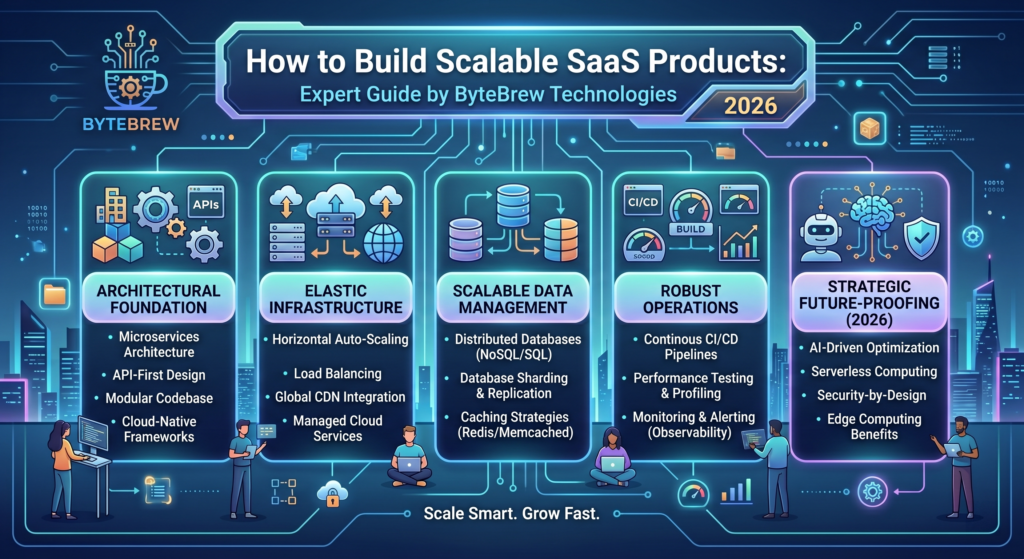
In this comprehensive guide, you’ll learn everything you need to know about building a scalable SaaS product—from idea validation to architecture and deployment.
- What is a Scalable SaaS Product?
A scalable SaaS product is a cloud-based application designed to handle increasing numbers of users, data, and transactions without compromising performance.
Key Characteristics:
- Multi-tenant architecture
- High availability
- Elastic scalability
- Secure data handling
- Performance optimization
Why Scalability Matters
Without scalability:
- Your app crashes under load
- User experience declines
- Revenue opportunities are lost
With scalability:
- You handle growth seamlessly
- Reduce infrastructure costs
- Improve customer satisfaction
- Step 1: Validate Your SaaS Idea
Before building anything, validate your idea.
Ask These Questions:
- What problem does your SaaS solve?
- Who is your target audience?
- Are there existing competitors?
- What makes your solution unique?
Validation Methods:
- Market research
- Landing pages
- Surveys & interviews
- Competitor analysis
Pro Tip from ByteBrew Technologies
Start with a clear value proposition. If users don’t immediately understand your product, scaling won’t matter.
- Step 2: Build a Minimum Viable Product (MVP)
An MVP is a simplified version of your SaaS product with core features.
Why MVP is Important
- Reduces development cost
- Speeds up time-to-market
- Helps gather real user feedback
Key MVP Features
- User authentication
- Core functionality
- Basic dashboard
- Payment integration (optional)
Common Mistake
Trying to build everything at once. This delays launch and increases risk.
- Step 3: Choose the Right Tech Stack
Your technology stack plays a critical role in scalability.
Frontend Technologies
- React.js
- Vue.js
- Angular
Backend Technologies
- Node.js
- Python (Django, FastAPI)
- Ruby on Rails
Database Options
- PostgreSQL (Relational)
- MongoDB (NoSQL)
Cloud Platforms
- AWS
- Google Cloud
- Microsoft Azure
Key Considerations
- Performance
- Developer expertise
- Community support
- Scalability features
- Step 4: Design Scalable Architecture
A scalable SaaS product requires robust architecture.
Monolithic vs Microservices
Monolithic Architecture
- Easier to build initially
- Harder to scale later
Microservices Architecture
- Independent services
- Better scalability
- More complex to manage
Recommended Approach
Start with a modular monolith, then transition to microservices as you scale.
Multi-Tenant Architecture
In SaaS, multiple users (tenants) share the same application.
Types:
- Shared database, shared schema
- Shared database, separate schema
- Separate database per tenant
Best Practice
Use shared infrastructure with logical separation for efficiency.
- Step 5: Implement Cloud Infrastructure
Cloud computing enables scalability.
Key Components
- Load balancers
- Auto-scaling groups
- Content Delivery Networks (CDN)
- Containerization (Docker, Kubernetes)
Benefits
- Pay-as-you-go pricing
- Global availability
- High reliability
- Step 6: Focus on Performance Optimization
Techniques:
- Caching (Redis, Memcached)
- Database indexing
- API optimization
- Lazy loading
Monitoring Tools
- New Relic
- Datadog
- Prometheus
Key Metrics
- Response time
- Server load
- Error rates
- Step 7: Ensure Security & Compliance
Security is critical for SaaS success.
Essential Security Practices
- Data encryption (SSL/TLS)
- Secure authentication (OAuth, JWT)
- Regular security audits
- Role-based access control
Compliance Standards
- GDPR
- HIPAA (if healthcare)
- SOC 2
- Step 8: Implement CI/CD for Faster Deployment
Continuous Integration and Deployment streamline development.
Benefits
- Faster releases
- Fewer bugs
- Automated testing
Popular Tools
- GitHub Actions
- Jenkins
- GitLab CI/CD
- Step 9: Pricing Strategy for SaaS
Your pricing impacts scalability and growth.
Common Models
- Subscription-based
- Freemium
- Usage-based
Tips
- Start simple
- Offer tiered plans
- Optimize based on user behavior
- Step 10: Scale Your SaaS Product
Once your product gains traction, focus on scaling.
Scaling Strategies
- Horizontal scaling (add servers)
- Vertical scaling (increase resources)
- Database sharding
Growth Tactics
- SEO & content marketing
- Paid advertising
- Affiliate programs
- Common Mistakes to Avoid
- Over-engineering early
- Ignoring user feedback
- Poor security practices
- Lack of monitoring
- Scaling too late
- Future Trends in SaaS (2026 & Beyond)
- AI-powered SaaS applications
- No-code/low-code platforms
- Vertical SaaS (industry-specific)
- API-first development
- Serverless architecture
- Why Choose ByteBrew Technologies?
At ByteBrew Technologies, we help startups and businesses build scalable SaaS products with:
Our Expertise
- MVP development
- SaaS architecture design
- Cloud deployment
- Performance optimization
- Ongoing support & scaling
Our Approach
- Understand your business
- Validate your idea
- Build MVP بسرعة
- Scale efficiently
Conclusion
Building a scalable SaaS product requires the right combination of strategy, technology, and execution. From idea validation to architecture and scaling, every step plays a crucial role in long-term success.
If done right, your SaaS product can:
- Generate recurring revenue
- Scale globally
- Transform industries
🚀 Ready to Build Your SaaS Product?
Partner with ByteBrew Technologies to turn your idea into a powerful, scalable SaaS platform.
👉 Contact us today to start your journey.