Introduction
Thank you for reading this post, don't forget to subscribe!In today’s fast-moving digital landscape, startups face an undeniable challenge: build fast, validate quickly, and scale wisely. The difference between a successful startup and one that burns through its budget often comes down to a single strategic decision—whether or not to build a Minimum Viable Product (MVP) first.
Many founders make the mistake of diving straight into full-scale product development, investing months (or even years) into building something they think users want. Unfortunately, assumptions are expensive. Markets shift, user behavior evolves, and competition moves fast.
This is where an MVP becomes not just helpful—but essential.
In this comprehensive, SEO-optimized guide, we’ll break down:
- What an MVP really is (and what it is not)
- Why every startup needs an MVP before full development
- Key benefits and real-world impact
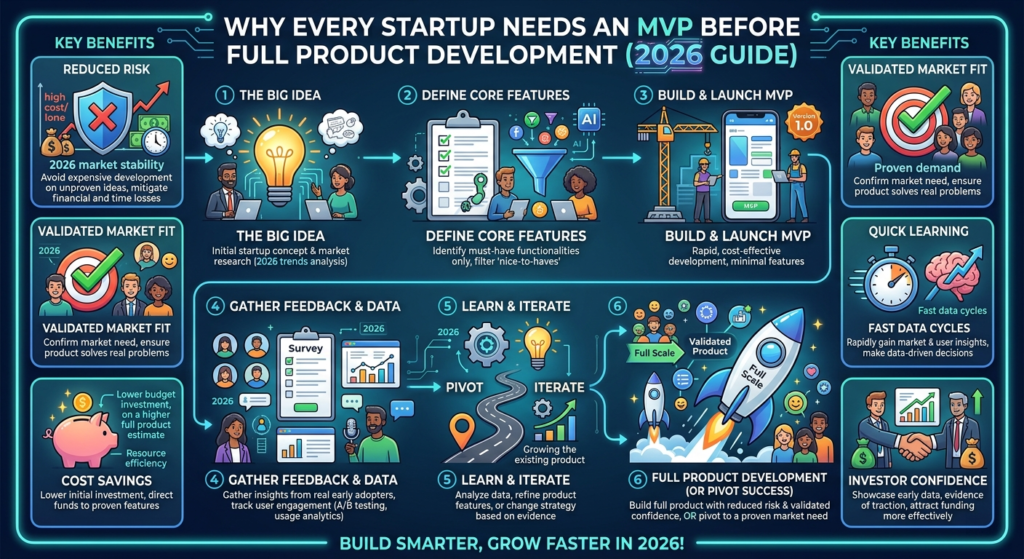
- Step-by-step MVP development process
- Common mistakes to avoid
- Cost, timelines, and tools
- How MVPs drive long-term success
What is an MVP?
A Minimum Viable Product (MVP) is the simplest version of a product that includes only the core features needed to solve a specific problem for early users.
It is not:
- A half-built product
- A low-quality version
- A prototype with no real users
Instead, an MVP is:
- Functional
- User-focused
- Built for validation
The goal is simple:
👉 Test your idea in the real market with minimal resources
Why Every Startup Needs an MVP
- Validate Your Idea Before Investing Heavily
The biggest risk for any startup is building something no one wants.
An MVP allows you to:
- Test real demand
- Gather user feedback
- Identify flaws early
Instead of guessing, you get data-driven insights.
Example:
Instead of building a full SaaS platform, launch with:
- Basic login system
- Core feature
- Simple dashboard
If users engage → scale it
If not → pivot early
- Save Time and Development Costs
Full product development can cost thousands (or even millions). MVPs significantly reduce this risk.
Without MVP:
- Long development cycles
- High upfront cost
- Risk of failure
With MVP:
- Faster launch (2–8 weeks)
- Lower investment
- Controlled risk
This is especially important for startups working with limited budgets.
- Faster Time to Market
Speed is everything in 2026.
Markets are competitive. If you wait too long:
- Competitors may launch first
- Trends may shift
- Opportunity may disappear
An MVP helps you:
- Launch quickly
- Gain early users
- Start building traction
- Focus on Core Features
Many startups fail because they try to build everything at once.
An MVP forces you to ask:
👉 “What is the ONE problem we are solving?”
This clarity helps:
- Avoid feature overload
- Improve user experience
- Build a cleaner product
- Attract Investors and Stakeholders
Investors don’t just fund ideas—they fund validated concepts.
An MVP helps you show:
- Real users
- Engagement metrics
- Market demand
This increases your chances of:
- Securing funding
- Building partnerships
- Gaining credibility
- Gather Real User Feedback
User feedback is gold.
An MVP allows you to:
- Understand user behavior
- Identify pain points
- Improve features
Instead of building blindly, you evolve based on real needs.
- Reduce Risk of Failure
Startups fail for many reasons, but one of the biggest is:
👉 Building the wrong product
An MVP reduces risk by:
- Testing assumptions early
- Allowing pivots
- Avoiding wasted effort
Key Benefits of MVP Development
✔ Cost Efficiency
Spend less while learning more
✔ Faster Learning
Real-world insights instead of assumptions
✔ Better Product-Market Fit
Build what users actually need
✔ Scalable Foundation
Start small, grow strategically
Step-by-Step MVP Development Process
Step 1: Identify the Problem
Ask:
- What problem are we solving?
- Who is our target audience?
Clarity here is crucial.
Step 2: Define Core Features
List all features, then prioritize:
- Must-have (core)
- Nice-to-have (later)
Focus only on essentials.
Step 3: Conduct Market Research
Analyze:
- Competitors
- Target users
- Market demand
This helps refine your idea.
Step 4: Create Wireframes or Prototype
Design a simple layout:
- User flow
- Basic UI/UX
Tools you can use:
- Figma
- Adobe XD
Step 5: Develop the MVP
Use modern technologies:
- Web apps (React, Next.js)
- Backend (Node.js, Firebase)
- No-code tools (for faster launch)
Step 6: Launch to Early Users
Release your MVP to:
- Beta users
- Early adopters
Collect feedback actively.
Step 7: Analyze & Improve
Track:
- User engagement
- Retention
- Feedback
Iterate continuously.
Types of MVPs You Can Build
- Landing Page MVP
Simple page explaining your idea with a signup form
- No-Code MVP
Built using tools like Bubble or Webflow
- Concierge MVP
Manually deliver service before automating
- Single-Feature MVP
Focus on one powerful feature
Common MVP Mistakes to Avoid
❌ Building Too Many Features
Keep it simple
❌ Ignoring User Feedback
Your users guide your product
❌ Poor User Experience
Even MVPs should be user-friendly
❌ Skipping Market Research
Data is essential
❌ Delaying Launch
Perfection kills speed
MVP vs Full Product Development
Aspect | MVP | Full Product |
Cost | Low | High |
Time | Fast | Long |
Risk | Low | High |
Features | Limited | Complete |
Goal | Validation | Scaling |
Cost of MVP Development in 2026
Costs vary based on complexity:
- Basic MVP: $1,000 – $5,000
- Medium MVP: $5,000 – $15,000
- Advanced MVP: $15,000+
Using a professional software house can ensure:
- Quality development
- Faster delivery
- Scalable architecture
How MVP Helps in Scaling Your Startup
Once validated, you can:
- Add advanced features
- Improve UI/UX
- Expand to new markets
- Build mobile applications
This phased approach ensures sustainable growth.
Real-World MVP Examples
Many successful companies started with MVPs:
- Airbnb → Simple website renting rooms
- Dropbox → Demo video before product
- Facebook → Basic university network
The lesson:
👉 Start small, grow big
Why MVP is the Smartest Strategy in 2026
With AI, automation, and fast-changing markets:
- Building fast is not enough
- Building right is what matters
An MVP ensures:
- You build what users want
- You minimize risk
- You maximize growth potential
Final Thoughts
If you’re a startup founder, here’s the reality:
👉 You don’t need a full product to get started
👉 You need a validated idea
An MVP is not a shortcut—it’s a strategic approach to building successful products.
Instead of spending months perfecting something in isolation, launch early, learn fast, and grow smarter.