Introduction
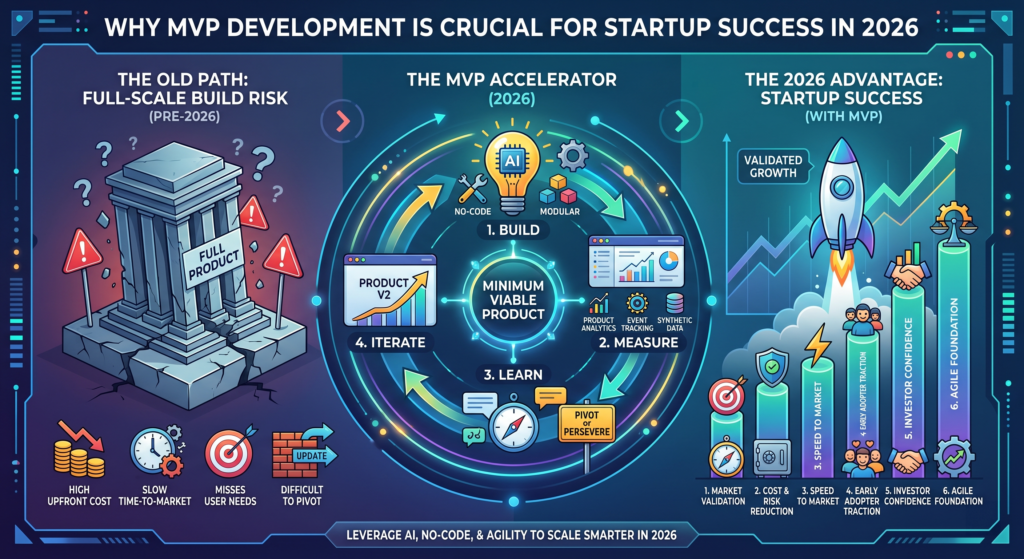
In the fast-paced digital landscape of 2026, startups face intense competition, rapidly evolving technologies, and ever-changing customer expectations. Launching a full-scale product without validating the idea can lead to wasted time, high costs, and eventual failure. This is where MVP (Minimum Viable Product) development becomes a game-changer.
Thank you for reading this post, don't forget to subscribe!An MVP is not just a simplified version of your product—it is a strategic approach that allows startups to test ideas, gather real user feedback, and iterate quickly. In today’s startup ecosystem, where speed and adaptability define success, MVP development has become essential rather than optional.
This article explores why MVP development is crucial for startup success in 2026, how it works, its benefits, real-world applications, and best practices to follow.
What is MVP Development?
A Minimum Viable Product (MVP) is the most basic version of a product that includes only the core features necessary to solve a specific problem for early users.
Instead of building a fully-featured product, startups launch an MVP to:
- Validate their idea
- Test market demand
- Collect user feedback
- Improve the product iteratively
Key Characteristics of an MVP:
- Focuses on core functionality
- Built with minimal resources
- Designed for early adopters
- Enables quick feedback loops
Why MVP Development is More Important Than Ever in 2026
1. Rapidly Changing Market Dynamics
Technology trends like AI, automation, and SaaS are evolving faster than ever. Startups must adapt quickly, and MVPs allow them to test ideas without long development cycles.
2. Increased Competition
Thousands of startups launch every year. MVPs help businesses enter the market faster and gain a competitive edge.
3. Cost Efficiency
With rising development costs, startups cannot afford to build full-scale products without validation. MVPs reduce financial risk.
4. Customer-Centric Development
Modern users expect personalized and efficient solutions. MVPs allow startups to build products based on real user needs rather than assumptions.
Key Benefits of MVP Development for Startups
🚀 1. Faster Time to Market
Launching quickly is critical in 2026. MVP development allows startups to:
- Enter the market early
- Capture initial users
- Start generating revenue sooner
💰 2. Reduced Development Costs
Building a full product can be expensive. MVPs:
- Focus only on essential features
- Minimize unnecessary expenses
- Optimize resource allocation
📊 3. Real User Feedback
Instead of guessing what users want, MVPs provide:
- Direct feedback from real users
- Insights into user behavior
- Data-driven decision-making
🔄 4. Continuous Improvement
MVPs support iterative development:
- Launch → Learn → Improve → Repeat
- Helps refine the product over time
🎯 5. Better Product-Market Fit
Achieving product-market fit is crucial. MVPs help startups:
- Understand customer needs
- Adjust features accordingly
- Build a product users actually want
💡 6. Attracting Investors
Investors prefer startups with validated ideas. An MVP:
- Demonstrates real demand
- Shows traction and user engagement
- Reduces investment risk
MVP Development Process (Step-by-Step)
Step 1: Identify the Problem
Start with a clear problem statement:
- What issue are you solving?
- Who is your target audience?
Step 2: Market Research
Analyze:
- Competitors
- Target users
- Market demand
Step 3: Define Core Features
Focus only on essential features that solve the main problem.
Step 4: Build the MVP
Develop a simple, functional product using:
- Agile methodologies
- Scalable technologies
Step 5: Launch to Early Users
Release the MVP to a limited audience:
- Early adopters
- Beta testers
Step 6: Collect Feedback
Gather:
- User reviews
- Usage data
- Pain points
Step 7: Iterate and Improve
Use feedback to:
- Enhance features
- Fix issues
- Add functionalities gradually
Types of MVPs in 2026
1. Single-Feature MVP
Focuses on one core feature that solves the main problem.
2. Landing Page MVP
A simple page to test interest and collect leads.
3. Prototype MVP
A visual representation of the product (UI/UX design).
4. Concierge MVP
Manual service that simulates the product experience.
5. No-Code/Low-Code MVP
Built using platforms like Webflow or Bubble for faster deployment.
MVP Development in the Era of AI and SaaS
In 2026, MVP development is heavily influenced by advanced technologies:
🤖 AI Integration
- AI-powered chatbots
- Predictive analytics
- Personalized user experiences
☁️ SaaS-Based MVPs
- Faster deployment
- Lower infrastructure costs
- Scalable architecture
🔗 API-First Development
- Faster integration
- Reduced development time
- Enhanced functionality
Common Mistakes to Avoid in MVP Development
❌ 1. Adding Too Many Features
Keep it simple. Overloading the MVP defeats its purpose.
❌ 2. Ignoring User Feedback
User insights are critical for improvement.
❌ 3. Poor Market Research
Skipping research can lead to building irrelevant products.
❌ 4. Focusing Only on Technology
A great product solves a real problem—not just uses advanced tech.
❌ 5. Delayed Launch
Waiting for perfection can kill momentum.
Real-World Examples of Successful MVPs
Many successful companies started as MVPs:
- Airbnb – Started with a simple website to rent out rooms
- Dropbox – Began with a demo video to validate demand
- Facebook – Initially launched as a basic social network for students
These examples show how MVPs can evolve into global platforms.
How MVP Development Helps Startups Scale
📈 1. Validated Growth Strategy
Startups can scale based on proven demand.
🔄 2. Agile Development
Continuous updates ensure adaptability.
🌍 3. Market Expansion
MVP insights help in entering new markets effectively.
Future Trends in MVP Development (2026 & Beyond)
🔥 1. AI-Driven MVPs
Automated development and smarter features.
⚡ 2. Faster Development Cycles
Thanks to no-code and low-code platforms.
📊 3. Data-Driven Decisions
Advanced analytics guiding product evolution.
🌐 4. Remote Development Teams
Global collaboration for faster innovation.
Best Practices for MVP Development
- Focus on solving one problem
- Keep the design simple and user-friendly
- Use agile methodology
- Prioritize user feedback
- Plan for scalability
- Continuously test and improve
Conclusion
In 2026, MVP development is no longer just a startup strategy—it is a necessity. With increasing competition, rapid technological advancements, and evolving customer expectations, startups must adopt a lean and agile approach to survive and thrive.
An MVP allows businesses to validate ideas, minimize risks, and build products that truly resonate with users. It provides a foundation for growth, innovation, and long-term success.
For startups aiming to make an impact in today’s digital world, investing in MVP development is one of the smartest decisions they can make.