
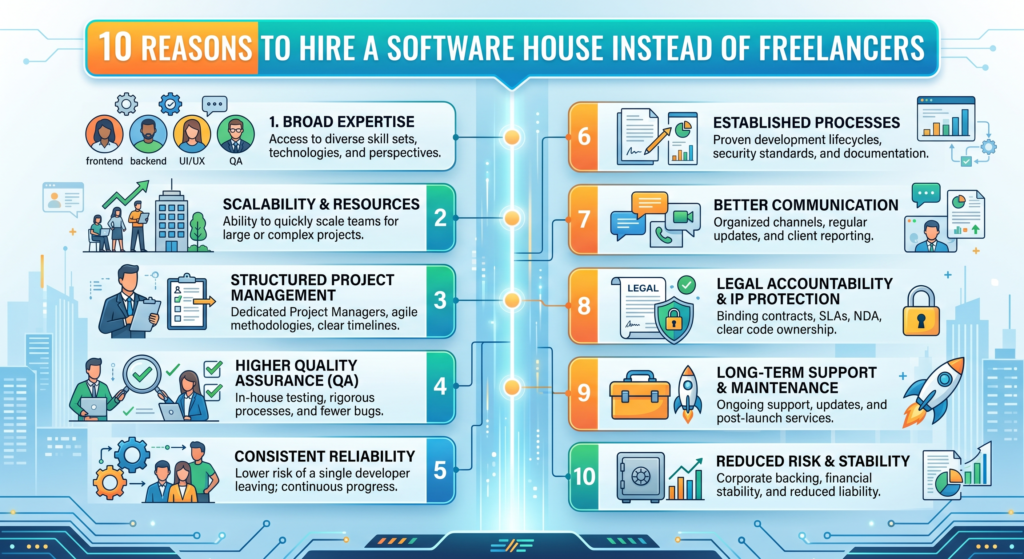
In today’s fast-paced digital world, businesses rely heavily on technology to stay competitive. Whether you’re launching a startup, scaling an existing business, or transforming your operations digitally, one critical decision you’ll face is choosing between hiring a freelancer or a software house.
Thank you for reading this post, don't forget to subscribe!At first glance, freelancers may seem like a cost-effective and flexible option. However, when it comes to reliability, scalability, quality, and long-term success, software houses often provide a more robust solution.
In this comprehensive guide, we’ll explore the top 10 reasons why hiring a software house is a smarter choice than freelancers, especially for businesses that are serious about growth and sustainability.
- Access to a Complete Team of Experts
When you hire a freelancer, you’re typically relying on a single individual who may specialize in one area—such as web development, design, or backend programming.
A software house, on the other hand, provides access to a full team of professionals, including:
- Frontend and backend developers
- UI/UX designers
- Project managers
- QA testers
- DevOps engineers
This means your project benefits from collective expertise, ensuring every aspect is handled professionally.
👉 Result: Better quality, faster delivery, and fewer errors.
- Structured Project Management
Freelancers often juggle multiple clients, and project management may not always be their strong suit.
Software houses follow structured workflows, using tools like:
- Agile or Scrum methodologies
- Task management systems (e.g., Jira, Trello)
- Regular progress updates and reporting
This ensures:
- Clear timelines
- Defined milestones
- Transparent communication
👉 Result: Your project stays on track with minimal delays.
- Reliability and Accountability
One of the biggest risks with freelancers is availability. They may:
- Become unresponsive
- Miss deadlines
- Leave projects midway
Software houses operate as registered businesses, which means:
- Contracts and agreements are in place
- Dedicated teams are assigned
- Backup resources are available
👉 Result: Higher reliability and peace of mind.
- Scalability for Growing Projects
As your business grows, your project requirements may change. You might need:
- Additional features
- Faster development
- More developers
With freelancers, scaling is difficult—you may need to hire multiple individuals and manage them yourself.
Software houses can scale resources instantly, adding team members as needed.
👉 Result: Seamless growth without operational headaches.
- Higher Quality Assurance
Freelancers usually test their own work, which increases the chances of bugs or missed issues.
Software houses have dedicated QA teams that:
- Perform manual and automated testing
- Ensure cross-device compatibility
- Identify and fix bugs before deployment
👉 Result: A more stable and professional product.
- Access to Latest Technologies
Technology evolves rapidly, and staying updated requires continuous learning.
Software houses invest in:
- Training their teams
- Adopting new frameworks and tools
- Following industry best practices
Freelancers may not always have the time or resources to stay updated.
👉 Result: Your project uses modern, scalable, and secure technologies.
- Long-Term Support and Maintenance
A project doesn’t end after deployment. It requires:
- Regular updates
- Bug fixes
- Performance optimization
Freelancers may not always be available for long-term support.
Software houses provide ongoing maintenance packages, ensuring your system remains up-to-date and secure.
👉 Result: Long-term stability and continuous improvement.
- Better Communication and Collaboration
Communication gaps are common when working with freelancers, especially across time zones.
Software houses offer:
- Dedicated account managers
- Regular meetings and updates
- Clear communication channels
This creates a collaborative environment, where your feedback is actively considered.
👉 Result: Fewer misunderstandings and better outcomes.
- Legal Security and Data Protection
Working with freelancers often involves minimal legal protection, which can be risky when dealing with sensitive data.
Software houses provide:
- Legal contracts
- NDAs (Non-Disclosure Agreements)
- Data security policies
👉 Result: Your intellectual property and business data remain सुरक्षित.
- Focus on Business Growth, Not Management
Hiring freelancers often means you have to:
- Manage tasks
- Coordinate between multiple individuals
- Monitor progress
This takes time away from your core business activities.
With a software house, the entire project is managed for you, allowing you to focus on:
- Strategy
- Sales
- Business growth
👉 Result: Increased productivity and better ROI.
Freelancer vs Software House: Quick Comparison
Feature | Freelancer | Software House |
Team Size | فرد واحد | مکمل ٹیم |
Reliability | Medium | High |
Scalability | Limited | Flexible |
Quality Assurance | Basic | Advanced |
Project Management | Limited | Structured |
Support | Uncertain | Ongoing |
When Should You Choose a Freelancer?
To be fair, freelancers can still be a good choice for:
- Small, one-time tasks
- Tight budgets
- Simple projects
However, for complex, long-term, or business-critical projects, a software house is the better option.
Final Thoughts
Choosing between a freelancer and a software house is a crucial decision that can significantly impact your project’s success.
While freelancers may seem appealing due to lower costs, the long-term benefits of hiring a software house far outweigh the initial savings. From expert teams and structured workflows to scalability and ongoing support, software houses provide a comprehensive solution tailored to business needs.
If you’re serious about building a high-quality, scalable, and future-ready digital product, partnering with a professional software house is the smartest investment you can make.
Bonus: How to Choose the Right Software House
Before making your decision, consider the following:
- Check portfolio and past projects
- Read client reviews and testimonials
- Evaluate communication and responsiveness
- Ask about technologies and development process
- Ensure post-launch support is included