
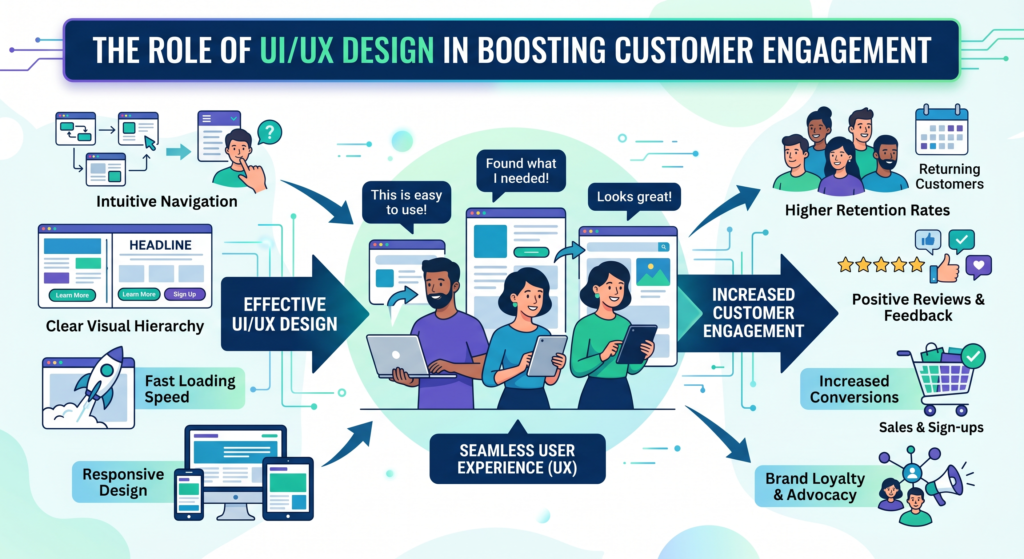
In today’s highly competitive digital world, having a website or mobile application is not enough. Businesses must focus on delivering a seamless, visually appealing, and user-friendly experience to attract and retain customers. This is where UI (User Interface) and UX (User Experience) design play a critical role.
Thank you for reading this post, don't forget to subscribe!A well-designed UI/UX does more than just make a product look attractive—it directly impacts customer engagement, conversion rates, and brand loyalty. Whether you are running an e-commerce store, a SaaS platform, or a corporate website, investing in UI/UX design can significantly improve how users interact with your business.
In this blog, we will explore the importance of UI/UX design and how it helps boost customer engagement in modern digital platforms.
What is UI/UX Design?
Before understanding its impact, it is important to know what UI and UX actually mean:
UI (User Interface) Design
UI design focuses on the visual elements of a digital product, such as:
- Buttons
- Colors
- Typography
- Layout
- Icons
- Navigation menus
It is all about how a product looks and feels.
UX (User Experience) Design
UX design focuses on the overall experience a user has when interacting with a product, including:
- Ease of navigation
- User journey flow
- Speed and performance
- Accessibility
- Problem-solving efficiency
In simple terms:
UI is how it looks, UX is how it works.
Why UI/UX Design Matters for Customer Engagement
Customer engagement refers to how users interact with your website or application—how long they stay, what actions they take, and how often they return.
A strong UI/UX design directly improves engagement by:
- Reducing user frustration
- Increasing time spent on site
- Encouraging interactions
- Improving conversion rates
- Building trust in your brand
Let’s explore how this happens in detail.
- First Impressions Matter
It takes only a few seconds for users to form an opinion about your website. If the design looks outdated or confusing, users will leave immediately.
A modern UI design ensures:
- Clean layout
- Attractive visuals
- Professional branding
- Consistent design elements
A strong first impression increases the chances of users staying longer and exploring your services.
- Easy Navigation Improves User Experience
One of the biggest factors in user engagement is simple and intuitive navigation.
If users cannot find what they are looking for quickly, they will leave your website.
Good UX design ensures:
- Clear menu structure
- Logical page flow
- Search functionality
- Minimal clicks to reach information
When users find what they need easily, they are more likely to engage with your content and services.
- Mobile-Friendly Design Increases Engagement
Today, most users browse websites on mobile devices. A responsive UI/UX design ensures that your website works perfectly on all screen sizes.
Mobile-friendly design includes:
- Responsive layouts
- Touch-friendly buttons
- Fast loading pages
- Optimized images
A smooth mobile experience significantly increases engagement and reduces bounce rates.
- Faster Loading Speed Keeps Users Interested
Speed is a key part of UX design. Even a delay of a few seconds can cause users to leave your website.
A well-optimized UI/UX design helps:
- Reduce unnecessary scripts
- Optimize images
- Improve backend performance
- Enhance caching systems
Faster websites lead to higher engagement and better SEO rankings.
- Emotional Connection Through Design
Good UI/UX design is not just technical—it is emotional.
Colors, typography, and layout all influence how users feel about your brand.
For example:
- Blue builds trust
- Green represents growth
- Red creates urgency
When users emotionally connect with your design, they are more likely to engage, trust, and convert.
- Better User Journey Increases Conversions
A user journey is the path a visitor takes from landing on your website to completing an action (like signing up or purchasing).
A well-designed UX ensures:
- Smooth onboarding process
- Clear call-to-action (CTA) buttons
- Logical step-by-step flow
- Minimal distractions
This improves conversion rates and customer engagement significantly.
- Accessibility Expands Your Audience
Good UX design ensures that your website is accessible to everyone, including users with disabilities.
Accessibility features include:
- Readable fonts
- High contrast colors
- Keyboard navigation support
- Screen reader compatibility
An accessible design increases your reach and improves engagement from a wider audience.
- Trust and Credibility Building
Users trust websites that look professional and well-structured.
A strong UI/UX design builds credibility through:
- Consistent branding
- Clean layout
- Professional visuals
- Easy-to-understand content
When users trust your platform, they engage more and return frequently.
- Reducing Bounce Rate
Bounce rate refers to the percentage of users who leave your website without interacting.
Poor design increases bounce rate, while good UI/UX reduces it by:
- Keeping users engaged
- Providing clear navigation
- Offering valuable content
- Improving readability
Lower bounce rates lead to better engagement and SEO performance.
- UI/UX Design and SEO Go Hand in Hand
Many people think SEO is only about keywords, but Google also considers user experience.
Good UI/UX helps SEO by:
- Increasing dwell time
- Reducing bounce rate
- Improving mobile usability
- Enhancing page speed
So, investing in UI/UX design also improves your search engine rankings.
How Software Houses Improve UI/UX Design
Professional software houses like WEB Craft Innovations focus on delivering high-quality UI/UX solutions by:
- Conducting user research
- Creating wireframes and prototypes
- Designing responsive interfaces
- Testing usability
- Improving performance
This ensures that businesses get a product that not only looks good but also performs exceptionally well.
Future of UI/UX Design
The future of UI/UX is evolving rapidly with technologies like:
- Artificial Intelligence (AI)
- Voice interfaces
- Augmented Reality (AR)
- Personalized user experiences
Businesses that adopt modern UI/UX trends will stay ahead of their competitors.
Conclusion
UI/UX design is no longer optional—it is a necessity for any digital business. A well-structured and user-friendly design can dramatically improve customer engagement, increase conversions, and strengthen brand loyalty.
From first impressions to final conversions, UI/UX plays a key role in shaping user behavior. If you want to grow your business online, investing in professional UI/UX design is one of the smartest decisions you can make.