
Introduction
Thank you for reading this post, don't forget to subscribe!In today’s rapidly evolving digital world, businesses rely on multiple software systems to manage operations, customers, and services efficiently. However, no single system can operate in isolation and still deliver optimal results. This is where API integration becomes a game-changer.
At ByteBrew Technologies, we believe API integration is the backbone of modern software architecture. It enables seamless communication between applications, improves automation, enhances user experience, and allows businesses to scale without limitations.
In this blog, we will explore the importance of API integration in modern software systems, its benefits, challenges, and why it is essential for digital transformation.
What is API Integration?
API (Application Programming Interface) integration is the process of connecting different software applications so they can communicate and exchange data automatically.
An API acts as a bridge that allows systems to interact without manual intervention.
Example:
- Payment gateways like Stripe processing transactions
- Google Maps embedded in delivery applications
- WhatsApp APIs used for automated customer communication
These systems work together through API integration.
Why API Integration is Important in Modern Software Systems
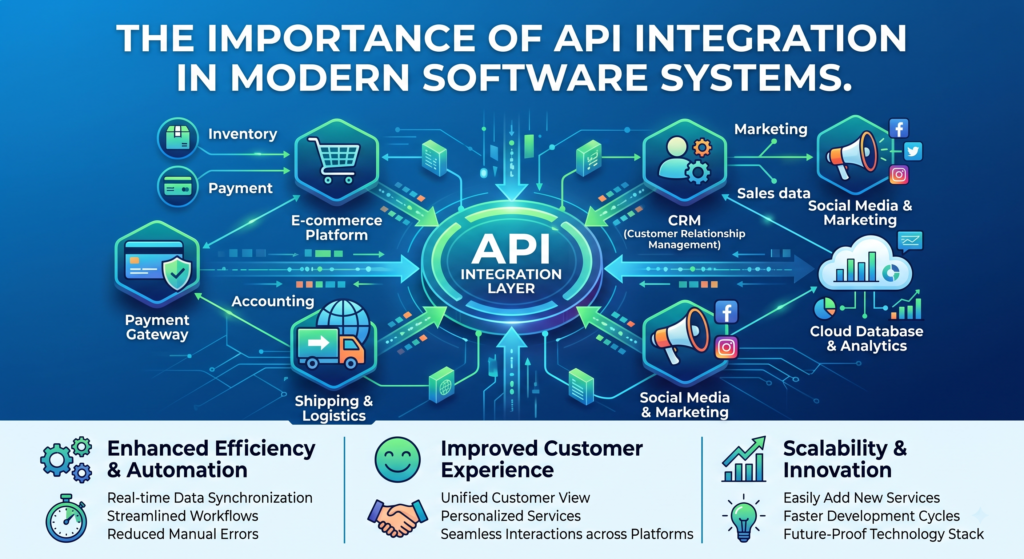
Modern businesses depend on multiple tools such as CRMs, ERPs, cloud platforms, and mobile applications. Without integration, these systems become isolated and inefficient.
API integration solves this by creating a connected digital ecosystem.
- Seamless System Communication
API integration allows different software systems to communicate smoothly.
For example:
- E-commerce platforms connect with inventory systems
- Mobile apps sync with backend servers
- CRM systems integrate with email marketing tools
This eliminates data silos and improves workflow efficiency.
- Business Process Automation
API integration reduces manual work by automating repetitive processes such as:
- Order processing
- Payment verification
- Data synchronization
- Notifications and alerts
This improves efficiency and reduces human errors.
- Enhanced Customer Experience
A connected system delivers a better user experience.
Examples include:
- Real-time delivery tracking
- Instant payment confirmations
- Personalized recommendations
When systems communicate in real time, customers enjoy faster and smoother services.
- Faster Development Cycles
At ByteBrew Technologies, API integration allows developers to build powerful applications faster by leveraging existing services instead of building everything from scratch.
For example:
- Using payment APIs instead of creating payment systems
- Using Google Maps API for location services
- Using cloud storage APIs for file management
This reduces development time and cost significantly.
- Scalability for Growing Businesses
As businesses grow, their systems must scale efficiently.
API integration allows:
- Easy addition of new features
- Integration of third-party services
- Expansion across web, mobile, and desktop platforms
This ensures long-term flexibility and growth.
- Centralized Data Management
API integration enables data from multiple systems to be collected in one place.
For example:
- Sales data from e-commerce platforms
- Customer insights from CRMs
- Analytics from marketing tools
This centralized approach improves decision-making and reporting.
- Cost Efficiency
Instead of building separate systems for every function, API integration helps reduce costs by:
- Reusing existing services
- Reducing development workload
- Lowering infrastructure expenses
This makes software development more efficient and affordable.
- Improved Security
Modern APIs come with strong security protocols such as:
- API keys
- OAuth authentication
- Token-based access control
These ensure secure communication between systems and protect sensitive data.
- Real-Time Data Exchange
Real-time communication is essential in modern applications.
API integration enables:
- Live tracking systems
- Instant notifications
- Real-time analytics dashboards
This helps businesses make faster and more accurate decisions.
- Driving Innovation and Flexibility
API integration provides developers at ByteBrew Technologies the flexibility to innovate continuously.
It allows:
- Fast integration of new technologies
- Use of AI and machine learning services
- Creation of scalable digital ecosystems
This keeps businesses ahead in the competitive digital landscape.
Common Use Cases of API Integration
API integration is widely used across industries:
- E-commerce: Payment gateways, shipping APIs, inventory systems
- Fintech: Banking APIs, fraud detection systems, transaction processing
- Healthcare: Patient data systems and lab integrations
- SaaS platforms: Authentication and analytics services
- Mobile apps: Maps, notifications, and social login systems
Challenges in API Integration
Despite its advantages, API integration comes with challenges:
- Compatibility Issues
Different systems may use different data formats and standards.
- Security Risks
Poor API security can expose sensitive data.
- Maintenance Complexity
APIs require continuous monitoring and updates.
- Performance Issues
Poorly designed integrations can slow down system performance.
Best Practices for API Integration
At ByteBrew Technologies, we follow industry best practices to ensure secure and scalable integrations:
- Use secure authentication methods (OAuth, API keys)
- Maintain proper API documentation
- Monitor system performance continuously
- Implement proper error handling
- Use version control for APIs
- Design scalable and modular architectures
The Future of API Integration
The future of software development is API-driven.
Emerging trends include:
- AI-powered APIs
- Microservices architecture
- Serverless computing
- API-first development strategies
- Real-time event-driven systems
Businesses adopting these trends will gain a strong competitive advantage.
Conclusion
API integration is the foundation of modern software systems. It connects applications, automates processes, improves efficiency, and enables scalable digital transformation.
At ByteBrew Technologies, we specialize in building robust, secure, and scalable software systems powered by advanced API integration.
In today’s digital economy, businesses that embrace API integration will lead the future of innovation and growth.