
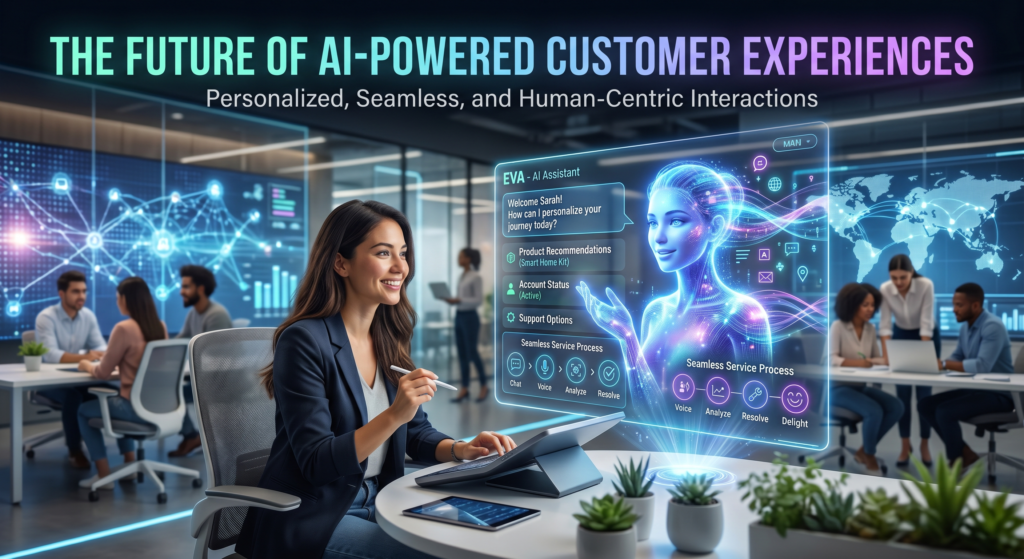
The Future of AI-Powered Customer Experiences
Thank you for reading this post, don't forget to subscribe!Introduction
Customer expectations have evolved dramatically over the past decade. Today’s consumers demand personalized interactions, instant responses, seamless support, and consistent experiences across every digital touchpoint. Businesses that fail to meet these expectations risk losing customers to competitors who can.
Artificial Intelligence (AI) has emerged as one of the most transformative technologies enabling organizations to deliver exceptional customer experiences at scale. From intelligent chatbots and personalized recommendations to predictive analytics and automated customer support, AI is reshaping how businesses interact with their customers.
As technology continues to advance, AI-powered customer experiences are becoming more sophisticated, human-like, and valuable than ever before. Organizations across industries are leveraging AI to enhance customer satisfaction, increase loyalty, improve operational efficiency, and drive business growth.
In this article, we explore the future of AI-powered customer experiences, emerging trends, key benefits, challenges, and how businesses can prepare for an AI-driven future.
What Are AI-Powered Customer Experiences?
AI-powered customer experiences refer to interactions between businesses and customers that are enhanced through artificial intelligence technologies. These technologies analyze customer data, understand behavior patterns, automate processes, and provide personalized services.
Common examples include:
- AI chatbots and virtual assistants
- Personalized product recommendations
- Predictive customer support
- Intelligent search functionality
- Voice assistants
- Automated email marketing
- Customer sentiment analysis
- AI-driven customer service solutions
The goal is simple: deliver faster, smarter, and more personalized experiences that meet customer needs while improving business efficiency.
Why AI Is Transforming Customer Experience
Modern customers expect businesses to understand their needs and provide relevant solutions quickly.
Traditional customer service methods often struggle to handle:
- Large volumes of customer inquiries
- Growing personalization demands
- Multiple communication channels
- 24/7 customer expectations
- Rapid response requirements
AI solves these challenges by enabling businesses to:
Deliver Instant Responses
AI-powered systems can provide immediate answers to customer inquiries, reducing wait times and improving satisfaction.
Offer Personalized Experiences
Machine learning algorithms analyze customer behavior, preferences, purchase history, and browsing patterns to deliver highly personalized recommendations.
Improve Efficiency
Automation reduces repetitive tasks, allowing human teams to focus on complex issues requiring empathy and strategic thinking.
Scale Customer Support
Businesses can serve thousands of customers simultaneously without significantly increasing operational costs.
Key AI Technologies Shaping Customer Experiences
- AI Chatbots and Virtual Assistants
Chatbots have evolved far beyond simple scripted responses.
Modern AI chatbots can:
- Understand natural language
- Interpret customer intent
- Learn from interactions
- Provide contextual responses
- Escalate complex issues to human agents
Future chatbots will become even more conversational and emotionally intelligent, making interactions feel increasingly human.
Businesses implementing advanced chatbots are already experiencing:
- Reduced support costs
- Faster response times
- Higher customer satisfaction
- Improved conversion rates
- Hyper-Personalization
Personalization is no longer optional.
Customers expect brands to understand:
- Their interests
- Purchasing behavior
- Communication preferences
- Previous interactions
Future AI systems will create hyper-personalized experiences by analyzing massive datasets in real time.
Examples include:
- Personalized website content
- Dynamic pricing strategies
- Customized product recommendations
- Tailored marketing campaigns
- Personalized customer journeys
Hyper-personalization helps businesses increase engagement, retention, and sales.
- Predictive Analytics
Predictive analytics uses AI and machine learning to forecast future customer behavior.
Businesses can predict:
- Purchase intent
- Customer churn risk
- Support requirements
- Product demand
- Customer lifetime value
Instead of reacting to customer issues, organizations can proactively solve problems before they occur.
For example:
A telecommunications company may identify customers likely to cancel their subscription and offer retention incentives before they leave.
This proactive approach significantly improves customer loyalty.
- Voice Technology
Voice-based interactions are becoming increasingly popular.
Consumers now use voice assistants for:
- Product searches
- Customer support
- Smart home management
- Online purchases
- Information requests
Future advancements in voice AI will provide:
- More accurate speech recognition
- Natural conversations
- Multilingual support
- Emotion detection
- Personalized responses
Businesses that optimize their services for voice interactions will gain a competitive advantage.
- AI-Powered Customer Service
Customer service is one of the biggest beneficiaries of AI innovation.
AI can assist support teams by:
- Categorizing tickets automatically
- Suggesting solutions
- Prioritizing urgent cases
- Identifying customer sentiment
- Automating routine tasks
Future customer service centers will combine human expertise with AI intelligence, creating faster and more effective support experiences.
Emerging Trends in AI-Powered Customer Experiences
Emotional AI
One of the most exciting developments is Emotional AI.
These systems can analyze:
- Voice tone
- Facial expressions
- Language patterns
- Behavioral signals
This enables businesses to understand customer emotions during interactions.
For example:
An AI system may detect frustration in a customer’s voice and automatically prioritize escalation to a human representative.
Emotional intelligence will make customer experiences more empathetic and personalized.
AI-Driven Omnichannel Experiences
Customers interact with businesses across multiple channels:
- Websites
- Mobile apps
- Social media
- Phone
- Live chat
Future AI systems will unify these interactions into a seamless omnichannel experience.
Customers will be able to switch between channels without repeating information or restarting conversations.
This consistency significantly enhances customer satisfaction.
Generative AI in Customer Experience
Generative AI is transforming how businesses create and deliver content.
Applications include:
- Personalized emails
- Product descriptions
- Customer support responses
- Marketing content
- Interactive conversations
Future generative AI systems will create highly customized experiences tailored to individual customer needs in real time.
AI-Powered Visual Search
Visual search allows customers to search using images rather than text.
Examples include:
- Uploading a product image to find similar items
- Identifying products through smartphone cameras
- Enhanced e-commerce discovery
As computer vision technology improves, visual search will become a standard feature across digital platforms.
Autonomous Customer Support
Future AI systems will not only answer questions but also take action.
Examples include:
- Processing refunds
- Managing subscriptions
- Updating account information
- Scheduling appointments
- Resolving technical issues
This shift toward autonomous customer service will reduce friction and improve customer convenience.
Benefits of AI-Powered Customer Experiences
Increased Customer Satisfaction
Fast responses and personalized interactions create more positive customer experiences.
Satisfied customers are more likely to:
- Make repeat purchases
- Recommend brands
- Leave positive reviews
- Remain loyal long term
Higher Operational Efficiency
AI automates repetitive tasks, reducing workload for customer service teams.
Benefits include:
- Lower costs
- Faster resolution times
- Improved productivity
- Better resource allocation
Better Business Insights
AI analyzes customer behavior at scale, uncovering valuable insights.
Businesses gain a deeper understanding of:
- Customer preferences
- Market trends
- Pain points
- Purchase behavior
These insights support smarter business decisions.
Increased Revenue
AI-powered recommendations and personalized marketing often lead to:
- Higher conversion rates
- Increased average order value
- Improved retention
- Greater customer lifetime value
Challenges Businesses Must Address
Despite its advantages, AI implementation presents challenges.
Data Privacy Concerns
Customers increasingly care about how their data is collected and used.
Organizations must:
- Ensure transparency
- Protect customer information
- Comply with regulations
- Maintain customer trust
Maintaining Human Connection
While AI can automate many interactions, customers still value human empathy.
Businesses should balance automation with human support to avoid creating impersonal experiences.
Implementation Costs
Advanced AI systems require investment in:
- Technology infrastructure
- Development
- Training
- Maintenance
Organizations should carefully evaluate ROI before deployment.
Bias and Accuracy
AI systems are only as good as the data they are trained on.
Businesses must continuously monitor AI performance to ensure fairness, accuracy, and reliability.
Industries Being Transformed by AI Customer Experiences
Retail and E-Commerce
AI enables:
- Product recommendations
- Personalized shopping experiences
- Inventory forecasting
- Automated support
Healthcare
Healthcare providers use AI for:
- Patient engagement
- Appointment scheduling
- Symptom assessment
- Personalized care recommendations
Banking and Financial Services
Financial institutions leverage AI for:
- Fraud detection
- Customer support
- Financial advice
- Personalized banking services
Travel and Hospitality
AI enhances travel experiences through:
- Personalized travel recommendations
- Intelligent booking systems
- Virtual travel assistants
- Automated customer support
Education
Educational platforms use AI to deliver:
- Personalized learning paths
- Student support
- Progress tracking
- Adaptive learning experiences
How Businesses Can Prepare for the Future
To stay competitive, organizations should:
Invest in Data Infrastructure
Quality data is the foundation of effective AI systems.
Adopt Customer-Centric AI Strategies
Focus on solving real customer problems rather than implementing AI simply because it is trendy.
Train Employees
Ensure teams understand how to work alongside AI technologies.
Start Small and Scale
Pilot AI initiatives before expanding organization-wide.
Prioritize Ethical AI
Maintain transparency, fairness, and accountability in AI implementations.
How ByteBrew Technologies Helps Businesses Embrace AI
At ByteBrew Technologies, we understand that the future of business lies in intelligent digital experiences.
Our team develops innovative technology solutions that help organizations:
- Build AI-powered web applications
- Create intelligent customer engagement platforms
- Implement automation solutions
- Develop custom software systems
- Optimize customer journeys through advanced technology
Whether you’re a startup looking to enhance customer interactions or an established enterprise seeking digital transformation, ByteBrew Technologies provides scalable solutions designed to improve efficiency, customer satisfaction, and business growth.
By combining modern software development practices with emerging AI technologies, we help businesses stay ahead in an increasingly competitive marketplace.
Conclusion
The future of AI-powered customer experiences is incredibly promising. As artificial intelligence continues to evolve, businesses will be able to deliver more personalized, efficient, and meaningful interactions than ever before.
From intelligent chatbots and predictive analytics to emotional AI and autonomous support systems, the next generation of customer experiences will be smarter, faster, and more customer-centric.
Organizations that embrace AI strategically today will be better positioned to meet tomorrow’s customer expectations, improve loyalty, and achieve sustainable growth.
The question is no longer whether businesses should adopt AI-powered customer experiences—it is how quickly they can implement them to remain competitive in a rapidly evolving digital world.
As customer expectations continue to rise, AI will become one of the most powerful tools for creating exceptional experiences that drive long-term success.