
Software development has become the backbone of modern businesses. From startups to large enterprises, every organization relies on software solutions to operate efficiently, serve customers, and scale their services.
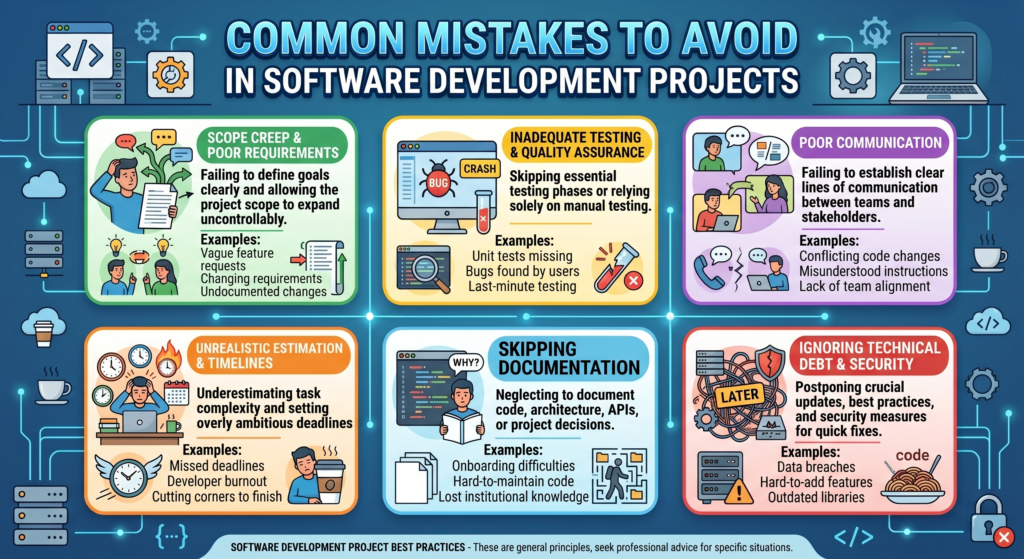
Thank you for reading this post, don't forget to subscribe!However, despite the growing importance of technology, many software projects still fail or underperform. The main reason is not always technical failure—it is usually avoidable mistakes during planning, execution, and delivery.
In this article, brought to you by Bytebrew Technologies, we will explore the most common mistakes in software development projects and how to avoid them to ensure successful outcomes.
- Poor Requirement Understanding
One of the earliest and most damaging mistakes in any software project is unclear requirements.
When project goals are not properly defined, the entire development process becomes unstable.
Common problems include:
- Vague or incomplete project scope
- Missing feature details
- Miscommunication between client and developer
- Frequent changes without structured approval
Impact:
Without clarity, developers are forced to guess requirements, leading to rework, delays, and increased costs.
How to avoid it:
- Conduct detailed requirement gathering sessions
- Create a clear Software Requirement Specification (SRS) document
- Define project scope and success criteria
- Get formal client approval before development begins
Clear requirements are the foundation of successful software development.
- Lack of Proper Project Planning
Skipping planning is one of the fastest ways to fail in software development.
Many teams rush into coding without a structured roadmap.
Common issues:
- No defined timeline or milestones
- Poor task distribution
- Lack of resource planning
- Unclear priorities
Consequences:
- Missed deadlines
- Budget overruns
- Disorganized development process
Solution:
- Break the project into phases (MVP approach)
- Create a detailed project roadmap
- Assign clear roles and responsibilities
- Use tools like Jira, Trello, or Asana for tracking
Good planning reduces risks and improves delivery efficiency.
- Choosing the Wrong Technology Stack
The technology stack determines how scalable, secure, and efficient your application will be.
Choosing the wrong tools can create long-term problems.
Mistakes:
- Using outdated technologies
- Overengineering simple solutions
- Ignoring scalability requirements
Risks:
- Poor performance
- Difficult maintenance
- High future upgrade costs
Best practice:
- Select technology based on project needs
- Consider long-term scalability
- Consult experienced developers before finalizing stack
At Bytebrew Technologies, we always recommend technology based on business goals—not trends.
- Ignoring UI/UX Design
A powerful application is useless if users cannot navigate it easily.
User experience plays a critical role in software success.
Common mistakes:
- Complex user interfaces
- Poor navigation flow
- Lack of mobile responsiveness
- Inconsistent design elements
Impact:
Users quickly abandon applications that are confusing or difficult to use.
Solution:
- Focus on simple and clean design
- Follow mobile-first design principles
- Conduct usability testing
- Maintain design consistency
Good UX design directly improves user retention and satisfaction.
- Poor Communication Between Stakeholders
Software development involves multiple stakeholders:
- Developers
- Designers
- Project managers
- Clients
When communication breaks down, the project suffers.
Problems:
- Misunderstood requirements
- Delayed feedback
- Repeated work
- Conflicting expectations
Solution:
- Maintain regular meetings (weekly or daily standups)
- Use collaboration tools like Slack or Microsoft Teams
- Share progress updates transparently
- Encourage active client involvement
Strong communication ensures smooth project execution.
- Not Using Agile Development Methodology
Traditional development methods often fail to handle changing requirements.
Problems with non-agile approaches:
- No flexibility for changes
- Late testing cycles
- High risk of project failure
Why Agile works better:
Agile development divides the project into small iterations (sprints), allowing:
- Continuous feedback
- Faster delivery
- Early bug detection
- Better adaptability
Most modern software companies, including Bytebrew Technologies, follow Agile practices for better results.
- Ignoring Testing and Quality Assurance
Skipping testing is one of the most expensive mistakes in software development.
Common issues:
- Bugs in production
- Security vulnerabilities
- Poor system performance
- Negative user experience
Types of testing often ignored:
- Unit testing
- Integration testing
- Performance testing
- Security testing
Solution:
- Implement QA from the beginning
- Use automated testing tools where possible
- Conduct thorough manual testing before deployment
- Fix issues before release
Quality assurance ensures reliability and builds user trust.
- Underestimating Budget and Timeline
Many projects fail because of unrealistic expectations.
Mistakes:
- Underestimating development effort
- Ignoring maintenance costs
- Setting unrealistic deadlines
Consequences:
- Stress on development team
- Reduced quality of work
- Project delays
Solution:
- Prepare realistic cost estimates
- Add buffer time for unexpected challenges
- Prioritize essential features first (MVP strategy)
Proper estimation ensures smoother execution.
- Lack of Scalability Planning
A system that works for 100 users may fail at 10,000 users if scalability is ignored.
Common mistakes:
- Monolithic architecture for large systems
- No load testing
- Poor database optimization
Risks:
- System crashes under heavy traffic
- Poor performance
- High infrastructure costs
Solution:
- Use scalable architecture (microservices where needed)
- Leverage cloud platforms like AWS, Azure, or Google Cloud
- Optimize database and backend performance
Scalability ensures long-term growth.
- Weak Security Practices
Security is often overlooked until a breach occurs.
Common security mistakes:
- Weak authentication systems
- Lack of encryption
- Poor API protection
- No access control system
Consequences:
- Data breaches
- Financial loss
- Reputation damage
Solution:
- Implement strong authentication (JWT, OAuth)
- Encrypt sensitive data
- Follow secure coding practices
- Conduct regular security audits
Security should be a priority from day one.
- Poor Documentation
Documentation is often ignored, but it is essential for long-term success.
Problems:
- Difficult maintenance
- Dependency on specific developers
- Confusion during updates
Solution:
- Maintain technical documentation
- Document APIs and system architecture
- Keep updated project notes
Good documentation makes future updates easier and faster.
- Ignoring Post-Launch Support
Software development does not end at deployment.
Common mistakes:
- No maintenance plan
- Ignoring user feedback
- Delayed bug fixes
Solution:
- Provide ongoing maintenance and support
- Monitor application performance
- Release regular updates
- Improve based on user feedback
Post-launch support ensures long-term stability and success.
Final Thoughts
Software development is not just about writing code—it is about building reliable, scalable, and user-friendly digital solutions.
Most project failures happen due to avoidable mistakes such as poor planning, weak communication, or lack of testing.
At Bytebrew Technologies, we focus on delivering high-quality software through:
- Clear requirement analysis
- Agile development practices
- Strong UI/UX design
- Secure and scalable architecture
- Continuous testing and support
By avoiding these common mistakes, businesses can significantly improve their chances of building successful software products that truly deliver value.