
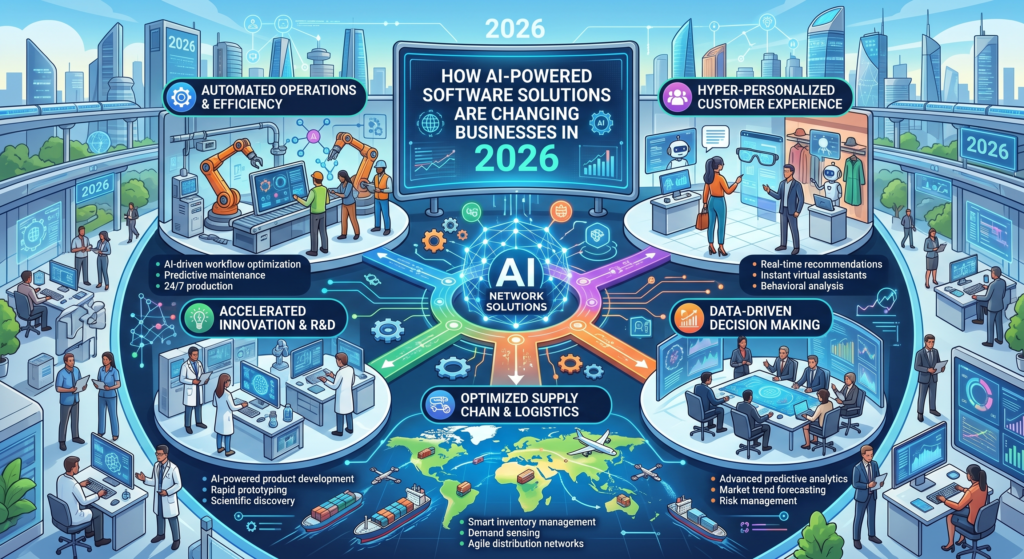
Artificial Intelligence (AI) is no longer a futuristic concept reserved for large technology corporations. In 2026, AI-powered software solutions are transforming businesses of all sizes across industries including healthcare, finance, retail, logistics, education, manufacturing, and customer service. Companies are leveraging AI to automate repetitive tasks, improve customer experiences, enhance cybersecurity, analyze large datasets, predict future trends, and make smarter business decisions.
Thank you for reading this post, don't forget to subscribe!The rapid evolution of AI technology has fundamentally changed how businesses operate. Organizations that once relied heavily on manual processes are now implementing intelligent software systems capable of learning, adapting, and optimizing operations in real time. AI-powered software has become one of the most powerful tools for digital transformation, helping businesses reduce costs, increase efficiency, and stay competitive in an increasingly digital economy.
This article explores how AI-powered software solutions are reshaping modern businesses, the benefits they offer, common use cases, challenges companies face, and what the future of AI-driven business technology looks like in 2026 and beyond.
What Are AI-Powered Software Solutions?
AI-powered software solutions are applications or platforms that use artificial intelligence technologies such as:
- Machine Learning (ML)
- Natural Language Processing (NLP)
- Computer Vision
- Predictive Analytics
- Generative AI
- AI Agents
- Deep Learning
- Intelligent Automation
These technologies enable software systems to analyze data, recognize patterns, make decisions, automate workflows, and improve performance over time without requiring constant human intervention.
Unlike traditional software, which follows fixed programming rules, AI-driven software can learn from data and adapt based on user behavior, business requirements, and operational trends.
Modern AI solutions are now integrated into:
- CRM platforms
- ERP systems
- Customer support tools
- Marketing automation software
- Cybersecurity systems
- E-commerce platforms
- HR management software
- Financial systems
- Business analytics tools
Businesses are increasingly adopting AI not just for automation, but for creating smarter, faster, and more scalable digital ecosystems.
Why Businesses Are Investing in AI Software Solutions
Businesses today face growing pressure to deliver faster services, reduce operational costs, improve customer experiences, and make data-driven decisions. AI-powered software helps organizations address these challenges effectively.
Some of the biggest reasons businesses are investing in AI include:
- Increased Operational Efficiency
AI automates repetitive and time-consuming tasks such as:
- Data entry
- Invoice processing
- Scheduling
- Reporting
- Inventory tracking
- Customer query handling
This allows employees to focus on higher-value work, improving overall productivity and efficiency.
According to industry research and enterprise technology reports, organizations are moving from AI experimentation toward measurable operational impact, integrating AI deeply into daily business processes.
- Better Decision-Making
AI-powered analytics platforms can process enormous amounts of data within seconds and provide valuable business insights.
These systems help businesses:
- Predict customer behavior
- Forecast sales trends
- Analyze market conditions
- Detect risks
- Optimize pricing strategies
- Improve supply chain management
Predictive analytics powered by AI gives organizations a significant competitive advantage.
- Improved Customer Experience
Modern consumers expect fast, personalized, and seamless digital experiences. AI software helps businesses meet these expectations through:
- AI chatbots
- Virtual assistants
- Personalized recommendations
- Smart search systems
- Automated customer support
- AI-driven marketing campaigns
Companies using AI-driven personalization often see increased customer satisfaction and higher conversion rates.
Restaurant chain Cava, for example, recently expanded its AI-powered operational systems to improve customer personalization, demand forecasting, inventory planning, and labor scheduling.
- Cost Reduction
AI automation significantly reduces manual labor costs and operational inefficiencies.
Businesses can lower expenses by:
- Automating workflows
- Reducing human errors
- Minimizing downtime
- Improving resource allocation
- Optimizing logistics and operations
AI also helps organizations identify unnecessary expenses and operational bottlenecks.
- Scalability
AI-powered software enables businesses to scale operations without proportionally increasing workforce or operational costs.
Cloud-based AI solutions allow organizations to:
- Handle larger customer volumes
- Process more transactions
- Expand globally
- Manage growing datasets
- Automate cross-department operations
This scalability is especially important for startups and rapidly growing businesses.
Major Ways AI-Powered Software Is Transforming Businesses
AI-Powered Automation
One of the biggest transformations AI brings is intelligent automation.
Traditional automation systems follow predefined rules. AI automation goes much further by learning patterns and making adaptive decisions.
Examples include:
- Automated invoice approvals
- AI-based recruitment screening
- Intelligent workflow management
- Automated fraud detection
- Predictive maintenance systems
AI-driven automation improves speed, consistency, and operational accuracy.
Research shows businesses increasingly rely on intelligent automation systems capable of optimizing workflows in real time.
AI in Customer Support
AI-powered customer support has evolved dramatically in recent years.
Modern AI customer service systems can:
- Handle thousands of queries simultaneously
- Understand natural language
- Provide instant responses
- Operate 24/7
- Escalate complex issues intelligently
AI chatbots and virtual assistants are now widely used across industries including e-commerce, banking, healthcare, and SaaS businesses.
Benefits include:
- Reduced response times
- Lower support costs
- Improved customer satisfaction
- Increased customer engagement
Generative AI and conversational AI are becoming central components of modern customer support platforms.
AI in Marketing and Sales
AI-powered marketing tools help businesses create highly personalized campaigns and improve lead generation.
AI software can analyze:
- Customer behavior
- Purchase history
- Website interactions
- Social media activity
- Email engagement
This enables businesses to deliver targeted marketing campaigns with higher conversion rates.
AI is transforming:
- Email marketing
- Content creation
- Ad optimization
- Sales forecasting
- Lead scoring
- Customer segmentation
Generative AI tools are also helping marketing teams produce content faster while maintaining personalization and scalability.
AI in Cybersecurity
Cybersecurity threats continue to grow as businesses become more digital.
AI-powered cybersecurity systems help organizations:
- Detect suspicious behavior
- Identify malware
- Prevent data breaches
- Monitor network traffic
- Automate threat responses
AI can analyze massive volumes of security data in real time, helping businesses detect threats much faster than traditional security systems.
As AI adoption increases, cybersecurity is becoming one of the most critical areas of AI investment.
AI in Software Development
AI is revolutionizing the software development industry itself.
Developers now use AI-powered coding assistants to:
- Generate code
- Detect bugs
- Automate testing
- Improve documentation
- Optimize performance
AI development tools significantly improve developer productivity and reduce development timelines.
A recent study on AI-generated software solutions found that AI tools increase developer productivity, particularly for smaller coding tasks and workflow optimization.
AI in Healthcare
Healthcare organizations are using AI-powered software for:
- Medical diagnostics
- Patient monitoring
- Drug discovery
- Appointment scheduling
- Predictive healthcare analytics
AI improves operational efficiency while helping healthcare providers deliver more accurate and personalized care.
Computer vision systems can analyze medical images, while predictive models help identify health risks earlier.
AI in Financial Services
Banks and financial institutions are rapidly adopting AI technologies.
AI-powered financial systems help with:
- Fraud detection
- Credit scoring
- Risk management
- Algorithmic trading
- Customer support
- Financial forecasting
Machine learning algorithms can identify unusual transaction patterns and detect fraud in real time.
AI in E-Commerce
E-commerce businesses use AI extensively to improve shopping experiences and optimize operations.
Popular AI applications include:
- Personalized product recommendations
- Dynamic pricing
- AI chatbots
- Inventory forecasting
- Customer behavior analysis
- Visual search technology
AI helps online stores increase sales while improving customer retention.
Rise of AI Agents in Modern Business
One of the most significant trends in 2026 is the rise of AI agents.
AI agents are advanced intelligent systems capable of performing multi-step tasks autonomously.
Unlike traditional chatbots, AI agents can:
- Analyze workflows
- Make operational decisions
- Interact with software systems
- Execute complex processes
- Learn from outcomes
Industry forecasts suggest AI agents will become integrated into a large percentage of enterprise software applications over the next few years.
Major technology companies are heavily investing in agentic AI systems that can automate increasingly sophisticated business operations.
Benefits of AI-Powered Software Solutions
Faster Business Operations
AI significantly accelerates operational processes and reduces delays.
Improved Accuracy
AI minimizes human error in tasks like data analysis, forecasting, and automation.
Better Resource Utilization
Businesses can allocate staff and resources more effectively using AI-driven insights.
Competitive Advantage
Organizations using AI effectively can innovate faster and outperform competitors.
Real-Time Insights
AI systems provide instant access to business intelligence and operational analytics.
Enhanced Personalization
AI enables highly personalized user experiences across digital platforms.
Challenges Businesses Face with AI Adoption
Despite its benefits, AI implementation comes with challenges.
Data Quality Issues
AI systems depend heavily on high-quality data.
Poor or incomplete data can lead to inaccurate predictions and poor performance.
Integration Complexity
Integrating AI into existing software infrastructure can be technically challenging.
Businesses often require experienced development teams to successfully implement AI systems.
Security and Privacy Concerns
AI systems process large amounts of sensitive business and customer data.
Organizations must ensure:
- Data privacy compliance
- Secure AI infrastructure
- Ethical AI usage
- Transparent decision-making
High Initial Investment
Enterprise-grade AI implementation can require significant upfront investment in:
- Infrastructure
- Development
- Training
- Cloud services
- Data management
However, long-term ROI often justifies the investment.
Skills Gap
Many organizations struggle to find experienced AI developers, machine learning engineers, and AI consultants.
The demand for AI talent continues to grow globally.
Future of AI-Powered Software Solutions
The future of AI in business looks incredibly promising.
Experts predict AI will continue evolving toward:
- Autonomous business systems
- AI-native software architecture
- Hyper-personalization
- Real-time decision intelligence
- Self-improving applications
- AI-driven digital ecosystems
Businesses are increasingly moving from basic AI experimentation to scalable, ROI-focused enterprise implementations.
AI-powered software is expected to become a standard component of modern business infrastructure over the next decade.
How Businesses Can Successfully Implement AI
To maximize the benefits of AI, businesses should:
Define Clear Objectives
Identify specific problems AI can solve within the organization.
Start Small
Begin with smaller AI projects before scaling enterprise-wide implementations.
Focus on Data Quality
Ensure business data is clean, organized, and accessible.
Choose the Right Technology Partner
Work with experienced software development companies that understand AI implementation.
Prioritize Security and Compliance
Maintain strong cybersecurity and ethical AI standards.
Train Employees
Help teams adapt to AI-powered workflows and technologies.
Why AI Matters for Modern Businesses
AI is no longer optional for businesses aiming to remain competitive in the digital economy.
Companies that fail to adopt AI-powered software solutions risk:
- Falling behind competitors
- Higher operational costs
- Poor customer experiences
- Slower innovation
- Reduced scalability
Meanwhile, businesses embracing AI are gaining major advantages through automation, analytics, personalization, and operational intelligence.
The organizations leading the future are those integrating AI into their core business strategies rather than treating it as a secondary technology investment.
Conclusion
AI-powered software solutions are fundamentally reshaping how businesses operate in 2026. From intelligent automation and predictive analytics to customer personalization and AI agents, artificial intelligence is driving a new era of digital transformation across industries.
Businesses are leveraging AI to increase efficiency, reduce costs, improve customer experiences, strengthen cybersecurity, and accelerate innovation. While challenges such as data quality, integration complexity, and security concerns remain, the long-term benefits of AI adoption are substantial.
As AI technology continues to evolve, organizations that invest in scalable, intelligent, and future-ready software solutions will be better positioned for sustainable growth and long-term success.
For software companies, startups, and enterprises alike, AI is no longer just a trend — it is becoming the foundation of modern business innovation.