
In today’s competitive digital landscape, a website is no longer just a company profile or an online brochure. It is the most powerful sales and marketing asset a business can own. For many companies, the website is the first point of contact with potential customers, and in many cases, it decides whether a visitor becomes a lead or leaves forever.
Thank you for reading this post, don't forget to subscribe!Despite investing in ads, social media, and branding, many businesses struggle with one major problem: low conversion rates. They get traffic—but not results.
So what separates an average website from a high-converting one?
At its core, a high-converting website is not just about design. It is about psychology, strategy, user experience, performance, and trust—all working together to guide visitors toward a clear action.
In this in-depth guide, we will explore the real secrets behind high-converting business websites and how companies like ByteBrew Technologies build digital experiences that turn visitors into customers.
What Does “High-Converting Website” Really Mean?
A high-converting website is one that successfully encourages visitors to take a meaningful action.
This action could be:
- Filling out a contact form
- Making a purchase
- Booking a consultation
- Signing up for a service
- Downloading resources
- Calling the business directly
In simple terms:
Traffic brings visitors. Conversion brings business.
Without conversion optimization, even the best marketing campaigns fail to deliver ROI.
- The Power of First Impressions
Users form opinions about a website within seconds. This means your homepage has only a brief moment to create trust and interest.
If the design feels outdated or unprofessional, users leave immediately.
What makes a strong first impression?
Clean and Modern Design
Minimalistic layouts help users focus on what matters most instead of overwhelming them with unnecessary visuals.
Strong Branding
Consistent colors, typography, and visuals create recognition and trust.
High-Quality Visuals
Professional images and UI elements increase perceived value.
Instant Clarity
Visitors should immediately understand:
- What the business does
- Who it serves
- Why it matters
A confusing homepage is one of the biggest reasons for lost conversions.
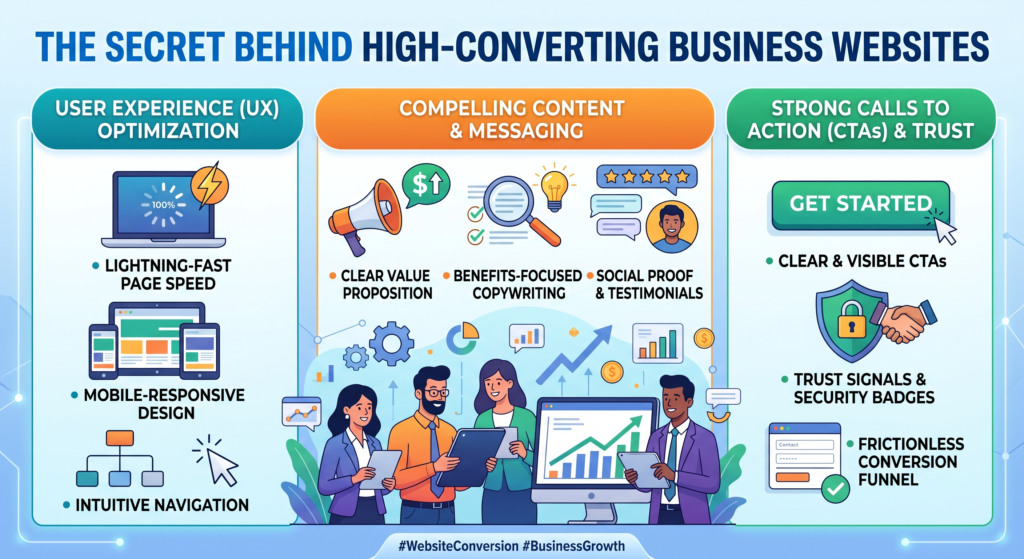
- User Experience (UX): The Core of Conversions
User experience is the foundation of every successful website. If users struggle to navigate or find information, they leave.
High-converting websites are designed around simplicity and clarity.
Key UX principles
Fast Loading Speed
Speed is critical. Even a 2–3 second delay can reduce conversions significantly.
Slow websites:
- Increase bounce rates
- Reduce trust
- Damage SEO rankings
Mobile Optimization
Most users browse on mobile devices, so a website must be fully responsive and touch-friendly.
A mobile-optimized website ensures:
- Smooth navigation
- Readable text
- Easy interaction
Simple Navigation Structure
Menus should be clear and predictable. Users should never feel lost.
Readable Content Layout
Good UX uses:
- Headings
- Bullet points
- Short paragraphs
- Visual hierarchy
Accessibility
A professional website should be usable by everyone, including users with disabilities.
- Clear Value Proposition: The Message That Sells
One of the most common reasons websites fail is unclear messaging.
A visitor should immediately understand your value.
Weak message:
“We provide digital services.”
Strong message:
“We help businesses grow online with high-performance websites, powerful software solutions, and result-driven digital strategies.”
The difference is clarity and benefit-driven communication.
A strong value proposition answers:
- What do you do?
- Why should I care?
- How does it help me?
If users cannot understand this within seconds, they leave.
- Call-to-Action (CTA): The Conversion Trigger
A website without strong CTAs is like a salesperson who never asks for a sale.
CTAs guide users toward action.
Examples of strong CTAs:
- Get Started Today
- Request a Free Consultation
- Contact Our Experts
- Book a Demo
- Start Your Project
- Get a Free Quote
What makes CTAs effective?
Visibility
Buttons must stand out visually.
Action-Oriented Language
Use strong verbs like “Get,” “Start,” “Build,” or “Discover.”
Strategic Placement
CTAs should appear:
- Above the fold
- In the middle of content
- At the end of pages
Simplicity
Avoid confusion—one CTA per goal is ideal.
- Trust: The Foundation of Every Conversion
No matter how good your design is, users will not convert unless they trust your business.
High-converting websites are built around credibility.
Trust-building elements
Client Testimonials
Real feedback builds confidence.
Case Studies
Show real results and success stories.
Portfolio
Demonstrate actual work quality.
Certifications and Experience
Prove expertise and professionalism.
Transparent Contact Information
Visible contact details increase legitimacy.
Secure Website (HTTPS)
Security signals are essential for trust.
Without trust, conversions simply do not happen.
- Content That Persuades and Educates
Content is one of the most powerful conversion tools.
High-converting websites do not just inform—they persuade.
Types of effective content
Homepage Messaging
Clear and benefit-driven introduction.
Service Pages
Explain problems and provide solutions.
Blog Content
Educates users and improves SEO.
FAQs
Removes doubts and objections.
Case Studies
Shows real-world success.
Good content focuses on benefits, not just features.
For example:
Instead of:
“We build websites using modern technologies.”
Say:
“We build fast, secure, and conversion-focused websites that help businesses attract more customers and increase revenue.”
- Visual Design Psychology
Design influences user behavior more than most people realize.
Every color, spacing choice, and layout decision impacts conversions.
Key design principles
Color Psychology
- Blue → Trust
- Green → Growth
- Red → Urgency
- Black → Premium feel
White Space
Clean spacing improves readability and reduces cognitive load.
Typography
Fonts should be:
- Readable
- Professional
- Consistent
Visual Hierarchy
Important elements should naturally attract attention.
Good design doesn’t just look good—it guides behavior.
- Speed Optimization: A Silent Conversion Killer
Website speed directly affects user behavior and sales.
Slow websites lose customers—even if everything else is perfect.
Common speed issues:
- Large images
- Unoptimized code
- Poor hosting
- Excess scripts
Optimization techniques:
- Image compression
- Caching systems
- Lightweight code
- CDN usage
- Clean architecture
Faster websites consistently perform better in conversions and SEO.
- SEO: Attracting the Right Audience
A high-converting website needs qualified traffic.
That is where SEO comes in.
SEO benefits:
- Organic traffic growth
- Better visibility
- Higher trust
- Long-term results
Key SEO strategies:
- Keyword optimization
- Technical SEO improvements
- Quality content creation
- Internal linking
- Meta tags optimization
SEO ensures that people who are already searching for your services find you.
- Mobile-First Design Strategy
Mobile users dominate the internet. If your website is not mobile-friendly, you are losing a huge number of potential customers.
Mobile optimization includes:
- Responsive layouts
- Fast loading pages
- Easy navigation
- Click-friendly buttons
- Simplified content
Google also prioritizes mobile-friendly websites in rankings.
- Social Proof: The Psychology of Influence
People trust what others say more than what businesses say.
Types of social proof:
- Reviews
- Testimonials
- Ratings
- Client logos
- Success stories
Social proof reduces hesitation and increases confidence.
- Landing Pages That Convert
Landing pages are designed with one purpose: conversion.
Unlike regular pages, they eliminate distractions.
High-converting landing page structure:
- Powerful headline
- Clear offer
- Strong visuals
- One focused CTA
- Trust signals
Landing pages are especially effective for:
- Ads
- Campaigns
- Promotions
- Analytics and Continuous Improvement
High-converting websites are not static—they evolve.
Important metrics:
- Conversion rate
- Bounce rate
- Session duration
- User flow
- Click behavior
Tools like analytics and heatmaps help businesses understand user behavior and improve performance over time.
- Common Mistakes That Kill Conversions
Many businesses unknowingly hurt their own websites.
Common mistakes:
- Slow loading speed
- Weak CTAs
- Poor mobile design
- Cluttered layouts
- Lack of trust signals
- Confusing navigation
Fixing these issues often leads to immediate improvements in conversions.
- The Role of Professional Development
Building a high-converting website requires more than just design skills.
It requires:
- Strategy
- Psychology understanding
- Technical expertise
- Marketing knowledge
Companies like ByteBrew Technologies focus on building websites that are not only visually appealing but also engineered for performance, scalability, and conversions.
A professional approach ensures:
- Better user experience
- Stronger branding
- Higher ROI
- Long-term growth
- The Future of High-Converting Websites
The digital world is evolving rapidly.
Future websites will rely heavily on:
- AI-driven personalization
- Chatbots and automation
- Voice search optimization
- Interactive experiences
- Advanced analytics
- Smart recommendation systems
Businesses that adapt early will stay ahead of competitors.
Final Thoughts
A high-converting business website is not built by chance—it is built with intention.
It is the result of combining:
- Smart design
- Strong messaging
- Fast performance
- Trust-building elements
- SEO strategy
- User-focused experience
When all these elements work together, a website becomes more than just an online presence—it becomes a powerful business growth engine.
For modern businesses, especially those working with teams like ByteBrew Technologies, the goal is not just to build websites, but to build digital systems that generate real results.
In a competitive online world, the difference between success and failure often comes down to one thing:
How well your website converts visitors into customers.