Introduction
Thank you for reading this post, don't forget to subscribe!In today’s fast-paced digital economy, businesses are under constant pressure to innovate, scale, and stay ahead of competitors. Off-the-shelf software tools may offer quick solutions, but they often fall short when it comes to meeting specific business requirements. This is where custom software solutions become a game-changer.
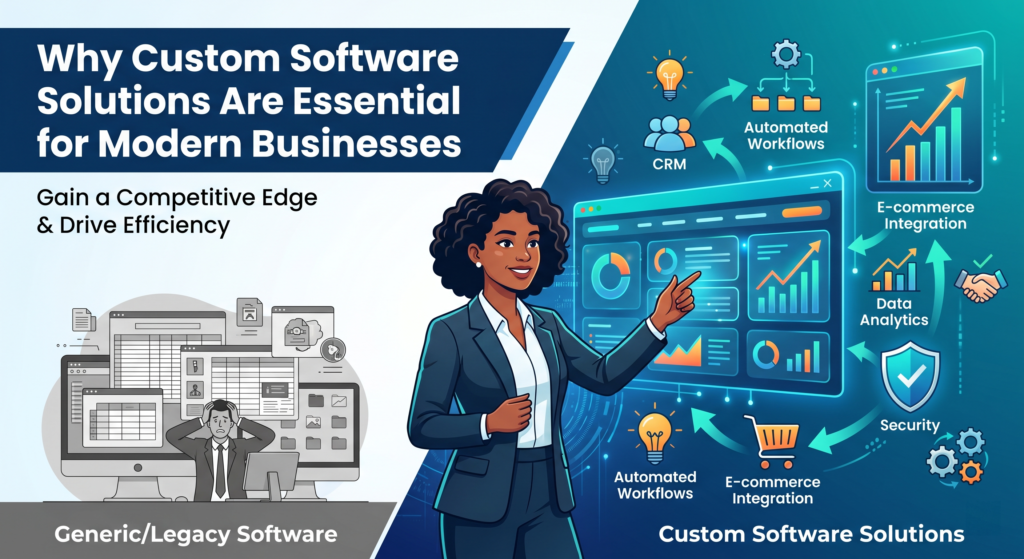
Custom software is designed specifically for a business’s unique needs, workflows, and goals. Unlike generic software, it provides flexibility, scalability, and efficiency that directly contribute to long-term growth.
In this blog, we will explore why custom software solutions are essential for modern businesses, how they work, their benefits, and why investing in tailored technology is no longer optional—it’s a necessity.
What Are Custom Software Solutions?
Custom software solutions refer to applications or systems that are specially developed for a specific organization or user base. These solutions are built from scratch or heavily customized to align with business processes.
Unlike ready-made software, which is designed for mass usage, custom software is:
- Tailored to business requirements
- Scalable as the business grows
- Integrated with existing systems
- Focused on solving specific challenges
Examples include:
- Custom CRM systems
- Enterprise resource planning (ERP) software
- E-commerce platforms with unique workflows
- Inventory management systems
- HR management systems
Why Businesses Are Moving Toward Custom Software
The global business environment has changed drastically. Companies are no longer satisfied with “one-size-fits-all” tools. Here are the main reasons behind this shift:
- Unique Business Requirements
Every business operates differently. For example, a logistics company has completely different needs than an e-commerce store. Generic software cannot efficiently handle such unique workflows.
Custom software is designed to match exact requirements, improving efficiency and reducing operational gaps.
- Increased Competition
Modern markets are highly competitive. Businesses need tools that give them an edge. Custom software helps companies automate processes, improve customer experience, and make faster decisions—giving them a strong competitive advantage.
- Digital Transformation Demand
Digital transformation is no longer optional. Businesses that fail to adopt modern systems risk falling behind. Custom software plays a major role in transforming manual operations into digital, automated processes.
Key Benefits of Custom Software Solutions
- Tailored to Your Business Needs
The biggest advantage of custom software is personalization. It is built around your workflow instead of forcing your business to adapt to software limitations.
This ensures:
- Smooth operations
- Reduced complexity
- Higher productivity
- Scalability for Future Growth
As your business grows, your software must grow with it. Custom solutions are highly scalable, meaning new features and modules can be added without rebuilding the system.
This is especially important for startups and expanding enterprises.
- Better Integration with Existing Systems
Most businesses already use multiple tools. Custom software can be integrated seamlessly with existing systems such as:
- Payment gateways
- CRM tools
- Accounting software
- Third-party APIs
This creates a unified digital ecosystem.
- Enhanced Security
Security is a major concern in the digital world. Off-the-shelf software is often targeted by hackers due to its widespread usage.
Custom software offers:
- Stronger security architecture
- Controlled access
- Reduced vulnerability
- Data protection based on business needs
- Cost Efficiency in the Long Run
While custom software may require higher initial investment, it saves money over time by:
- Reducing subscription costs
- Eliminating unnecessary features
- Improving operational efficiency
- Reducing manual labor
- Competitive Advantage
Custom software allows businesses to implement unique features that competitors using generic tools cannot replicate easily. This leads to better customer experiences and stronger brand positioning.
- Improved Productivity
Automation of repetitive tasks reduces human effort and errors. Employees can focus on more important strategic tasks instead of manual operations.
Custom Software vs Off-the-Shelf Software
Feature | Custom Software | Off-the-Shelf Software |
Flexibility | High | Limited |
Cost | Higher initial, lower long-term | Lower initial, recurring cost |
Scalability | Fully scalable | Limited |
Security | High control | Shared vulnerabilities |
Customization | Fully customizable | Minimal |
Support | Dedicated | General support |
From the comparison, it is clear that custom software provides long-term value and flexibility that pre-built tools cannot match.
How Custom Software Drives Business Growth
- Automating Business Processes
Automation reduces manual workload and increases speed. Tasks such as reporting, billing, inventory tracking, and customer management can be fully automated.
- Improving Customer Experience
Modern customers expect fast, seamless, and personalized services. Custom software allows businesses to:
- Personalize user experience
- Improve response time
- Provide better support systems
- Data-Driven Decision Making
Custom systems can collect and analyze business data in real time, helping managers make informed decisions.
This includes:
- Sales trends
- Customer behavior
- Operational performance
- Supporting Remote and Hybrid Work Models
With the rise of remote work, businesses need flexible systems. Custom software allows secure cloud-based access for teams from anywhere in the world.
Industries That Benefit from Custom Software
Custom software is not limited to one sector. It benefits almost every industry:
- Healthcare
- Patient management systems
- Appointment scheduling
- Electronic health records
- Education
- Learning management systems (LMS)
- Online exam platforms
- Student tracking systems
- E-Commerce
- Custom online stores
- Inventory management
- Order tracking systems
- Finance
- Accounting software
- Risk analysis systems
- Banking applications
- Logistics
- Fleet management systems
- Delivery tracking
- Route optimization tools
Challenges Without Custom Software
Businesses that rely only on generic tools often face:
- Limited functionality
- Poor integration
- Security risks
- Higher long-term costs
- Lack of flexibility
- Inefficient workflows
These challenges slow down growth and reduce competitiveness.
Why Investing in Custom Software Is a Smart Decision
Investing in custom software is not just a technical decision—it is a business strategy. It ensures:
- Long-term sustainability
- Better operational control
- Increased revenue opportunities
- Strong digital presence
In a world driven by technology, businesses that adopt custom solutions are better positioned for success.
Future of Custom Software Development
The future of custom software is strongly connected with emerging technologies:
- Artificial Intelligence (AI)
AI-powered software will enhance automation, prediction, and personalization.
- Cloud Computing
Cloud-based custom systems will improve accessibility and scalability.
- Internet of Things (IoT)
Businesses will integrate software with smart devices for real-time data.
- Blockchain
Improved security and transparency for financial and data systems.
Conclusion
Custom software solutions have become essential for modern businesses because they offer flexibility, scalability, security, and efficiency that generic tools simply cannot provide.
Whether you are a startup or an established enterprise, investing in custom software ensures that your business is future-ready and capable of competing in a rapidly evolving digital landscape.
In the long run, custom software is not just an expense—it is a powerful investment that drives innovation, productivity, and sustainable growth.