
Introduction
In today’s highly competitive digital world, software products and SaaS platforms are no longer judged only by their functionality. Users expect seamless experiences, intuitive interfaces, and fast, frictionless interactions. This is where UI (User Interface) and UX (User Experience) design become the foundation of successful digital products.
Thank you for reading this post, don't forget to subscribe!Whether you are building a startup MVP, a SaaS platform, or a large-scale enterprise application, UI/UX design directly impacts user satisfaction, retention, and revenue growth. In fact, many software products fail not because they lack features, but because users find them confusing, slow, or frustrating to use.
This blog explores why UI/UX design is critical for software and SaaS success, how it impacts business performance, and what best practices can help companies build world-class digital experiences.
What is UI/UX Design?
Before diving deeper, it’s important to clearly understand both terms:
UI (User Interface) Design
UI design focuses on the visual elements of a digital product. It includes:
- Layout and structure
- Buttons and navigation
- Typography and colors
- Visual hierarchy
- Interactive elements
UI is what users see and interact with.
UX (User Experience) Design
UX design focuses on the overall experience a user has while using the product. It includes:
- Ease of navigation
- User journey flow
- Speed and efficiency
- Problem-solving ability
- Emotional satisfaction
UX is how users feel while using the product.
Together, UI and UX determine whether a product feels easy, enjoyable, and valuable—or frustrating and confusing.
Why UI/UX Design Matters for Software and SaaS Products
1. First Impressions Determine User Retention
Users form an opinion about your software within seconds. If your interface looks outdated, cluttered, or confusing, users are likely to leave immediately.
A well-designed UI creates:
- Trust
- Professional credibility
- Emotional connection
In SaaS products, first impressions are critical because users often compare multiple tools before committing.
2. Better UX Increases Conversion Rates
For SaaS platforms, conversions are everything—sign-ups, subscriptions, upgrades, and renewals.
Good UX ensures:
- Easy onboarding process
- Clear call-to-action buttons
- Smooth navigation
- Minimal friction
For example, simplifying a 5-step sign-up process into 2 steps can significantly increase conversion rates.
Businesses using advanced UX practices often see 20%–200% improvement in conversion rates, depending on the product.
3. Reduces Customer Churn
Customer churn is one of the biggest challenges in SaaS businesses. Even if users sign up, they may leave if the product is difficult to use.
Poor UX leads to:
- Confusion
- Frustration
- Lack of product adoption
Good UX ensures users quickly understand value, leading to long-term retention and loyalty.
4. Enhances Product Usability and Efficiency
A well-designed SaaS product helps users accomplish tasks faster and more efficiently.
For example:
- Clear dashboards reduce decision time
- Logical workflows improve productivity
- Smart navigation reduces user effort
When users can achieve goals quickly, they are more likely to continue using the product.
5. Builds Brand Trust and Authority
Design is not just aesthetics—it reflects your brand identity.
A polished UI communicates:
- Reliability
- Innovation
- Professionalism
On the other hand, poor design can make even a powerful software product look untrustworthy.
In competitive SaaS markets, trust is a deciding factor for purchase decisions.
6. Improves Customer Satisfaction
Happy users are loyal users.
UX design ensures:
- Smooth interactions
- Minimal errors
- Positive emotional experience
When users enjoy using your software, they are more likely to:
- Stay longer
- Recommend it to others
- Leave positive reviews
This organic growth is extremely valuable for SaaS companies.
7. Supports Scalability of Software Products
As software grows, complexity increases. Without proper UX structure, systems become chaotic and hard to use.
Good UI/UX design ensures:
- Scalable architecture of screens
- Consistent design system
- Easy feature integration
- Organized navigation structure
This makes future updates easier and more efficient.
UI/UX Design and SaaS Business Growth
SaaS businesses depend heavily on recurring revenue models. This means user satisfaction must remain consistently high.
UI/UX directly affects SaaS growth in the following ways:
1. Onboarding Experience
A smooth onboarding process helps users understand the product value quickly.
2. Feature Adoption
Well-designed interfaces encourage users to explore more features.
3. Subscription Retention
If users find value easily, they are more likely to renew subscriptions.
4. Upselling Opportunities
Clear UI allows businesses to promote premium features effectively.
Essential UI/UX Design Principles for Software Success
1. Simplicity is Key
A clean and simple interface reduces cognitive load.
2. Consistency Across Screens
Fonts, colors, and layouts must remain consistent.
3. Mobile Responsiveness
Users expect seamless experiences across devices.
4. Accessibility
Design should be usable for all users, including those with disabilities.
5. Fast Load Times
Performance is a critical part of UX.
6. User-Centered Design
Always design based on user behavior, not assumptions.
Tools Used in Modern UI/UX Design
Figma
One of the most popular collaborative design tools used for wireframing, prototyping, and UI design.
Adobe XD
A powerful tool for designing and prototyping user experiences with interactive workflows.
Sketch
Widely used for UI design, especially in macOS environments.
Hotjar
Used to analyze user behavior through heatmaps and session recordings, helping improve UX decisions.
Google Analytics
Helps track user behavior, engagement, and conversion metrics.
These tools help designers and developers create data-driven and user-focused digital experiences.
Common UI/UX Mistakes That Hurt SaaS Success
1. Overcomplicated Interfaces
Too many features on one screen confuse users.
2. Poor Navigation Structure
Users should always know where they are and where to go next.
3. Ignoring Mobile Users
A non-responsive design can lose a large portion of traffic.
4. Weak Onboarding Flow
If users don’t understand the product in the first few minutes, they leave.
5. Inconsistent Design Elements
Inconsistency reduces trust and professionalism.
Real Impact of Good UI/UX Design
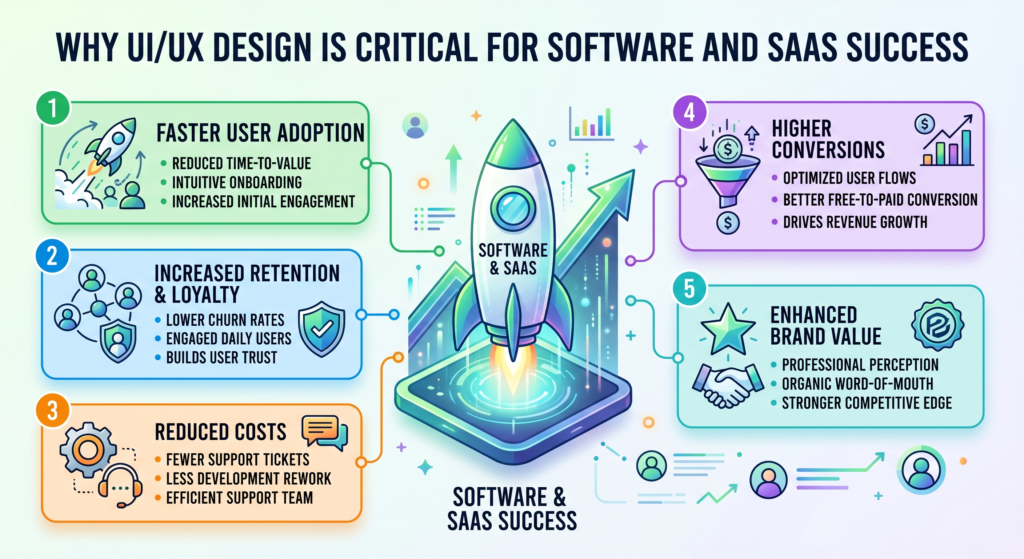
Companies that invest in UI/UX design experience:
- Higher user engagement
- Increased conversion rates
- Better customer retention
- Reduced support costs
- Stronger brand loyalty
In many cases, UI/UX improvements deliver better ROI than adding new features.
UI/UX Design in Modern Web Development
Modern web development is no longer just about coding. It is about creating experiences.
Platforms like WordPress and custom SaaS applications now prioritize:
- User journey mapping
- Interactive UI components
- Minimalist design systems
- Conversion-focused layouts
Businesses like ByteBrew Technologies are increasingly focusing on combining strong development with user-centered design to build high-performing SaaS and MVP solutions that scale efficiently.
Future of UI/UX in Software and SaaS
The future of UI/UX design is evolving rapidly with:
- AI-powered personalization
- Voice-based interfaces
- Predictive user flows
- Advanced micro-interactions
- No-code/low-code design systems
As competition increases, companies that invest in UX innovation will dominate the SaaS market.
Conclusion
UI/UX design is not just a design layer—it is a core business strategy for software and SaaS success. A well-designed product improves user satisfaction, increases conversions, reduces churn, and builds long-term brand trust.
In a digital economy where users have endless options, the difference between success and failure often comes down to one thing: experience.
If your software or SaaS product is not performing well, improving UI/UX design is one of the fastest and most effective ways to unlock growth.