Introduction
In today’s highly competitive digital economy, startups are constantly searching for ways to differentiate themselves, innovate faster, and deliver better experiences to their customers. Technology plays a critical role in this journey. Whether it’s building a new platform, launching a mobile application, or managing internal operations, software is often at the core of a startup’s business model.
Thank you for reading this post, don't forget to subscribe!When it comes to choosing the right software solution, startups usually face two major options: custom software development or ready-made (off-the-shelf) software. Ready-made software products are pre-built applications designed to serve a broad audience. They are typically quick to deploy and cheaper initially. However, they often come with limitations in terms of customization, scalability, and integration.
On the other hand, custom software development involves designing and building software specifically tailored to a startup’s unique business needs, workflows, and goals. Although it may require more investment at the beginning, custom software provides long-term flexibility, competitive advantage, and growth potential.
Because of these benefits, many startups prefer custom software development over ready-made solutions. In this blog, we will explore the key reasons why startups are increasingly choosing custom software and how it helps them grow faster in the digital world.
Understanding Custom Software Development
Custom software development refers to the process of creating software applications that are specifically designed to meet the unique requirements of a particular business or organization. Instead of adapting your business processes to fit generic software, custom software is built to support your exact workflow.
For startups, this approach is particularly valuable because they often have innovative ideas and unique business models that cannot be fully supported by generic solutions. Custom software allows them to turn their ideas into reality without compromising on functionality or flexibility.
Custom solutions can include:
Web applications
Mobile apps
Enterprise software systems
SaaS platforms
Automation tools
Customer management systems
By investing in custom development, startups gain full control over how their software works, how it evolves, and how it supports their growth.
Limitations of Ready-Made Software for Startups
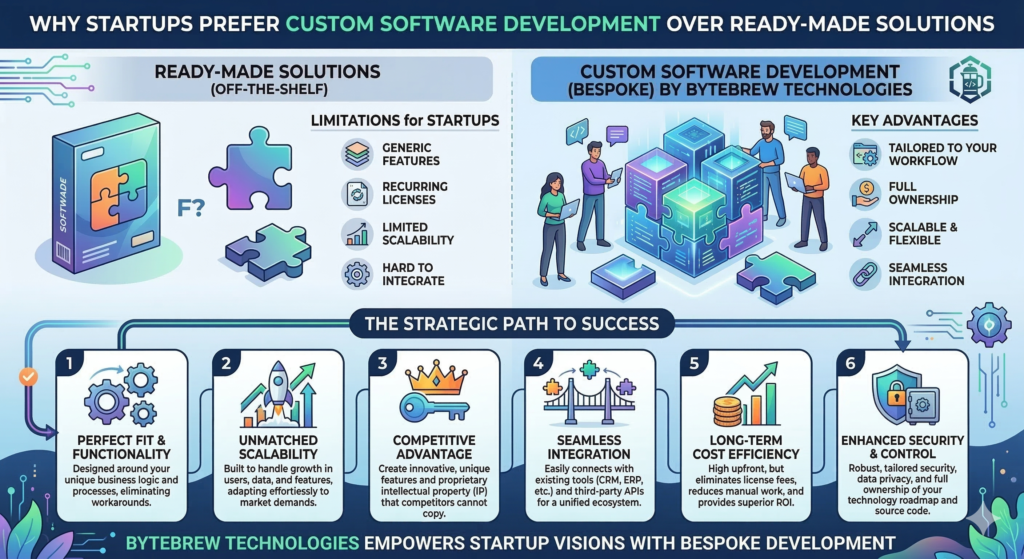
Ready-made software solutions can be useful for basic needs, but they often create challenges for startups that want to scale or innovate. Some of the most common limitations include:
1. Lack of Flexibility
Off-the-shelf software is designed for mass users. This means startups often have to adjust their workflows to match the software instead of the software adapting to their needs.
2. Limited Customization
Many ready-made solutions only offer limited customization options. As startups grow, they may require new features or functionalities that the software simply cannot provide.
3. Subscription Costs
Most ready-made platforms operate on monthly or yearly subscription models. Over time, these recurring costs can become expensive, especially for startups with growing teams.
4. Integration Challenges
Startups often use multiple tools for marketing, analytics, payments, and operations. Ready-made software may not integrate easily with all these systems.
5. Vendor Dependency
When using third-party software, startups rely heavily on the vendor’s updates, pricing changes, and policies. This lack of control can create long-term risks.
Because of these limitations, startups often shift toward custom software as they grow.
Key Reasons Why Startups Prefer Custom Software Development
1. Tailored to Business Needs
One of the biggest advantages of custom software is that it is designed specifically for the startup’s business model. Every feature, function, and workflow is built according to the company’s exact requirements.
This ensures:
Higher efficiency
Better productivity
Seamless workflow integration
Instead of forcing employees to adapt to rigid systems, custom software supports the way the startup actually operates.
2. Scalability for Future Growth
Startups are built to grow quickly. What works for a small team today may not work when the company expands to hundreds or thousands of users.
Custom software can be designed with scalability in mind, allowing startups to:
Add new features easily
Handle increasing user traffic
Expand to new markets
This flexibility ensures that the software grows alongside the business.
3. Competitive Advantage
In many industries, technology is the primary differentiator between companies. Startups that rely on the same ready-made tools as their competitors may struggle to stand out.
Custom software allows startups to build unique platforms, services, or features that competitors cannot easily replicate. This creates a strong competitive advantage and helps startups position themselves as innovators.
4. Improved Security
Security is a major concern for startups, especially those handling sensitive customer data or financial transactions.
Ready-made software solutions are often targeted by hackers because they are widely used. Custom software, on the other hand, offers better security because:
It is built with unique architecture
It includes tailored security protocols
It reduces exposure to common vulnerabilities
This makes it more difficult for attackers to exploit the system.
5. Better Integration with Business Tools
Startups often rely on multiple digital tools such as:
CRM systems
Payment gateways
Marketing automation platforms
Analytics tools
Custom software can be designed to integrate seamlessly with these systems, creating a unified digital ecosystem. This improves efficiency and eliminates the need for manual data transfers.
6. Long-Term Cost Efficiency
Although custom software development may require higher initial investment, it often proves more cost-effective in the long run.
With ready-made software, startups typically face:
Monthly subscription fees
Licensing costs
Upgrade charges
Add-on feature costs
Over several years, these expenses can exceed the cost of building custom software. Custom solutions eliminate many of these recurring fees and provide full ownership of the platform.
7. Full Ownership and Control
When startups develop custom software, they own the entire system, including the code and intellectual property.
This provides several advantages:
Freedom to modify features anytime
No dependency on external vendors
Greater control over updates and improvements
Ownership also increases the company’s overall valuation, especially for tech startups.
8. Enhanced User Experience
User experience plays a major role in the success of any digital product. Ready-made software often includes generic user interfaces designed for a broad audience.
Custom software allows startups to create highly personalized user experiences tailored to their target market.
This leads to:
Higher customer satisfaction
Better engagement
Increased retention rates
For startups building digital products or platforms, this can make a huge difference in success.
9. Faster Innovation
Innovation is the lifeblood of startups. Companies need the ability to experiment, test new ideas, and launch new features quickly.
Custom software provides the flexibility needed for rapid innovation. Developers can continuously improve the platform based on user feedback and market trends.
This allows startups to stay ahead of competitors and adapt quickly to changing customer needs.
10. Stronger Brand Identity
Technology can be a powerful extension of a startup’s brand identity. Custom-built platforms can reflect the company’s unique design, functionality, and user experience.
This creates a stronger brand presence and helps startups build trust with their customers.
Instead of looking like every other company using the same generic tools, startups can deliver a unique digital experience.
When Should Startups Choose Custom Software?
Custom software development is particularly beneficial for startups that:
Have unique business models
Plan to scale rapidly
Need specialized features
Require high security
Want full control over their technology
However, startups with very limited budgets or simple operational needs may initially start with ready-made solutions before transitioning to custom development as they grow.
The Role of a Professional Software Development Company
Building custom software requires technical expertise, strategic planning, and a deep understanding of business needs. This is why many startups partner with professional software development companies.
A reliable software development partner can help startups:
Analyze business requirements
Design scalable architecture
Build secure and efficient applications
Provide ongoing maintenance and updates
Working with experienced developers ensures that the final product meets both current and future business needs.
Future of Custom Software Development for Startups
As technology continues to evolve, custom software development will become even more important for startups.
Emerging technologies such as:
Artificial Intelligence (AI)
Cloud computing
Blockchain
Internet of Things (IoT)
Machine learning
are opening new opportunities for innovation. Startups that invest in custom software will be better positioned to leverage these technologies and create groundbreaking solutions.
Additionally, the rise of digital-first businesses means that software is no longer just a support tool—it is often the core product itself.
Conclusion
In the fast-paced startup ecosystem, choosing the right technology strategy can determine whether a company succeeds or struggles to grow. While ready-made software may offer convenience and lower initial costs, it often lacks the flexibility, scalability, and innovation potential that startups need.
Custom software development provides startups with tailored solutions designed specifically for their unique business models. It enables them to scale efficiently, integrate seamlessly with other tools, enhance security, and create exceptional user experiences.
Although the initial investment may be higher, the long-term benefits—such as full ownership, competitive advantage, and cost efficiency—make custom software development a smart choice for many startups.
As the digital landscape continues to evolve, startups that invest in customized technology solutions will be better equipped to innovate, adapt, and succeed in an increasingly competitive market.