
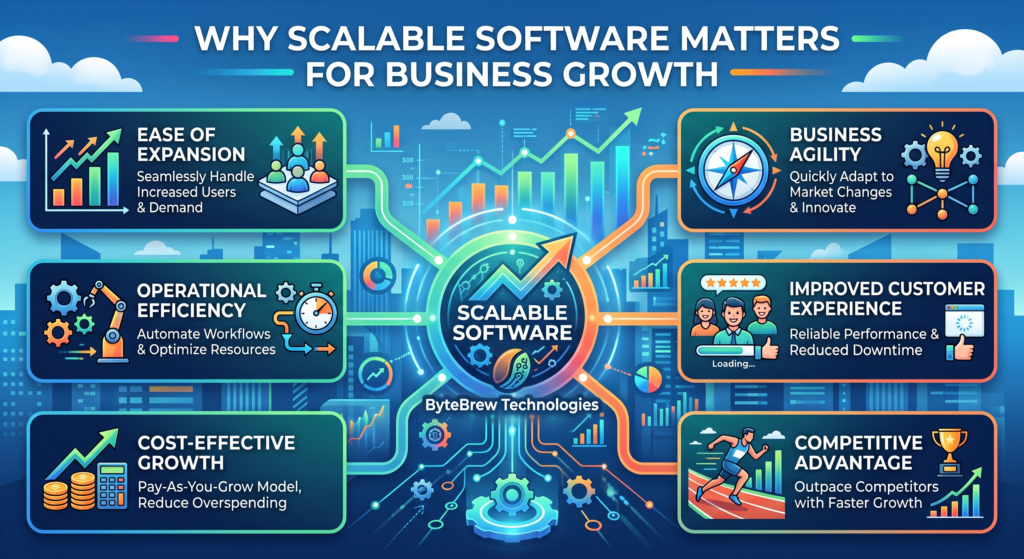
Why Scalable Software Matters for Business Growth
Thank you for reading this post, don't forget to subscribe!Introduction
In today’s rapidly evolving digital landscape, businesses are under constant pressure to innovate, improve efficiency, and meet growing customer expectations. Whether you’re a startup, a small business, or a large enterprise, the software solutions you choose can significantly impact your long-term success. One of the most critical factors often overlooked during software development is scalability.
Scalable software is designed to handle increased workloads, users, transactions, and data without compromising performance. As businesses grow, their operational requirements become more complex, making scalability an essential component of sustainable growth.
At ByteBrew Technologies, we believe that investing in scalable software is not just a technical decision—it’s a strategic business investment that prepares organizations for future opportunities and challenges.
In this comprehensive guide, we’ll explore why scalable software matters, its benefits, key characteristics, implementation strategies, and how it can drive business growth.
What Is Scalable Software?
Scalable software refers to applications and systems that can efficiently accommodate growth without requiring complete redevelopment or significant infrastructure changes.
A scalable software solution can:
- Handle increasing numbers of users.
- Process larger volumes of data.
- Support additional features and functionalities.
- Adapt to changing business requirements.
- Maintain optimal performance under increased demand.
For example, a startup launching an e-commerce platform may initially serve a few hundred customers per month. As the business expands and attracts thousands of users, the software must continue operating smoothly without crashes, slow loading times, or security vulnerabilities.
Why Scalability Is Essential for Modern Businesses
Business growth often comes with increased demands on technology systems. Without scalable software, organizations may encounter operational bottlenecks, poor customer experiences, and costly system failures.
Scalability ensures that software can grow alongside the business rather than becoming a limitation.
The Digital Growth Challenge
Businesses today face:
- Rapid market expansion.
- Increased customer expectations.
- Higher transaction volumes.
- Growing data storage needs.
- More complex workflows.
- Multi-platform accessibility requirements.
Scalable software helps organizations overcome these challenges while maintaining efficiency and reliability.
Key Benefits of Scalable Software
- Supports Business Growth
One of the primary benefits of scalable software is its ability to support business expansion.
As organizations grow, they often experience:
- Increased customer traffic.
- Additional employees.
- Expanded product offerings.
- New market opportunities.
Scalable systems accommodate these changes without requiring a complete overhaul.
Businesses can confidently pursue growth strategies knowing their technology infrastructure can handle increased demand.
- Improves Customer Experience
Customer satisfaction plays a crucial role in business success.
When software systems become overloaded, users may experience:
- Slow page loading times.
- Application crashes.
- Delayed transactions.
- Poor responsiveness.
These issues can drive customers away and damage brand reputation.
Scalable software ensures:
- Fast performance.
- Reliable service availability.
- Seamless user experiences.
- Consistent functionality.
A positive customer experience leads to increased retention and loyalty.
- Reduces Long-Term Costs
Many businesses choose inexpensive short-term solutions that eventually become expensive to maintain.
Non-scalable systems often require:
- Frequent upgrades.
- Major redevelopment projects.
- Emergency infrastructure investments.
- Increased maintenance costs.
Scalable software minimizes these expenses by allowing gradual expansion as business needs evolve.
This proactive approach significantly lowers total ownership costs over time.
- Enhances Operational Efficiency
Efficient operations are critical for profitability.
Scalable software automates and streamlines processes such as:
- Customer management.
- Inventory tracking.
- Sales reporting.
- Employee collaboration.
- Financial management.
As workload increases, the software continues operating efficiently without slowing down internal processes.
- Provides Competitive Advantage
Businesses that can adapt quickly to market changes often outperform competitors.
Scalable software enables organizations to:
- Launch new features rapidly.
- Enter new markets.
- Handle seasonal traffic spikes.
- Respond to customer demands faster.
This flexibility provides a significant competitive edge in dynamic industries.
The Risks of Non-Scalable Software
Failing to prioritize scalability can create serious business challenges.
Performance Issues
As usage increases, poorly designed software may become slower and less reliable.
This can result in:
- Frustrated customers.
- Lost revenue.
- Reduced productivity.
Increased Downtime
System failures become more common when software reaches capacity limits.
Downtime can lead to:
- Financial losses.
- Customer dissatisfaction.
- Reputational damage.
Security Vulnerabilities
Older systems often struggle to accommodate modern security requirements.
Scaling challenges may expose businesses to:
- Data breaches.
- Compliance violations.
- Cybersecurity threats.
Costly Replacements
Eventually, businesses may need to replace outdated systems entirely.
Full system replacements are often:
- Expensive.
- Time-consuming.
- Disruptive to operations.
Investing in scalable software from the beginning helps avoid these issues.
Characteristics of Scalable Software
Flexible Architecture
Scalable software is built using modular architecture.
This approach allows developers to:
- Add features independently.
- Update components efficiently.
- Scale individual functions as needed.
Cloud Compatibility
Cloud infrastructure plays a major role in software scalability.
Cloud-based solutions offer:
- Elastic resource allocation.
- On-demand computing power.
- Global accessibility.
- Reduced hardware costs.
High Performance
Scalable systems maintain speed and responsiveness even during peak usage periods.
Performance optimization includes:
- Efficient databases.
- Load balancing.
- Caching mechanisms.
- Optimized code structures.
Robust Security
Growth should never compromise security.
Scalable software incorporates:
- Advanced authentication.
- Data encryption.
- Access controls.
- Continuous monitoring.
Easy Integration
Businesses often rely on multiple software platforms.
Scalable solutions integrate seamlessly with:
- CRM systems.
- ERP platforms.
- Payment gateways.
- Marketing tools.
- Third-party APIs.
How Scalable Software Drives Business Growth
Facilitates Market Expansion
Entering new markets often requires increased technical capacity.
Scalable software supports:
- Multiple languages.
- Regional compliance requirements.
- International transactions.
- Increased user volumes.
This enables businesses to expand globally without technical limitations.
Supports Innovation
Companies that innovate consistently remain competitive.
Scalable software allows organizations to:
- Test new products.
- Launch new services.
- Implement emerging technologies.
Innovation becomes easier when software infrastructure can accommodate experimentation.
Enables Data-Driven Decision Making
Business growth generates valuable data.
Scalable systems can process and analyze:
- Customer behavior.
- Sales performance.
- Operational metrics.
- Market trends.
These insights help leaders make informed strategic decisions.
Accommodates Workforce Growth
As businesses hire more employees, software requirements increase.
Scalable systems support:
- Additional user accounts.
- Collaboration tools.
- Workflow automation.
- Department-specific functionality.
This ensures productivity remains high as teams expand.
The Role of Cloud Technology in Scalability
Cloud computing has transformed how businesses approach scalability.
Benefits include:
Elastic Resources
Businesses can increase or decrease resources based on demand.
Cost Efficiency
Pay-as-you-go pricing eliminates unnecessary infrastructure expenses.
Improved Reliability
Cloud providers offer redundancy and disaster recovery capabilities.
Faster Deployment
New features and updates can be implemented quickly.
Cloud-based scalable software allows businesses to remain agile and responsive.
Industries That Benefit from Scalable Software
E-Commerce
Online stores experience fluctuating traffic volumes.
Scalable platforms handle:
- Seasonal sales.
- Promotional campaigns.
- Growing customer bases.
Healthcare
Healthcare providers require systems capable of managing:
- Patient records.
- Telemedicine services.
- Compliance requirements.
Finance
Financial institutions depend on scalable software for:
- Secure transactions.
- Fraud detection.
- Real-time reporting.
Education
Educational platforms must support:
- Online learning.
- Student enrollment growth.
- Content delivery.
Manufacturing
Manufacturers use scalable software to manage:
- Supply chains.
- Production planning.
- Inventory management.
Best Practices for Building Scalable Software
Plan for Future Growth
Development teams should anticipate future business requirements from the beginning.
Choose the Right Technology Stack
Modern frameworks and technologies support scalability more effectively.
Adopt Cloud Infrastructure
Cloud platforms provide flexibility and cost-effective scaling.
Implement Microservices Architecture
Microservices allow independent scaling of different system components.
Optimize Database Performance
Efficient databases are critical for maintaining speed as data volumes increase.
Conduct Regular Performance Testing
Continuous testing identifies bottlenecks before they impact users.
Prioritize Security
Security measures should evolve alongside system growth.
Signs Your Business Needs Scalable Software
Your organization may need scalable software if:
- Website traffic is increasing rapidly.
- System performance is declining.
- Customer complaints are rising.
- Expansion plans are underway.
- Data volumes are growing significantly.
- Existing systems require frequent maintenance.
Recognizing these indicators early can prevent future operational challenges.
How ByteBrew Technologies Helps Businesses Build Scalable Solutions
At ByteBrew Technologies, we specialize in developing scalable software solutions tailored to business growth objectives.
Our development approach focuses on:
- Custom software development.
- Scalable web applications.
- Mobile application development.
- Cloud-based solutions.
- System integration services.
- Performance optimization.
- Security-focused architecture.
We understand that every business has unique requirements. Our team designs software that not only meets current needs but also supports future growth and innovation.
Whether you’re launching a startup platform, modernizing legacy systems, or expanding enterprise operations, ByteBrew Technologies delivers scalable technology solutions that grow with your business.
Conclusion
Scalable software is no longer optional in today’s competitive digital environment. It serves as the foundation for sustainable growth, operational efficiency, superior customer experiences, and long-term success.
Businesses that invest in scalable software gain the flexibility to adapt, innovate, and expand without being constrained by technological limitations.
By choosing scalable solutions early, organizations can avoid costly redesigns, improve performance, and create a strong foundation for future growth.
As your business evolves, your software should evolve with it.
Partnering with experienced software development professionals like ByteBrew Technologies ensures that your technology infrastructure is prepared for the opportunities and challenges of tomorrow.
Ready to Build Scalable Software for Your Business?
Contact ByteBrew Technologies today to discover how our custom software development services can help your organization grow efficiently, securely, and successfully.