
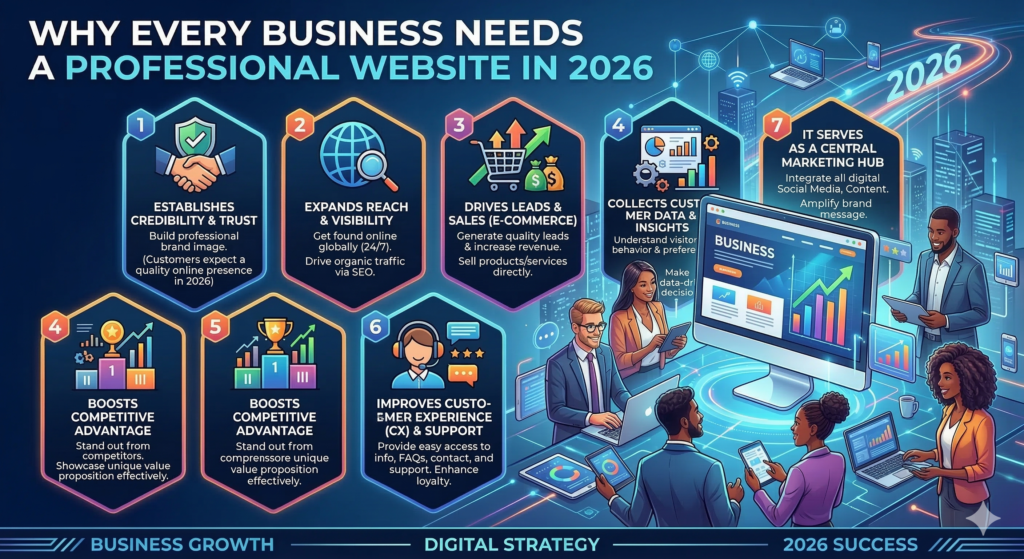
In the modern digital economy, having an online presence is no longer optional—it is a necessity. Businesses across the world are rapidly embracing digital platforms to connect with customers, promote their services, and build strong brand identities. As we move deeper into the digital age, the importance of a professional website continues to grow. In 2026, a well-designed and professionally developed website is not just a marketing tool; it is the foundation of a successful business strategy.
Thank you for reading this post, don't forget to subscribe!Whether you run a small startup, a local shop, or a multinational corporation, a professional website plays a crucial role in shaping how customers perceive your business. It acts as your digital storefront, your marketing platform, and your customer service center all at once. Businesses that fail to invest in professional websites risk losing opportunities to competitors who are more digitally prepared.
This article explores why every business needs a professional website in 2026 and how it can significantly contribute to growth, credibility, and long-term success.
The Digital Era of Business
The way people search for products and services has changed dramatically over the past decade. Today, customers rely heavily on the internet to research companies before making purchasing decisions. When someone hears about a business, the first thing they often do is search for it online.
If a business does not have a professional website, potential customers may question its credibility. Even if the company provides excellent products or services, the lack of a professional online presence can create doubt in the minds of consumers.
In 2026, consumers expect businesses to have websites that are informative, visually appealing, and easy to navigate. A professional website provides detailed information about products, services, pricing, contact details, and company background. It helps businesses communicate effectively with their target audience while building trust and reliability.
Building Credibility and Trust
One of the biggest advantages of having a professional website is credibility. Customers are more likely to trust a business that has a well-structured and professionally designed website. It shows that the company is serious about its brand and committed to providing value to customers.
A professional website typically includes important elements such as:
Clear business information
Professional branding
Customer testimonials
Service descriptions
Contact details
Secure browsing features
When customers see these elements on a website, they feel more confident in dealing with the business. In contrast, businesses that rely solely on social media pages may appear less professional.
A website also allows businesses to showcase their expertise through blogs, case studies, and industry insights. This positions the company as a knowledgeable and trustworthy authority in its field.
24/7 Accessibility for Customers
Unlike a physical store that operates during limited hours, a website is available to customers 24 hours a day, seven days a week. This constant accessibility provides convenience for customers and increases business opportunities.
Customers can visit a website anytime to learn about products, services, or company details. They can submit inquiries, request quotes, or even make purchases without needing to visit a physical location.
In 2026, customers expect instant access to information. Businesses that provide easy online access to their services have a competitive advantage over those that rely only on traditional communication methods.
Expanding Market Reach
A professional website allows businesses to reach a much wider audience than traditional marketing methods. Instead of targeting only local customers, companies can connect with people from different cities, regions, and even countries.
Search engines help potential customers discover businesses online. When a website is properly optimized, it can appear in search results when people look for related products or services. This organic visibility can generate valuable leads and increase sales.
For example, a small business that once served only local customers can now attract clients from across the country through a strong online presence. This expanded reach creates new opportunities for growth and expansion.
Enhancing Marketing Strategies
Digital marketing has become one of the most powerful tools for business growth. A professional website acts as the central hub for all marketing activities.
Businesses use websites to support various marketing strategies such as:
Content marketing through blogs and articles
Search engine optimization (SEO)
Email marketing campaigns
Social media marketing
Online advertising
When businesses run marketing campaigns, they usually direct traffic to their websites. The website then provides detailed information that helps convert visitors into customers.
Without a professional website, many digital marketing strategies cannot function effectively. In 2026, businesses that integrate their websites with digital marketing channels achieve better visibility and higher customer engagement.
Showcasing Products and Services
A professional website provides an ideal platform to showcase products and services in a detailed and attractive manner. Businesses can include high-quality images, videos, descriptions, and pricing information to help customers understand their offerings.
This is particularly important for service-based companies that need to explain how their solutions work. Through a website, businesses can demonstrate their expertise, highlight their unique value, and differentiate themselves from competitors.
An organized website also helps customers find the information they need quickly. Clear menus, structured pages, and intuitive design improve the overall user experience.
Strengthening Brand Identity
Brand identity is an essential part of business success. A professional website helps companies build a strong and consistent brand image.
From the color scheme and typography to the tone of content and visual design, every element of a website contributes to how customers perceive the brand. A professionally developed website ensures that these elements work together to create a cohesive and memorable brand experience.
In 2026, branding is more important than ever because customers have many choices. A strong brand identity helps businesses stand out in competitive markets and attract loyal customers.
Improving Customer Engagement
Websites provide multiple ways for businesses to engage with their customers. Features such as contact forms, live chat, comment sections, and newsletters allow companies to interact directly with visitors.
Customer engagement helps businesses understand the needs and preferences of their audience. This information can then be used to improve products, services, and marketing strategies.
For example, businesses can publish blog posts that answer common customer questions. This not only helps customers but also improves search engine visibility.
Supporting Business Growth
As businesses grow, their operational needs become more complex. A professional website can integrate with various digital tools to streamline processes and improve efficiency.
For instance, websites can connect with:
Customer relationship management (CRM) systems
Online booking systems
E-commerce platforms
Payment gateways
Analytics tools
These integrations help businesses manage customer interactions, track performance, and automate many tasks. As a result, companies can focus more on delivering value and less on manual administrative work.
Competitive Advantage
In competitive markets, businesses must constantly find ways to differentiate themselves. A professional website can provide a significant competitive advantage.
Companies that invest in high-quality website design, fast performance, and excellent user experience are more likely to attract and retain customers. On the other hand, businesses with outdated or poorly designed websites may struggle to compete.
In 2026, technology continues to evolve rapidly. Customers expect websites to be mobile-friendly, secure, and easy to use. Businesses that meet these expectations will stay ahead of competitors who neglect their digital presence.
Cost-Effective Marketing Tool
Compared to traditional advertising methods such as television, radio, or print media, a website is a highly cost-effective marketing tool. Once a website is developed, it can continuously generate leads and sales without significant ongoing costs.
Businesses can update content, promote new services, and publish blog posts without needing expensive marketing campaigns. Over time, a well-optimized website can attract consistent traffic from search engines.
This long-term value makes a professional website one of the smartest investments a business can make.
Data and Insights for Better Decisions
A professional website also provides valuable data about customer behavior. Through analytics tools, businesses can track how visitors interact with their websites.
They can analyze information such as:
Number of website visitors
Popular pages
Customer demographics
Traffic sources
Conversion rates
These insights help businesses understand what works and what needs improvement. Data-driven decisions allow companies to refine their marketing strategies and achieve better results.
Adapting to Changing Consumer Behavior
Consumer behavior continues to evolve as technology advances. People now prefer researching online before contacting businesses or making purchases.
In 2026, customers expect fast-loading websites, mobile-friendly designs, and easy navigation. Businesses that fail to meet these expectations may lose potential customers.
A professional website ensures that businesses stay aligned with modern consumer preferences. It provides a seamless digital experience that encourages visitors to explore services and take action.
Conclusion
In today’s digital landscape, a professional website is one of the most powerful tools a business can have. It enhances credibility, expands market reach, supports marketing strategies, and improves customer engagement. As technology continues to evolve, the importance of having a strong online presence will only increase.
In 2026, businesses that invest in professionally designed websites will be better positioned to succeed in competitive markets. A website is more than just an online platform—it is the digital foundation of a modern business.
Companies that recognize the value of professional web development and prioritize their online presence will build stronger brands, attract more customers, and achieve sustainable growth in the years ahead.