
In today’s digital world, your website is often the first impression customers have of your business. Whether you run a startup, a multinational enterprise, or a local company looking to expand globally, your online presence plays a critical role in growth, credibility, and profitability.
Thank you for reading this post, don't forget to subscribe!However, when businesses begin building or upgrading their websites, one common question arises:
What is the difference between web design and web development?
Many people use these terms interchangeably, but they represent two distinct disciplines that work together to create a successful website. Understanding their differences helps you make smarter decisions, allocate your budget effectively, and choose the right professionals for your project.
In this comprehensive guide, we’ll explore:
What is web design?
What is web development?
Key differences between web design and web development
How both work together
Which one your business needs
Why professional services matter for long-term success
What Is Web Design?
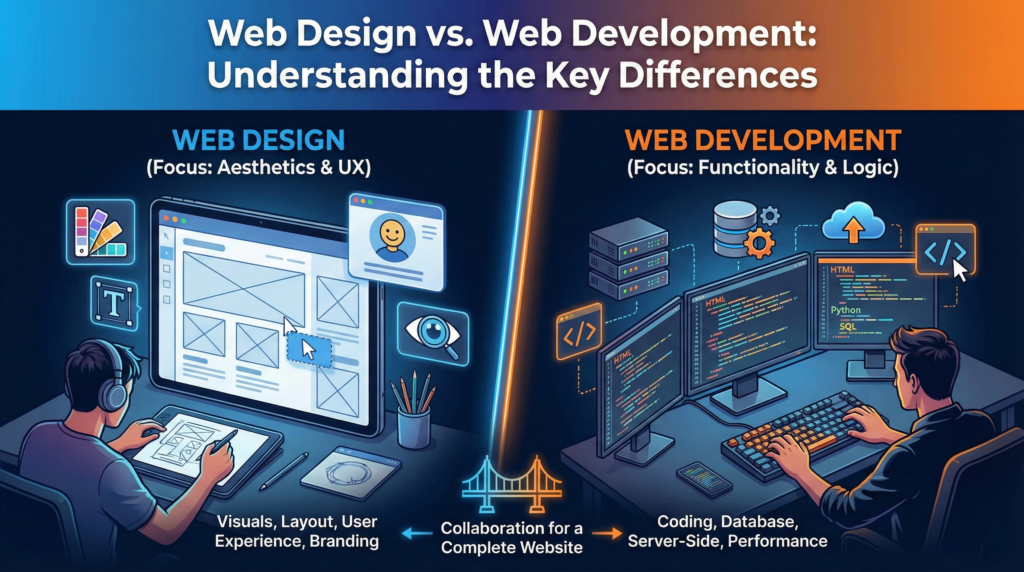
Web design focuses on the visual appearance, user experience (UX), and overall look and feel of a website. It’s about how the website appears to users and how they interact with it.
A web designer is responsible for:
Layout and structure
Color schemes
Typography
Imagery
User interface (UI)
User experience (UX)
Branding consistency
In simple terms, web design is about how the website looks and feels.
Core Elements of Web Design
1. User Interface (UI) Design
UI design focuses on the visual elements users interact with, such as:
Buttons
Navigation menus
Forms
Icons
Interactive elements
A well-designed UI ensures that users can navigate the website easily without confusion.
2. User Experience (UX) Design
UX design is about how users experience the website. It involves:
Logical content structure
Easy navigation
Clear call-to-action buttons
Fast accessibility to information
A great UX keeps visitors engaged and encourages them to take action—whether that’s making a purchase, filling out a form, or contacting your business.
3. Responsive Design
With users accessing websites on desktops, tablets, and smartphones, responsive design ensures your website adapts seamlessly to all screen sizes.
4. Branding & Visual Identity
Web design ensures that your website reflects your brand’s personality through:
Colors
Fonts
Imagery
Tone of visuals
For example, a tech company may use modern minimalistic design, while a luxury brand may opt for elegant typography and high-end visuals.
What Is Web Development?
Web development focuses on the technical side of a website—how it works behind the scenes.
If web design is about how a website looks, web development is about how it functions.
A web developer builds and maintains the structure of a website using programming languages and frameworks.
Types of Web Development
1. Front-End Development
Front-end developers work on the parts of the website users see and interact with.
They use technologies such as:
HTML
CSS
JavaScript
Their job is to turn design mockups into functional, interactive websites.
2. Back-End Development
Back-end development focuses on server-side operations, including:
Databases
Server configuration
Application logic
Security systems
This ensures that when users submit forms, log in, or make purchases, everything works correctly.
3. Full-Stack Development
Full-stack developers handle both front-end and back-end development, providing complete website solutions.
Web Design vs. Web Development: The Key Differences
Let’s break down the core differences clearly.
| Aspect | Web Design | Web Development |
|---|---|---|
| Focus | Visual appearance & user experience | Technical functionality |
| Goal | Make the site attractive & user-friendly | Make the site functional & secure |
| Skills | Creativity, design tools, UX principles | Coding, databases, server management |
| Tools | Figma, Adobe XD, Photoshop | HTML, CSS, JavaScript, PHP, Python |
| Outcome | Design mockups & prototypes | Fully functional website |
In Simple Words:
Web designers create the blueprint and style.
Web developers build the structure and functionality.
Both are equally important.
How Web Design and Web Development Work Together
A successful website requires collaboration between designers and developers.
Step 1: Planning
Understanding business goals, target audience, and required features.
Step 2: Design Phase
Designers create wireframes and visual layouts.
Step 3: Development Phase
Developers transform designs into working code.
Step 4: Testing & Optimization
Ensuring the site works smoothly across all devices and browsers.
Step 5: Launch & Maintenance
Deploying the website and maintaining performance.
Without design, a website may look unattractive and confuse users.
Without development, a website simply cannot function.
Why Businesses Often Confuse the Two
Many business owners believe:
“I just need a website.”
“A designer can build everything.”
“A developer can handle the design too.”
While some professionals can handle both areas, complex projects require specialized skills.
For example:
A beautiful website that loads slowly will lose customers.
A technically perfect website with poor design will fail to engage visitors.
You need both.
Which One Does Your Business Need?
The answer depends on your goals.
You Need Web Design If:
Your website looks outdated
Users leave quickly
You want a brand refresh
You need better user experience
You Need Web Development If:
Your website has technical issues
Pages load slowly
Forms don’t work properly
You want advanced features (eCommerce, membership systems, CRM integration)
You Need Both If:
You’re launching a new website
You’re scaling your business globally
You want better performance and higher conversions
For companies planning to start with platforms like WordPress to reduce costs and scale later into mobile apps, combining strong design with solid development is the smartest long-term strategy.
The Business Impact of Web Design and Development
1. Increased Credibility
A professional website builds trust instantly.
2. Higher Conversions
Optimized UX + smooth functionality = more leads and sales.
3. Better SEO Performance
Search engines prioritize:
Mobile-friendly design
Fast loading speed
Secure infrastructure
Both design and development influence SEO success.
4. Competitive Advantage
A well-built website positions your business ahead of competitors with outdated platforms.
Common Mistakes Businesses Make
❌ Choosing Price Over Quality
Cheap services often lead to poor design or buggy development.
❌ Ignoring Mobile Optimization
Mobile-first design is no longer optional.
❌ Neglecting Performance
Slow websites increase bounce rates.
❌ Skipping Ongoing Maintenance
Websites require updates and security monitoring.
The Future of Web Design and Development in 2026
The digital landscape continues to evolve rapidly. Key trends include:
AI-powered personalization
Voice search optimization
Progressive Web Apps (PWAs)
Advanced security protocols
Faster performance standards
Businesses must adapt to stay competitive.
Why Professional Expertise Matters
Hiring experienced professionals ensures:
Strategic planning
SEO-optimized structure
Secure coding practices
Responsive design
Scalable architecture
A professional team understands how to align design and development with business goals—not just create a website, but build a digital growth engine.
Final Thoughts
Understanding the difference between web design and web development empowers you to make informed decisions.
To summarize:
Web design focuses on aesthetics and user experience.
Web development focuses on functionality and technical performance.
Both are essential for building a successful website.
In a competitive digital world, your website is more than an online brochure—it’s your most powerful marketing tool.
Investing in professional web design and web development ensures your business stands out, performs efficiently, and converts visitors into loyal customers.
If you’re planning to launch a new website or upgrade your existing one, now is the time to focus on both design excellence and technical strength.
Because a great website doesn’t just look good—it works flawlessly. 🚀