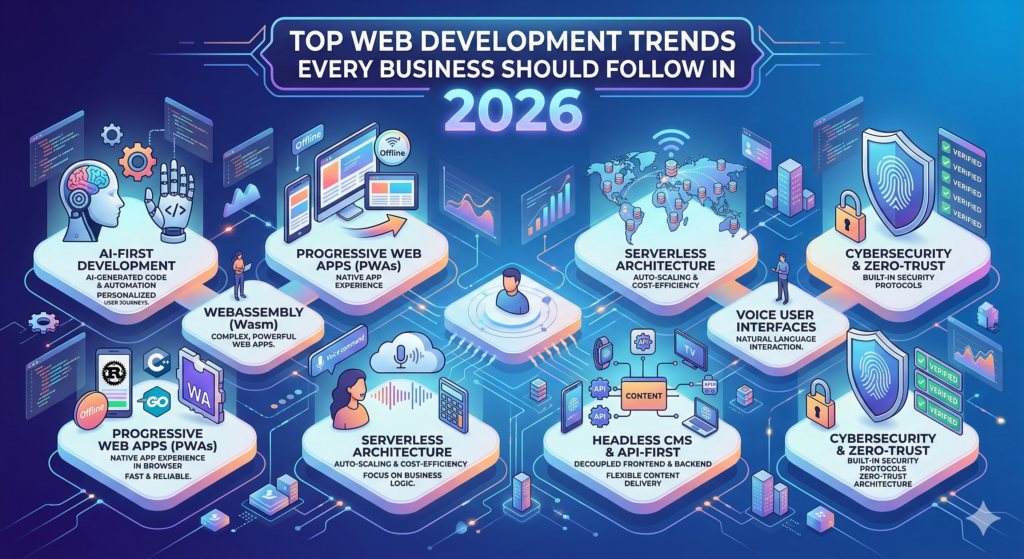
Top Web Development Trends Every Business Should Follow in 2026
Introduction
The digital landscape is evolving faster than ever, and in 2026, web development is no longer just about building websites—it’s about creating intelligent, high-performance, and user-centric digital experiences. Businesses that fail to adapt to modern web development trends risk falling behind competitors who are leveraging advanced technologies to deliver seamless online interactions.
Thank you for reading this post, don't forget to subscribe!From artificial intelligence to serverless architectures, the way websites are built, deployed, and optimized has transformed dramatically. Today’s users expect speed, personalization, security, and accessibility—and businesses must meet these expectations to succeed.
In this blog, we will explore the top web development trends every business should follow in 2026, and how adopting these trends can drive growth, improve customer experience, and boost conversions.
1. AI-Powered Web Development
Artificial Intelligence (AI) has become a cornerstone of modern web development. Developers are no longer writing every line of code manually—AI tools now assist in coding, testing, debugging, and even design.
AI-driven workflows allow developers to build applications faster and with greater efficiency. In fact, studies show that a large percentage of developers experience significant productivity gains when using AI-assisted tools.
How AI Benefits Businesses:
Faster development cycles
Automated customer support (chatbots)
Personalized user experiences
Predictive analytics for better decision-making
AI is also enabling “agentic experiences”, where websites can adapt and respond dynamically to user behavior instead of remaining static.
2. Progressive Web Apps (PWAs)
Progressive Web Apps (PWAs) continue to dominate in 2026 as businesses look for cost-effective alternatives to native mobile apps.
PWAs combine the best features of websites and mobile applications, offering:
Offline functionality
Fast loading speeds
App-like user experience
They eliminate the need for downloading apps from app stores while still providing a seamless mobile experience.
Why PWAs Matter:
With mobile usage dominating online traffic, businesses need solutions that perform flawlessly across all devices. PWAs ensure high performance and improved user retention.
3. Serverless Architecture
Serverless computing is revolutionizing how web applications are built and deployed. Instead of managing servers, developers can focus entirely on writing code while cloud providers handle infrastructure.
Key Benefits:
Reduced operational costs
Automatic scalability
Faster deployment
Improved performance
Serverless architecture is particularly beneficial for startups and growing businesses looking to scale quickly without heavy infrastructure investments.
4. Edge Computing for Faster Performance
Speed is a critical factor in user experience. Even a one-second delay in page load time can significantly reduce conversions.
Edge computing solves this problem by processing data closer to the user rather than relying on centralized servers. This results in:
Faster loading times
Reduced latency
Better real-time performance
In 2026, edge computing is becoming a default approach for modern web applications.
5. Full-Stack and Meta Frameworks
Frameworks like Next.js and Nuxt are now leading the development ecosystem, enabling developers to build full-stack applications efficiently.
These frameworks:
Simplify development processes
Improve SEO performance
Offer built-in optimization features
Meta-frameworks are quickly becoming the standard for modern web development.
6. API-First Development
API-first development is another major trend shaping the future of web development.
Instead of building applications as a single unit, developers create APIs first and then connect various components like:
Frontend interfaces
Mobile apps
Third-party services
Advantages:
Flexibility and scalability
Easier integration
Faster development cycles
This approach is especially important for businesses that operate across multiple platforms.
7. Component-Based Architecture
Modern web development is moving towards reusable, modular components. This approach allows developers to build applications using smaller, independent units.
Benefits:
Faster development
Improved code maintainability
Consistent design systems
Component-driven layouts are now a key part of modern UI development strategies.
8. Enhanced Web Security
With the rise of cyber threats, security has become a top priority in web development.
In 2026, businesses are focusing on:
Zero-trust security models
Secure authentication systems
Data encryption
Poor security can lead to data breaches, financial losses, and damage to brand reputation. Therefore, investing in secure web development practices is essential.
9. Accessibility and Inclusive Design
Web accessibility is no longer optional—it is becoming a legal and ethical requirement.
New tools and frameworks are helping developers create websites that are accessible to everyone, including users with disabilities.
Key Features:
Keyboard navigation
Screen reader compatibility
Improved color contrast
Companies that prioritize accessibility not only comply with regulations but also expand their audience reach.
10. Advanced UI/UX and Motion Design
User experience (UX) plays a crucial role in the success of a website. In 2026, web design is shifting toward:
Interactive animations
Motion design
Personalized interfaces
Modern design trends focus on creating engaging and visually appealing experiences that keep users on the site longer.
Functional motion design is becoming increasingly popular, enhancing usability while maintaining performance.
11. Voice Search and Conversational Interfaces
With the growing popularity of voice assistants, voice search optimization is becoming essential.
Websites are now integrating:
Voice search functionality
Conversational interfaces
AI-powered assistants
This trend improves accessibility and enhances user experience, especially for mobile users.
12. Cloud-Based and Scalable Solutions
Cloud computing continues to dominate web development in 2026.
Businesses are shifting to cloud-based solutions because they offer:
Scalability
Flexibility
Cost efficiency
Cloud platforms allow businesses to handle large amounts of data and traffic without compromising performance.
13. Immersive Experiences (AR/VR Integration)
Augmented Reality (AR) and Virtual Reality (VR) are transforming how users interact with websites.
These technologies are especially useful in:
E-commerce (virtual product previews)
Real estate (virtual tours)
Education (interactive learning)
Modern web development is increasingly incorporating immersive experiences to enhance engagement.
14. Performance Optimization and Core Web Vitals
Performance remains a top priority in 2026.
Google’s Core Web Vitals continue to influence search rankings, making it essential for businesses to optimize:
Page speed
Responsiveness
Visual stability
Optimized websites not only rank higher in search engines but also provide better user experiences.
15. Rise of “Smart” and Personalized Websites
Websites are becoming smarter and more personalized.
AI-driven personalization allows websites to:
Recommend products
Adjust content dynamically
Improve user engagement
Modern websites can now adapt in real time based on user behavior, creating a highly customized experience.
Why These Trends Matter for Your Business
Adopting modern web development trends is not just about staying current—it’s about staying competitive.
Businesses that embrace these trends can:
Improve customer satisfaction
Increase conversions
Enhance brand credibility
Gain a competitive advantage
On the other hand, outdated websites can lead to poor user experiences and lost opportunities.
How ByteBrew Technologies Can Help
At ByteBrew Technologies, we specialize in building modern, scalable, and high-performance web solutions tailored to your business needs.
Our team stays ahead of the latest trends to deliver:
Custom web development solutions
AI-powered applications
Mobile-responsive designs
Secure and scalable systems
Whether you are a startup or an established enterprise, adopting the right web development strategies can transform your digital presence.
Conclusion
Web development in 2026 is defined by innovation, speed, and intelligence. From AI-powered tools to immersive user experiences, businesses must adapt to these trends to remain competitive in an increasingly digital world.
The future of web development is not just about technology—it’s about creating meaningful experiences that connect businesses with their audiences.
By embracing these trends, businesses can unlock new opportunities, drive growth, and stay ahead in the ever-evolving digital landscape.
Final Thoughts
The key to success in 2026 is not just following trends but implementing them strategically. Businesses that invest in modern web development will be better positioned to thrive in the digital era.