
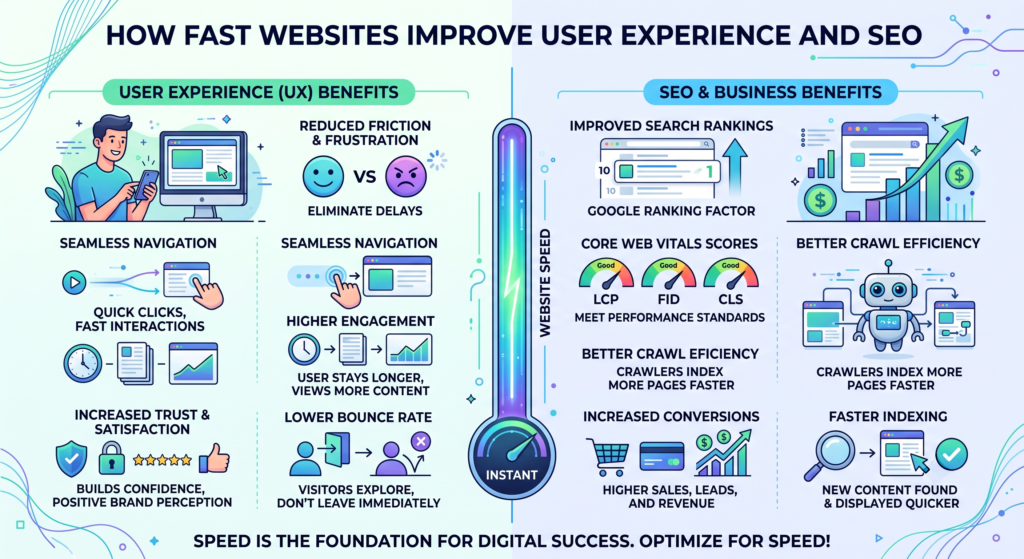
How Fast Websites Improve User Experience and SEO
Thank you for reading this post, don't forget to subscribe!Introduction
In today’s digital world, speed is no longer a luxury—it’s an expectation. Whether visitors are shopping online, reading a blog, or looking for professional services, they expect websites to load instantly. Research consistently shows that users abandon websites that take more than a few seconds to load, making website speed one of the most important factors for online success.
At ByteBrew Technologies, we understand that a fast website is the foundation of exceptional user experience and long-term search engine success. Our team develops high-performance websites that not only look modern but also deliver outstanding speed, helping businesses attract more visitors, improve engagement, and achieve higher search engine rankings.
This article explores why website speed matters, how it affects user experience and SEO, and what businesses can do to optimize their websites for maximum performance.
What Is Website Speed?
Website speed refers to how quickly a webpage loads and becomes fully interactive for visitors. It includes several performance measurements, such as:
- Initial page load time
- Time until users can interact with the page
- Image loading speed
- Server response time
- Overall website responsiveness
A high-performing website loads quickly on desktops, tablets, and smartphones regardless of internet speed.
Why Website Speed Matters
Visitors form an opinion about your website within seconds. If your pages load slowly, potential customers may leave before viewing your products or services.
A fast website creates a positive first impression by providing:
- Instant access to information
- Smooth navigation
- Better usability
- Increased trust
- Professional credibility
In today’s competitive online marketplace, speed directly influences customer satisfaction.
Website Speed and User Experience
- Faster Loading Creates Better First Impressions
First impressions matter online.
When users click on your website, they expect immediate access to content. Every additional second of loading increases frustration and decreases the likelihood of engagement.
Fast websites instantly communicate professionalism and reliability.
- Lower Bounce Rate
Bounce rate refers to visitors leaving your website without interacting.
Slow websites often experience high bounce rates because users simply don’t wait.
Fast websites encourage users to:
- Explore additional pages
- Read blog posts
- View products
- Contact your business
- Complete purchases
The longer visitors stay, the greater the opportunity to convert them into customers.
- Better Mobile Experience
More than half of internet traffic now comes from mobile devices.
Mobile users often browse using slower internet connections than desktop users. Fast-loading websites provide a seamless experience regardless of device.
Mobile optimization includes:
- Responsive layouts
- Compressed images
- Lightweight code
- Efficient loading techniques
A fast mobile experience leads to happier users and better business results.
- Higher Customer Satisfaction
Website visitors appreciate convenience.
When pages load instantly, customers feel confident using your website, increasing the chances they will:
- Return later
- Recommend your business
- Make purchases
- Submit inquiries
Satisfied visitors often become loyal customers.
- Improved Accessibility
Performance improvements benefit everyone, including users with:
- Older smartphones
- Limited internet connections
- Rural internet services
- Low-bandwidth networks
A fast website ensures your business remains accessible to the widest possible audience.
How Website Speed Impacts SEO
Search Engine Optimization (SEO) helps websites appear higher in search engine results.
Website speed has become an important ranking factor because search engines prioritize websites that deliver excellent user experiences.
- Google Uses Page Speed as a Ranking Signal
Google aims to deliver the best possible results to users.
Fast websites provide better experiences, making them more likely to rank above slower competitors.
Although content quality remains essential, performance significantly contributes to overall rankings.
- Core Web Vitals
Google introduced Core Web Vitals to measure website performance and user experience.
These metrics evaluate:
Largest Contentful Paint (LCP)
Measures how quickly the main content becomes visible.
Ideal:
Less than 2.5 seconds
Interaction to Next Paint (INP)
Measures responsiveness after user interaction.
Lower interaction delays create smoother browsing.
Cumulative Layout Shift (CLS)
Measures visual stability.
Pages that don’t unexpectedly shift while loading provide a much better user experience.
Improving these metrics helps websites achieve stronger SEO performance.
- Better Crawl Efficiency
Search engines use automated bots to crawl websites.
Fast-loading websites allow search engines to:
- Crawl more pages
- Index content faster
- Update search results efficiently
Slow websites may prevent complete indexing.
- Increased Organic Traffic
Higher rankings naturally generate more visitors.
When websites combine:
- Quality content
- Strong SEO
- Fast loading
- Mobile optimization
They attract significantly more organic traffic over time.
Website Speed and Conversion Rates
Website speed directly influences sales and lead generation.
Studies consistently show that even one-second improvements can increase conversion rates.
Fast websites encourage visitors to:
- Buy products
- Fill out contact forms
- Book consultations
- Subscribe to newsletters
- Request quotations
Every second saved can positively impact revenue.
Common Causes of Slow Websites
Many websites become slow because of avoidable technical issues.
Common causes include:
Large Images
Uploading oversized images dramatically increases loading times.
Images should always be optimized before publishing.
Poor Web Hosting
Cheap hosting often results in slower server response times.
Reliable hosting provides better performance and stability.
Excessive Plugins
Installing unnecessary plugins increases website complexity.
Businesses should only keep plugins that provide real value.
Unoptimized Code
Large CSS and JavaScript files increase page size.
Removing unnecessary code improves loading speed.
Too Many HTTP Requests
Each webpage requests files such as:
- Images
- Fonts
- Scripts
- Stylesheets
Reducing unnecessary requests improves performance.
Best Practices for Faster Websites
Businesses can improve website speed using several proven strategies.
Optimize Images
Use modern image formats.
Compress images without sacrificing quality.
Enable Browser Caching
Caching stores website resources on visitors’ devices.
Returning visitors experience much faster loading.
Use Content Delivery Networks (CDNs)
CDNs distribute website files across global servers.
Visitors receive content from the nearest location, reducing loading time.
Minify CSS and JavaScript
Removing unnecessary spaces and code reduces file sizes.
Smaller files load much faster.
Choose High-Performance Hosting
Investing in quality hosting provides:
- Faster servers
- Better uptime
- Improved reliability
- Enhanced security
Implement Lazy Loading
Load images only when users scroll to them.
This significantly improves initial page speed.
Regular Performance Testing
Website performance should be monitored regularly using industry-standard testing tools.
Continuous optimization keeps websites competitive.
Benefits of a Fast Website
Businesses investing in website performance enjoy numerous long-term benefits:
- Better search engine rankings
- Increased website traffic
- Lower bounce rates
- Higher conversion rates
- Improved customer satisfaction
- Stronger online reputation
- Better mobile usability
- Higher return on investment
- Increased lead generation
- Improved business growth
Website speed is not just a technical improvement—it is a strategic business investment.
How ByteBrew Technologies Builds High-Speed Websites
At ByteBrew Technologies, speed optimization is integrated into every stage of website development.
Our development process includes:
- Clean and optimized coding practices
- Responsive website development
- Image optimization
- Advanced caching implementation
- Core Web Vitals optimization
- Mobile-first development
- SEO-friendly architecture
- Performance monitoring
- Secure and scalable hosting recommendations
- Ongoing website maintenance and optimization
Our goal is to deliver websites that provide outstanding user experiences while achieving excellent search engine visibility.
Conclusion
Website speed has become one of the most critical factors influencing online success. Visitors expect fast, responsive, and reliable websites, while search engines reward businesses that deliver exceptional user experiences.
A high-performance website not only improves SEO rankings but also increases customer satisfaction, reduces bounce rates, boosts conversions, and strengthens your brand’s credibility.
At ByteBrew Technologies, we specialize in developing fast, secure, and SEO-optimized websites that help businesses grow in today’s competitive digital landscape. Whether you’re launching a new website or improving an existing one, investing in speed optimization is one of the smartest decisions you can make for your business.
The faster your website performs, the greater your opportunities to attract visitors, engage customers, and achieve sustainable online growth.