Introduction
In today’s fast-paced digital economy, businesses must constantly adapt to changing technologies, customer expectations, and competitive pressures. Companies that fail to evolve often struggle to maintain relevance in the marketplace, while those that embrace digital innovation gain a clear advantage. Technology has become a key driver of efficiency, productivity, and customer satisfaction, making it an essential component of modern business success.
Thank you for reading this post, don't forget to subscribe!One of the most effective ways organizations can stay competitive is by investing in custom software solutions. Unlike generic software products designed for mass usage, custom software is specifically developed to meet the unique needs of a particular business. These tailored solutions allow organizations to streamline operations, improve productivity, and deliver better customer experiences.
Professional development firms like ByteBrew Technologies specialize in building customized digital solutions that align with a company’s specific goals and operational requirements. By leveraging custom software, businesses can enhance efficiency, strengthen security, and create innovative systems that support long-term growth.
This article explores how custom software solutions help businesses stay competitive and why investing in tailored technology can be a game-changing decision.
Understanding Custom Software Solutions
Custom software solutions are applications designed and developed to meet the specific needs of a business or organization. Instead of using standardized tools that may not fully align with operational requirements, companies can build systems that perfectly fit their workflows.
These solutions can include:
Customer Relationship Management (CRM) systems
Enterprise Resource Planning (ERP) software
Inventory and supply chain management tools
E-commerce platforms
Mobile applications
Data analytics and reporting systems
Automation tools for internal processes
Unlike off-the-shelf software, custom solutions allow businesses to control functionality, design, and scalability. This flexibility ensures that the technology supports the company’s goals rather than forcing the company to adapt to the software.
The Competitive Advantages of Custom Software
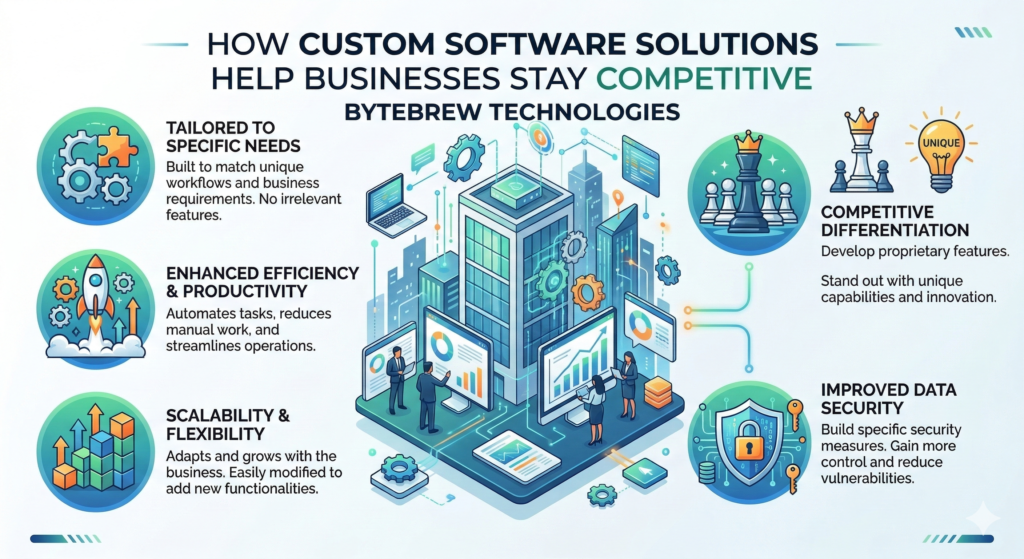
1. Tailored Solutions for Unique Business Needs
Every business operates differently, with its own processes, strategies, and objectives. Generic software products often include unnecessary features while lacking critical tools that a company may require.
Custom software solves this problem by providing a solution designed specifically for the organization. Businesses can include features that directly support their operations, making the software far more efficient and relevant.
For example, a logistics company may require real-time shipment tracking, route optimization, and automated delivery updates. A custom-built system can combine these functionalities into a single platform, improving efficiency and reducing operational complexity.
2. Improved Efficiency and Workflow Automation
Efficiency is a key factor in maintaining competitiveness. Custom software solutions allow businesses to automate repetitive tasks and streamline workflows, enabling employees to focus on more strategic activities.
Automation can help organizations:
Reduce manual errors
Save time on repetitive tasks
Improve communication between departments
Increase overall productivity
For instance, automated billing systems can generate invoices instantly, reducing administrative workload while ensuring accurate financial records.
3. Scalability to Support Business Growth
As businesses expand, their operational needs change. Off-the-shelf software may struggle to accommodate new features, increased users, or growing data volumes.
Custom software solutions are designed with scalability in mind. Developers can easily add new modules, upgrade features, or integrate additional systems as the business grows.
This flexibility allows companies to scale without needing to replace their entire technology infrastructure, saving both time and money in the long run.
4. Enhanced Customer Experience
Customer experience plays a major role in building brand loyalty and maintaining a competitive edge. Businesses that deliver seamless digital interactions are more likely to attract and retain customers.
Custom software allows organizations to create personalized customer experiences by implementing features such as:
Personalized product recommendations
Faster and more efficient customer support systems
Simplified purchasing processes
User-friendly mobile applications
By tailoring digital services to meet customer expectations, businesses can build stronger relationships with their audience.
5. Better Data Management and Business Insights
Data-driven decision-making is essential for modern businesses. Companies that effectively analyze data can identify market trends, improve strategies, and optimize performance.
Custom software solutions can include advanced analytics tools that collect and process data relevant to the organization’s operations. These insights help businesses understand:
Customer behavior and preferences
Sales performance
Marketing effectiveness
Operational efficiency
With accurate and real-time insights, businesses can make informed decisions that enhance their competitive advantage.
6. Stronger Security and Data Protection
Cybersecurity has become a major concern for businesses of all sizes. Data breaches and cyberattacks can lead to financial losses, reputational damage, and legal complications.
Custom software solutions offer enhanced security because they are specifically designed for a company’s internal systems. Unlike widely used software, which may be targeted by hackers due to its popularity, custom-built systems provide a more secure environment.
Security features may include:
Data encryption
Multi-factor authentication
Custom access controls
Secure APIs and integrations
These measures help protect sensitive business and customer information.
7. Seamless Integration with Existing Systems
Many businesses use multiple digital tools to manage operations, including accounting software, marketing platforms, and communication systems. Integrating these tools can sometimes be difficult when using generic software.
Custom software solutions can be designed to integrate seamlessly with existing systems, ensuring smooth data exchange between platforms. This improves workflow efficiency and eliminates the need for manual data transfers.
For example, a custom CRM system can integrate with email marketing platforms, payment gateways, and analytics tools to create a unified business ecosystem.
8. Long-Term Cost Efficiency
Although custom software development may involve a higher initial investment, it often proves more cost-effective over time.
Off-the-shelf software typically requires ongoing subscription fees, licensing costs, and additional payments for upgrades or advanced features. Businesses may also need multiple software tools to manage different functions.
Custom software consolidates these functions into a single tailored solution, reducing dependency on multiple subscriptions and minimizing long-term operational expenses.
The Role of Professional Software Development Companies
Developing high-quality custom software requires expertise in technology, design, and business strategy. Professional software development companies play a crucial role in helping organizations build reliable digital solutions.
Companies such as ByteBrew Technologies provide end-to-end development services, ensuring that businesses receive software solutions tailored to their needs.
The development process typically involves several stages:
1. Requirement Analysis
Understanding the business’s goals, challenges, and operational requirements.
2. Strategic Planning
Designing a solution that aligns with long-term objectives.
3. Development and Coding
Building the software using modern programming languages and frameworks.
4. Testing and Quality Assurance
Ensuring the system performs reliably and meets performance standards.
5. Deployment and Integration
Implementing the software within the business environment.
6. Ongoing Support and Maintenance
Providing updates, improvements, and technical support as the business evolves.
By working with experienced development professionals, companies can ensure that their software solutions remain reliable, scalable, and future-ready.
Industries Benefiting from Custom Software
Custom software solutions provide value across many industries, including:
Healthcare
Custom platforms help manage patient records, schedule appointments, and improve communication between healthcare providers.
Retail and E-commerce
Retail businesses use custom solutions for inventory management, online stores, and customer analytics.
Finance
Financial institutions rely on secure custom software for transactions, fraud detection, and regulatory compliance.
Education
Educational organizations use custom learning management systems to enhance digital learning experiences.
Logistics and Transportation
Custom software helps manage supply chains, optimize delivery routes, and track shipments in real time.
These industry-specific solutions enable organizations to operate more efficiently while delivering better services to their customers.
Future Trends in Custom Software Development
The future of custom software development is closely tied to emerging technologies that are reshaping industries worldwide.
Artificial Intelligence and Machine Learning
AI-powered systems can automate processes, analyze large datasets, and generate predictive insights.
Cloud Computing
Cloud-based platforms allow businesses to access their systems from anywhere while ensuring secure data storage and scalability.
Internet of Things (IoT)
IoT technology enables devices to communicate with each other, providing real-time operational insights.
Mobile-First Development
With increasing smartphone usage, businesses are investing more in mobile applications to connect with customers.
Companies that adopt these technologies through custom software solutions will remain ahead of the competition.
Conclusion
In today’s competitive business environment, technology plays a crucial role in shaping success. Organizations that rely solely on generic software solutions often struggle to adapt to evolving market demands. Custom software solutions provide the flexibility, efficiency, and innovation required to maintain a competitive edge.
By investing in tailored digital systems, businesses can streamline operations, improve customer experiences, strengthen security, and gain valuable insights through data analytics. These advantages enable companies to respond quickly to market changes and seize new opportunities.
Professional development companies like ByteBrew Technologies help businesses transform their ideas into powerful software solutions that support long-term growth. Through strategic planning, advanced technologies, and expert development, custom software empowers organizations to thrive in the modern digital landscape.
As digital transformation continues to accelerate, businesses that embrace custom software solutions will be better equipped to innovate, expand, and remain competitive in the years ahead.