
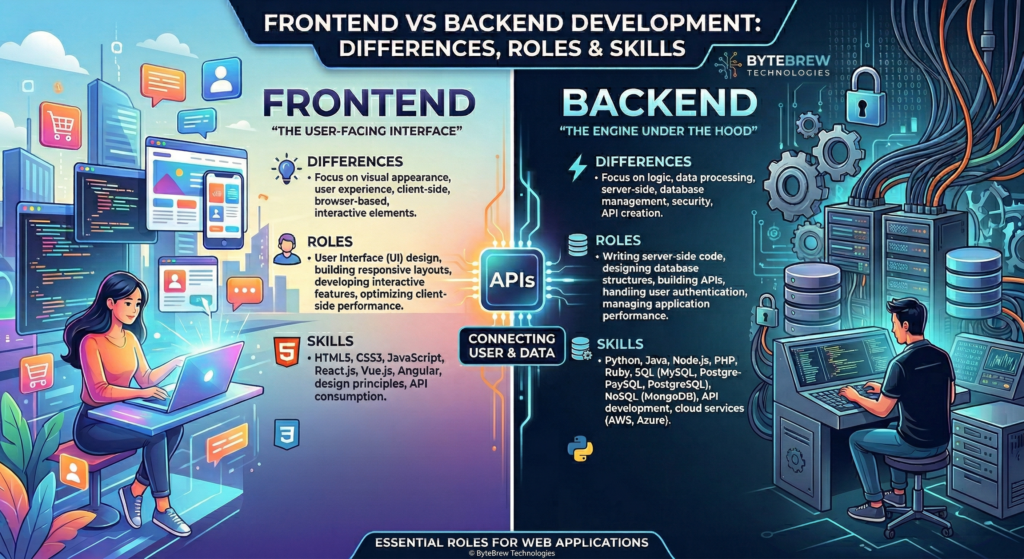
Introduction
Thank you for reading this post, don't forget to subscribe!In today’s digital-first world, every website, web application, and software product relies on two fundamental pillars: frontend development and backend development. Whether you’re browsing an eCommerce store, using a SaaS platform, or interacting with a mobile app, both frontend and backend work together seamlessly to deliver a smooth user experience.
For business owners, understanding these two aspects is crucial when hiring a software house or planning a digital product. For aspiring developers, knowing the difference helps in choosing the right career path.
This comprehensive guide will break down frontend vs backend development, covering their differences, roles, technologies, skills, and how they work together.
What is Frontend Development?
Frontend development refers to the client-side of a website or application — everything that users see and interact with directly.
Key Responsibilities of Frontend Development
Frontend developers focus on:
- Designing user interfaces (UI)
- Ensuring responsive design (mobile-friendly layouts)
- Improving user experience (UX)
- Optimizing performance and loading speed
- Creating interactive elements like buttons, forms, and animations
Core Technologies Used in Frontend
Frontend development relies on three foundational technologies:
- HTML (HyperText Markup Language)
Structures the content of a webpage - CSS (Cascading Style Sheets)
Controls layout, colors, fonts, and design - JavaScript
Adds interactivity and dynamic behavior
Popular Frontend Frameworks & Libraries
- React.js
- Angular
- Vue.js
- Bootstrap (for UI design)
Example
When a user visits your website (like bbrewtech.com), everything they see — layout, buttons, images, animations — is created by frontend development.
What is Backend Development?
Backend development refers to the server-side of a website or application. It handles the logic, database, and communication between the server and frontend.
Key Responsibilities of Backend Development
Backend developers are responsible for:
- Managing databases
- Writing business logic
- Handling user authentication
- Processing requests from frontend
- Ensuring security and data protection
Core Technologies Used in Backend
- Programming Languages:
- Python
- JavaScript (Node.js)
- PHP
- Java
- C#
- Databases:
- MySQL
- MongoDB
- PostgreSQL
- Server Technologies:
- Apache
- Nginx
Example
When a user fills out a contact form:
- Frontend collects the data
- Backend processes it
- Database stores it
Frontend vs Backend: Key Differences
Feature | Frontend Development | Backend Development |
Focus | User Interface (UI) | Server, Logic, Database |
Visibility | Visible to users | Hidden from users |
Languages | HTML, CSS, JavaScript | Python, Java, PHP, Node.js |
Goal | User experience | Data processing & functionality |
Tools | React, Vue, Angular | Django, Laravel, Express |
How Frontend and Backend Work Together
Frontend and backend are not separate systems — they work together as a complete ecosystem.
Workflow Example:
- User clicks a “Login” button (Frontend)
- Request is sent to the server (Backend)
- Backend verifies user credentials
- Database confirms details
- Response is sent back to frontend
- User gets access or error message
This interaction is usually handled via APIs (Application Programming Interfaces).
Roles and Responsibilities
👨💻 Frontend Developer Role
A frontend developer focuses on:
- Designing UI components
- Ensuring cross-browser compatibility
- Optimizing page speed
- Implementing responsive design
- Enhancing user engagement
👨💻 Backend Developer Role
A backend developer focuses on:
- Writing server-side logic
- Managing databases
- Building APIs
- Ensuring application security
- Handling scalability
Skills Required
Frontend Developer Skills
Technical Skills:
- HTML, CSS, JavaScript
- Frameworks like React or Vue
- Responsive design (Mobile-first approach)
- Version control (Git)
Soft Skills:
- Creativity
- Attention to detail
- UX thinking
Backend Developer Skills
Technical Skills:
- Programming languages (Python, PHP, Node.js)
- Database management
- API development
- Security best practices
Soft Skills:
- Problem-solving
- Logical thinking
- System design understanding
Full Stack Development: The Best of Both Worlds
A full stack developer works on both frontend and backend.
Advantages:
- Handles complete project
- Cost-effective for startups
- Faster development cycle
Technologies Used:
- MERN Stack (MongoDB, Express, React, Node.js)
- LAMP Stack (Linux, Apache, MySQL, PHP)
Which One Should You Choose?
Choose Frontend If:
- You enjoy design and creativity
- You like visual interfaces
- You focus on user experience
Choose Backend If:
- You enjoy logic and problem-solving
- You prefer working with data
- You like system architecture
Business Perspective: Why Both Matter
For businesses, frontend and backend are equally important.
Frontend Benefits:
- Better user engagement
- Higher conversion rates
- Strong brand identity
Backend Benefits:
- Smooth functionality
- Secure data handling
- Scalability for growth
A poorly designed frontend can drive users away, while a weak backend can break your system.
Latest Trends in 2026
Frontend Trends:
- AI-powered UI design
- Progressive Web Apps (PWAs)
- Motion UI and micro-interactions
Backend Trends:
- Serverless architecture
- Cloud computing (AWS, Azure)
- AI-driven automation systems
Common Challenges
Frontend Challenges:
- Cross-browser compatibility
- Performance optimization
- Responsive design issues
Backend Challenges:
- Data security
- Scalability
- API performance
Tools Used by Developers
Frontend Tools:
- VS Code
- Figma (UI/UX design)
- Chrome DevTools
Backend Tools:
- Postman (API testing)
- Docker
- GitHub
Real-World Example
Let’s take an eCommerce website:
Frontend:
- Product pages
- Add to cart button
- Checkout interface
Backend:
- Inventory management
- Payment processing
- Order database
Both are required for a smooth experience.
Cost of Frontend vs Backend Development
Frontend Cost Depends On:
- UI complexity
- Animations
- Responsiveness
Backend Cost Depends On:
- Database size
- API complexity
- Security requirements
For most projects, backend development can be more complex and costly.
Future of Frontend and Backend Development
The future is moving toward:
- AI-driven development
- Low-code and no-code platforms
- Automation in both frontend and backend
However, skilled developers will always be in demand.
Conclusion
Frontend and backend development are the two pillars of modern web applications. While frontend focuses on user experience and design, backend ensures functionality, data processing, and security.
For businesses, investing in both ensures:
- Better performance
- Higher customer satisfaction
- Scalable growth
For developers, choosing between frontend and backend depends on interests, skills, and career goals. Or, you can become a full stack developer and master both.
Final Thoughts
If you’re planning to build a website or SaaS platform, working with an experienced software house like ByteBrew Technologies can help you leverage both frontend and backend expertise to create powerful, scalable solutions.