In modern software development, choosing the right project management methodology can significantly impact the success of a project. Two of the most widely used approaches are Agile and Waterfall. While both have been around for years, the debate continues in 2026: Which methodology works best today?
Thank you for reading this post, don't forget to subscribe!At ByteBrew Technologies, we work with businesses of all sizes to build scalable, high-performance digital solutions. One of the first decisions we help clients make is selecting the right development methodology. In this article, we’ll break down Agile and Waterfall, compare their differences, and help you understand which one suits your project best.
What is Waterfall Methodology?
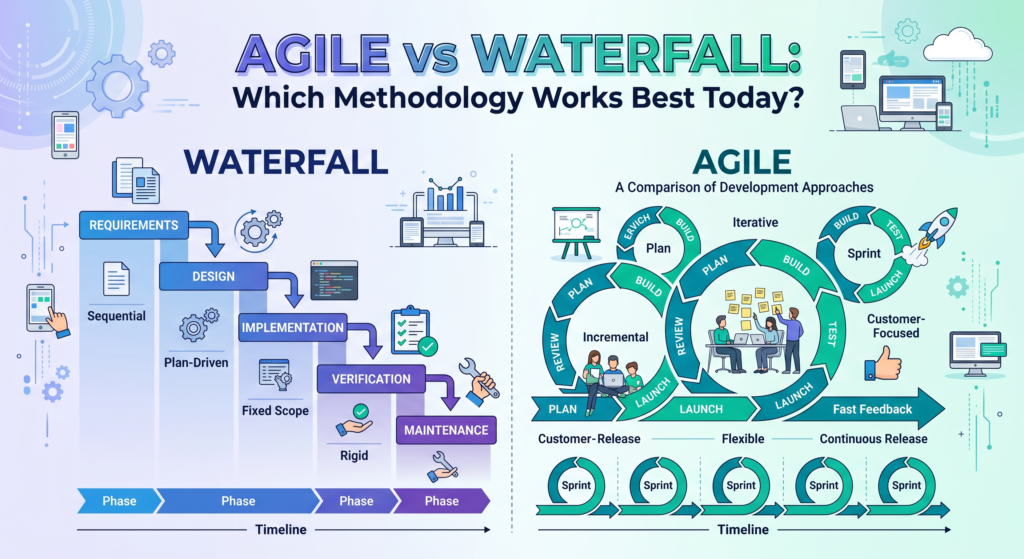
Waterfall is a traditional software development model that follows a linear and sequential process. Each phase must be completed before moving to the next one, making it highly structured and predictable.
Phases of the Waterfall Model:
- Requirement Gathering
- System Design
- Implementation (Coding)
- Testing
- Deployment
- Maintenance
Once a phase is completed, going back to make changes is difficult and often costly.
Key Features of Waterfall:
- Step-by-step development process
- Strong emphasis on documentation
- Clear project scope from the beginning
- Predictable timelines and budgets
Advantages of Waterfall:
- Easy to manage due to structured phases
- Clear documentation for future reference
- Works well for small or fixed-scope projects
- Simple and straightforward workflow
Disadvantages of Waterfall:
- Very rigid and difficult to change once development starts
- Testing occurs late in the cycle
- High risk if initial requirements are incorrect
- Not suitable for fast-changing projects
What is Agile Methodology?
Agile is a modern and flexible approach to software development that focuses on iteration, collaboration, and continuous improvement. Instead of delivering the entire project at once, Agile breaks it into smaller parts called sprints.
Each sprint delivers a functional piece of software that is reviewed and improved based on feedback.
Key Features of Agile:
- Iterative development in short cycles
- Continuous client feedback and collaboration
- Flexible to changes at any stage
- Rapid delivery of working software
Popular Agile Frameworks:
- Scrum
- Kanban
- Extreme Programming (XP)
Advantages of Agile:
- Highly flexible and adaptable
- Faster delivery of features
- Continuous improvement based on feedback
- Better alignment with customer needs
- Lower risk of project failure
Disadvantages of Agile:
- Less predictable cost and timeline
- Requires active client involvement
- Can be challenging for inexperienced teams
- Documentation may be less detailed
Agile vs Waterfall: Key Differences
Let’s compare both methodologies in a simple and clear way:
- Development Approach
- Waterfall: Linear and structured
- Agile: Iterative and flexible
- Flexibility
- Waterfall: Low flexibility
- Agile: High flexibility
- Client Involvement
- Waterfall: Limited after planning stage
- Agile: Continuous involvement throughout
- Testing Process
- Waterfall: After development completion
- Agile: Continuous testing in every sprint
- Delivery Style
- Waterfall: Final product delivered at the end
- Agile: Regular incremental deliveries
- Risk Management
- Waterfall: Higher risk due to late testing
- Agile: Lower risk due to continuous feedback
When Should You Use Waterfall?
Waterfall is best suited for projects where requirements are fixed and unlikely to change.
Ideal Use Cases:
- Government or compliance-based systems
- Infrastructure or industrial software
- Small projects with fixed scope
- Projects with strict documentation requirements
Example:
A payroll system for a corporation with fixed legal and accounting requirements is better suited for Waterfall.
When Should You Use Agile?
Agile is widely used in today’s fast-paced digital world, especially where flexibility and speed matter.
Ideal Use Cases:
- Startups and MVP development
- Mobile and web applications
- SaaS platforms
- E-commerce systems
- Products that evolve based on user feedback
Example:
A food delivery app or social media platform should use Agile due to constant feature updates and user-driven improvements.
Why Agile is More Popular Today
In 2026, businesses operate in a highly competitive and rapidly changing digital environment. Customer expectations evolve quickly, and companies must adapt fast.
Agile is preferred because:
- Faster time-to-market is essential
- User feedback drives product success
- Market conditions change frequently
- Continuous improvement is required for competitiveness
At ByteBrew Technologies, Agile is often our preferred approach because it allows us to deliver faster, adapt quickly, and maintain strong collaboration with clients.
Can Agile and Waterfall Be Combined?
Yes — many organizations now use a Hybrid Model, combining the strengths of both approaches.
How Hybrid Works:
- Planning and requirement gathering follow Waterfall
- Development and testing follow Agile sprints
Benefits of Hybrid Model:
- Balanced structure and flexibility
- Better control over large projects
- Reduced risk with improved adaptability
- Suitable for enterprise-level systems
Common Mistakes When Choosing a Methodology
Businesses often face challenges when they choose the wrong development approach:
- Using Agile without experienced developers
- Applying Waterfall to fast-changing projects
- Lack of client involvement in Agile projects
- Poor communication between teams
- Overcomplicating simple projects
Selecting the wrong methodology can lead to delays, budget overruns, and poor product performance.
Real-World Examples
Waterfall Example:
A banking compliance system where rules are fixed and changes are rare.
Agile Example:
An e-commerce mobile app that regularly updates features based on customer behavior.
So, Which Methodology Works Best Today?
There is no universal answer — but in most modern scenarios:
👉 Agile is the preferred choice in 2026 due to its flexibility, speed, and customer-focused approach.
However:
👉 Waterfall still remains useful for structured, predictable, and compliance-heavy environments.
The right choice depends on:
- Project complexity
- Budget
- Timeline
- Flexibility requirements
- Business goals
Final Thoughts
Both Agile and Waterfall have their strengths. The key is not choosing the most popular method, but selecting the one that best fits your project needs.
If you want fast delivery, continuous improvement, and adaptability — Agile is ideal. If you need strict control, documentation, and fixed requirements — Waterfall is still effective.
At ByteBrew Technologies, we help businesses choose the right development strategy and build scalable digital solutions that align with their goals and growth plans.