Introduction
Thank you for reading this post, don't forget to subscribe!In today’s digital world, every business relies on software to operate efficiently, manage customers, automate tasks, and scale growth. Whether you are running a startup, a small business, or a large enterprise, choosing the right software solution is a critical decision.
One of the most common dilemmas businesses face is:
Should we invest in custom software or use ready-made (off-the-shelf) software?
Both options have advantages and disadvantages. The right choice depends on your business goals, budget, scalability needs, and long-term vision.
In this blog, we will break down both options in detail so you can confidently decide what is best for your business.
What Is Custom Software?
Custom software (also known as tailor-made software) is built specifically for a business based on its unique requirements.
Instead of adapting your business to the software, the software is designed to fit your business.
Key Features of Custom Software:
- Built from scratch according to your needs
- Fully customizable features and design
- Scalable as your business grows
- High level of security and control
- Long-term ownership and flexibility
Companies like ByteBrew Technologies specialize in developing custom software solutions that align with business goals and workflows.
What Is Ready-Made Software?
Ready-made software (also called off-the-shelf software) is a pre-built solution designed for a wide range of users.
Examples include CRM tools, accounting software, and project management platforms.
Key Features of Ready-Made Software:
- Pre-developed and ready to use
- Lower initial cost
- Quick setup and deployment
- Standard features for general use
- Limited customization options
Popular tools like Shopify, QuickBooks, and Trello fall into this category.
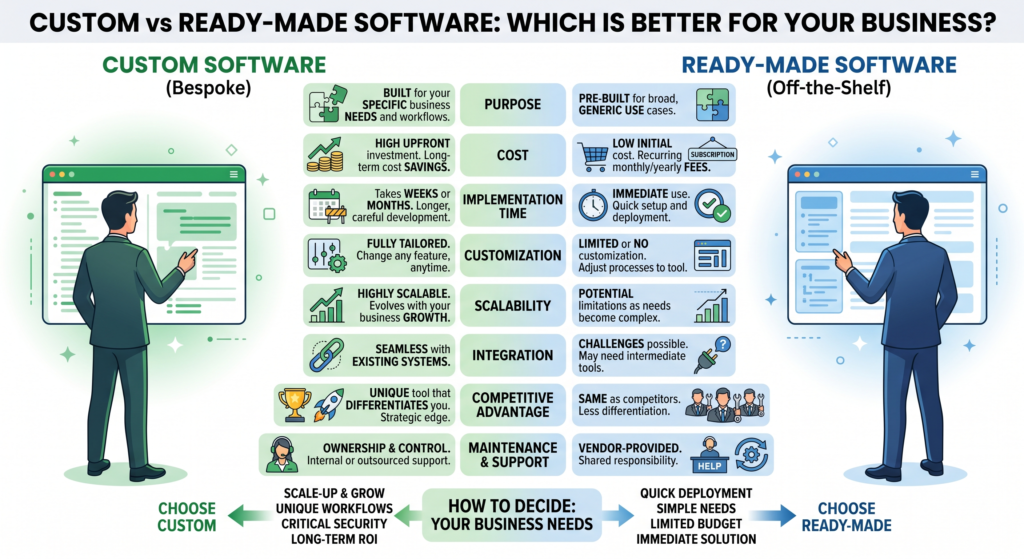
Custom Software vs Ready-Made Software: Key Differences
- Cost Comparison
Custom Software
Custom software requires a higher initial investment because it is built from scratch. However, it becomes cost-effective in the long run since there are no unnecessary subscription fees.
Ready-Made Software
Ready-made solutions are cheaper upfront, often using monthly or yearly subscriptions. But costs can increase over time as your business scales or requires additional features.
Summary:
- Short-term budget → Ready-made software wins
- Long-term investment → Custom software wins
- Flexibility and Customization
Custom Software
Custom software is fully flexible. Every feature, workflow, and design is built according to your business needs.
Ready-Made Software
Off-the-shelf software offers limited customization. You must adjust your business processes to fit the software.
Example:
A logistics company may need custom tracking features that generic software cannot provide.
- Scalability
Custom Software
Custom solutions are designed to grow with your business. You can add new modules, features, and integrations anytime.
Ready-Made Software
Scalability is limited. You may need to upgrade to expensive plans or switch platforms as your business grows.
- Time to Launch
Custom Software
Development takes time—usually weeks or months depending on complexity.
Ready-Made Software
Can be implemented immediately, making it ideal for urgent needs.
Summary:
- Fast launch → Ready-made software
- Long-term strategic system → Custom software
- Security
Custom Software
Custom software provides higher security because it is built specifically for your system, reducing exposure to common vulnerabilities.
Ready-Made Software
Since it is widely used, it can be a common target for cyberattacks.
- Maintenance and Support
Custom Software
Maintenance is handled by the development team or your IT partner. You have full control over updates.
Ready-Made Software
Maintenance is handled by the vendor, but you are dependent on their updates and policies.
- Integration with Other Systems
Custom Software
Easily integrates with internal systems, APIs, and third-party tools based on your requirements.
Ready-Made Software
Limited integration options depending on the platform.
Advantages of Custom Software
Custom software offers several powerful benefits:
- Built for Your Business Needs
Every feature is designed according to your workflow.
- Better Efficiency
Eliminates unnecessary tools and automates business processes.
- Competitive Advantage
Gives your business unique capabilities competitors may not have.
- Long-Term ROI
Although expensive initially, it saves money over time.
- Full Ownership
You own the software and control its future development.
Advantages of Ready-Made Software
Ready-made solutions also have strong advantages:
- Low Initial Cost
Perfect for startups with limited budgets.
- Quick Deployment
Start using immediately without development time.
- Proven Reliability
Widely tested by thousands of users.
- Regular Updates
Automatic updates from the vendor.
Disadvantages of Custom Software
Despite its benefits, custom software has some challenges:
- High upfront development cost
- Longer development time
- Requires technical expertise
- Maintenance responsibility lies with the business or developer
Disadvantages of Ready-Made Software
Off-the-shelf solutions also have limitations:
- Limited customization
- Subscription costs increase over time
- Not tailored to unique business needs
- Potential security risks due to wide usage
- Dependency on vendor policies
When Should You Choose Custom Software?
Custom software is the best choice if:
- Your business has unique workflows
- You need high scalability
- You want long-term ROI
- You require strong security
- You want full control over features
Businesses working with companies like ByteBrew Technologies often choose custom solutions to build scalable digital products.
When Should You Choose Ready-Made Software?
Ready-made software is ideal if:
- You have a limited budget
- You need a quick solution
- Your requirements are simple
- You are a startup testing an idea
- You do not need deep customization
Real-World Example
Imagine two businesses:
Business A (E-commerce Startup)
They use Shopify (ready-made software).
- Quick setup
- Low cost
- Limited customization
Business B (Large Logistics Company)
They build a custom tracking system.
- Fully customized routes and tracking
- Integrated inventory system
- Scalable architecture
Both are correct choices depending on needs.
Future of Business Software in 2026
The future is moving toward hybrid solutions:
- AI-powered automation
- Cloud-based systems
- Custom integrations with SaaS tools
- Microservices architecture
Businesses will increasingly combine both custom and ready-made solutions for maximum efficiency.
Final Verdict: Which Is Better?
There is no universal winner.
- If you want speed and affordability → choose ready-made software
- If you want growth, scalability, and control → choose custom software
For serious long-term business growth, custom software usually provides better ROI and flexibility.
Conclusion
Choosing between custom and ready-made software is a strategic decision that directly impacts your business success.
Ready-made software is perfect for quick solutions, but custom software is built for businesses that want to scale, innovate, and dominate their industry.
If you are planning to build a powerful digital system tailored to your business, working with a professional development company like ByteBrew Technologies can help you turn your ideas into scalable, high-performance software solutions.