In today’s highly competitive digital world, businesses are constantly searching for smarter ways to improve productivity, streamline operations, and enhance customer relationships. One of the most powerful tools helping companies achieve these goals is Custom CRM Software. CRM, which stands for Customer Relationship Management, has become an essential part of modern business operations. However, while many companies use ready-made CRM platforms, businesses that want flexibility, scalability, and long-term growth are increasingly investing in custom CRM solutions.
Thank you for reading this post, don't forget to subscribe!Custom CRM software not only helps businesses manage customer interactions but also plays a major role in business automation. From automating repetitive tasks to improving team collaboration and customer engagement, a custom CRM system can transform the way an organization operates.
This article explains why custom CRM software is important for business automation, its key benefits, features, implementation strategies, and how it helps businesses grow efficiently in the digital era.
What Is Custom CRM Software?
Custom CRM software is a personalized customer relationship management system designed specifically according to a company’s unique business requirements. Unlike generic CRM platforms that provide standard features for all industries, custom CRM software is built to match the workflows, goals, and operational processes of a particular business.
A custom CRM solution can include features such as:
- Customer data management
- Sales automation
- Lead tracking
- Marketing automation
- Workflow management
- Reporting and analytics
- Customer support integration
- Employee collaboration tools
The primary purpose of custom CRM software is to centralize customer-related information while automating routine business processes to improve efficiency and productivity.
The Growing Importance of Business Automation
Business automation refers to the use of technology to automate repetitive tasks and business operations with minimal human involvement. Companies are rapidly adopting automation to save time, reduce operational costs, and increase accuracy.
Modern businesses deal with thousands of customer interactions daily through emails, calls, websites, social media, and messaging platforms. Managing these interactions manually can lead to inefficiency, delays, and missed opportunities.
This is where custom CRM software becomes extremely valuable.
A well-designed CRM system automates multiple business activities, including:
- Customer communication
- Lead management
- Sales follow-ups
- Appointment scheduling
- Invoice generation
- Employee task assignment
- Reporting and performance tracking
Automation allows businesses to focus more on strategic growth rather than repetitive administrative tasks.
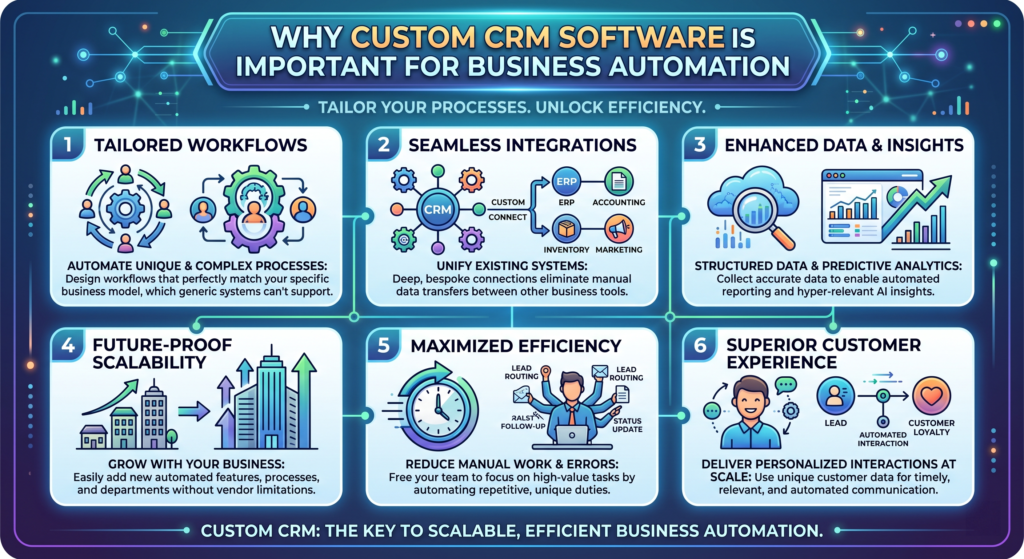
Why Custom CRM Software Is Important for Business Automation
- Personalized Business Workflow Automation
Every business operates differently. Generic CRM platforms may not fully support unique workflows, which often forces businesses to adjust their operations according to the software.
Custom CRM software eliminates this issue by allowing businesses to automate workflows based on their exact requirements.
For example:
- A real estate company can automate property inquiries and appointment scheduling.
- A healthcare clinic can automate patient record management and appointment reminders.
- An eCommerce business can automate order processing and customer support tickets.
This level of customization increases efficiency and ensures smoother business operations.
- Improved Customer Relationship Management
Customers expect fast responses, personalized experiences, and efficient communication. A custom CRM system helps businesses manage customer relationships more effectively by storing all customer information in one centralized location.
Businesses can track:
- Customer purchase history
- Communication records
- Preferences and behavior
- Support requests
- Sales interactions
With automation, businesses can send personalized emails, reminders, offers, and follow-up messages automatically, improving customer satisfaction and retention.
- Increased Productivity and Efficiency
One of the biggest benefits of custom CRM software is increased operational efficiency.
Employees often spend significant time on repetitive tasks such as:
- Data entry
- Manual reporting
- Email follow-ups
- Appointment scheduling
- Task management
Automation reduces manual workload and allows employees to focus on more valuable business activities.
For example:
- Sales teams can automate lead nurturing.
- Marketing teams can automate campaigns.
- HR departments can automate employee management tasks.
This improves overall productivity across the organization.
- Better Sales Management
Sales automation is one of the core functions of CRM software.
A custom CRM system helps sales teams by:
- Tracking leads automatically
- Managing sales pipelines
- Scheduling follow-ups
- Sending automated reminders
- Generating sales reports
Sales representatives can prioritize high-value leads and close deals faster with real-time customer insights.
Businesses can also identify sales trends and improve decision-making using CRM analytics.
- Enhanced Data Management and Centralization
Data is one of the most valuable assets for any business. Managing customer data across spreadsheets, emails, and different platforms can create confusion and inefficiency.
Custom CRM software centralizes all data into a single secure system.
Benefits include:
- Easy access to customer information
- Better data organization
- Improved collaboration between departments
- Reduced data duplication
- Higher data accuracy
Centralized data management also improves reporting and strategic planning.
- Better Team Collaboration
Departments such as sales, marketing, customer support, and management often need to collaborate closely.
Custom CRM software improves communication and teamwork by providing shared access to customer information and task management systems.
Employees can:
- Assign tasks
- Share updates
- Monitor progress
- Track project status
This improves coordination and ensures everyone works toward common business goals.
- Scalability for Future Business Growth
As businesses grow, their operational needs become more complex.
Ready-made CRM platforms may eventually become restrictive due to limited customization options. Custom CRM software, however, is designed to scale alongside the business.
Companies can add new features, integrations, and automation capabilities whenever required.
This makes custom CRM solutions a long-term investment for growing businesses.
Key Features of Custom CRM Software
Customer Data Management
Stores customer information securely, including contact details, purchase history, and communication records.
Sales Automation
Automates lead generation, sales tracking, and follow-up reminders.
Marketing Automation
Manages email marketing campaigns, customer segmentation, and promotional activities.
Workflow Automation
Automates repetitive operational tasks and approval processes.
Reporting and Analytics
Provides insights into sales performance, customer behavior, and business growth.
Mobile Accessibility
Allows employees to access CRM data remotely through smartphones and tablets.
Third-Party Integrations
Integrates with accounting software, email platforms, payment gateways, and other business tools.
Industries That Benefit from Custom CRM Software
Healthcare Industry
Hospitals and clinics use CRM systems for patient management, appointment scheduling, and communication automation.
Real Estate Businesses
Real estate agencies automate lead tracking, property management, and customer communication.
eCommerce Businesses
Online stores use CRM software to manage orders, customer support, and marketing campaigns.
Educational Institutions
Schools and universities automate student management, admissions, and communication processes.
Financial Services
Banks and financial firms use CRM systems for client management and workflow automation.
How Custom CRM Software Improves Customer Experience
Customer experience is one of the most important factors influencing business success.
Custom CRM software improves customer experience through:
- Faster response times
- Personalized communication
- Automated support systems
- Better issue resolution
- Consistent customer interaction
Satisfied customers are more likely to become loyal customers and recommend the business to others.
Cost Savings Through Business Automation
Although developing custom CRM software requires an initial investment, it helps businesses save money in the long run.
Automation reduces:
- Manual labor costs
- Administrative workload
- Human errors
- Operational inefficiencies
Businesses can achieve higher productivity with fewer resources.
Additionally, CRM analytics help companies identify profitable opportunities and improve resource allocation.
Data Security and Compliance
Businesses handling sensitive customer information must prioritize data security.
Custom CRM software offers enhanced security features such as:
- Role-based access control
- Data encryption
- Secure cloud storage
- Backup systems
- Compliance management
Companies can also ensure compliance with industry regulations and privacy laws.
Challenges of Using Generic CRM Platforms
Many businesses initially choose ready-made CRM software due to lower upfront costs. However, these platforms often come with limitations such as:
- Limited customization
- Expensive subscription fees
- Unnecessary features
- Restricted scalability
- Integration challenges
Custom CRM software solves these issues by offering complete flexibility and ownership.
Steps to Develop Custom CRM Software
- Identify Business Requirements
Understand the workflows, goals, and automation needs of the business.
- Define Core Features
Select essential CRM features based on operational requirements.
- Choose the Right Technology Stack
Use modern technologies for performance, scalability, and security.
- Design User-Friendly Interfaces
Ensure the CRM system is easy to use for employees and management.
- Develop and Test the System
Build the CRM platform and perform testing for functionality and security.
- Deploy and Train Employees
Launch the system and train employees to use it effectively.
Future of CRM Software and Business Automation
The future of CRM software is becoming more advanced with technologies such as:
- Artificial Intelligence (AI)
- Machine Learning
- Chatbots
- Predictive Analytics
- Cloud Computing
- Internet of Things (IoT)
AI-powered CRM systems can analyze customer behavior, predict sales trends, and automate customer interactions more intelligently.
Businesses adopting smart CRM solutions will gain a competitive advantage in the future digital economy.
Why Businesses Should Invest in Custom CRM Software
Custom CRM software is no longer a luxury for large enterprises only. Small and medium-sized businesses are also realizing the importance of automation and customer relationship management.
A custom CRM system helps businesses:
- Increase efficiency
- Improve customer satisfaction
- Automate repetitive tasks
- Reduce operational costs
- Boost sales performance
- Enhance team collaboration
- Scale business operations
Investing in custom CRM software allows businesses to stay competitive and future-ready.
Conclusion
Custom CRM software has become an essential solution for businesses aiming to improve operational efficiency and automate workflows. Unlike generic CRM platforms, custom CRM systems are tailored specifically to business requirements, making them more flexible, scalable, and effective.
From customer management and sales automation to marketing optimization and data analysis, CRM software plays a critical role in modern business automation strategies.
As technology continues to evolve, businesses that adopt custom CRM solutions will be better positioned to improve productivity, deliver superior customer experiences, and achieve long-term growth.
For companies looking to streamline operations and gain a competitive edge, investing in custom CRM software is one of the smartest business decisions in today’s digital world.