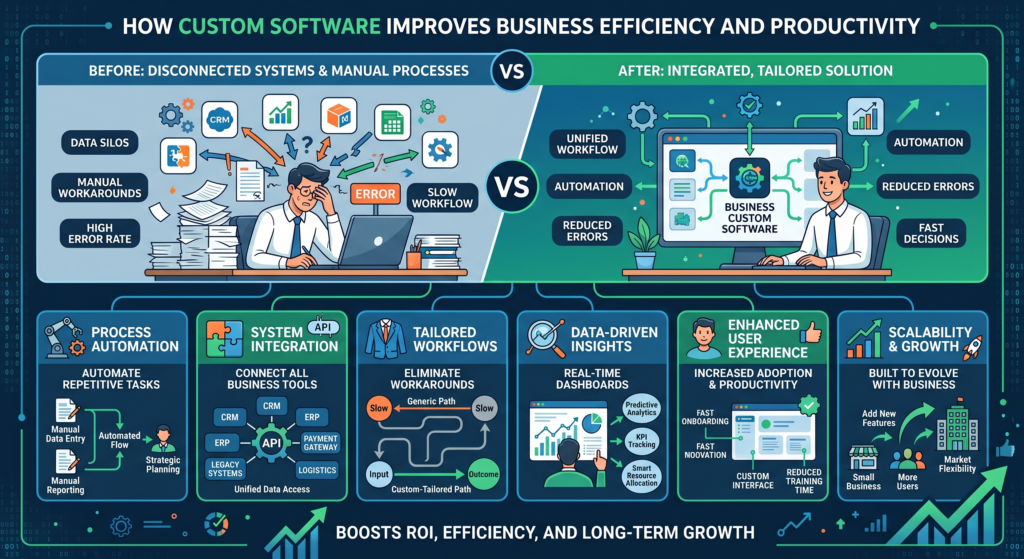
In today’s fast-paced digital world, businesses are constantly searching for smarter ways to improve operations, reduce costs, and increase productivity. Off-the-shelf software may offer basic functionality, but it often fails to address the unique requirements of growing companies. This is where custom software development becomes a game-changer.
Thank you for reading this post, don't forget to subscribe!Custom software solutions are specifically designed to match a company’s workflow, business model, and operational goals. Whether it’s automating repetitive tasks, improving communication, streamlining processes, or enhancing customer experiences, tailored software can significantly improve business efficiency and productivity.
Businesses today require scalable and innovative software solutions designed to optimize performance and support long-term growth.
What Is Custom Software?
Custom software is a tailored digital solution developed specifically for a business or organization. Unlike generic software products that serve broad audiences, custom software focuses on solving unique business challenges.
Examples of custom software include:
- CRM systems
- ERP platforms
- Inventory management systems
- Business automation tools
- Mobile applications
- SaaS platforms
- HR management systems
- Customer portals
- Workflow management systems
Because the software is built around the company’s specific needs, it delivers better performance, flexibility, and scalability.
Why Businesses Need Custom Software in 2026
Modern businesses face increasing challenges, including:
- Managing large volumes of data
- Improving operational efficiency
- Reducing manual work
- Enhancing customer experiences
- Supporting remote teams
- Scaling operations quickly
- Integrating multiple systems
Traditional software solutions often create limitations because they are designed for mass markets rather than individual businesses.
Custom software solves these problems by providing businesses with tools specifically optimized for their operations.
How Custom Software Improves Business Efficiency
- Automates Repetitive Tasks
One of the biggest benefits of custom software is automation.
Many businesses waste valuable time performing repetitive manual tasks such as:
- Data entry
- Report generation
- Invoice processing
- Employee scheduling
- Customer follow-ups
- Inventory tracking
Custom automation software can handle these tasks automatically, allowing employees to focus on more strategic work.
Benefits of Automation
- Saves time
- Reduces human errors
- Improves workflow speed
- Increases operational consistency
- Reduces labor costs
For example, an automated CRM system can instantly assign leads, send follow-up emails, and track customer interactions without manual intervention.
- Streamlines Business Operations
Every business has unique workflows and processes. Generic software often forces businesses to adapt their operations to fit the software.
Custom software works the opposite way.
It is designed around the company’s existing workflow, making operations smoother and more efficient.
Examples:
- Automated approval systems
- Real-time task tracking
- Department collaboration tools
- Custom dashboards
- Workflow management systems
This helps businesses reduce bottlenecks and improve productivity across departments.
- Enhances Employee Productivity
Employees perform better when they have tools designed specifically for their daily tasks.
Custom software eliminates unnecessary features and focuses only on functions relevant to the organization.
This leads to:
- Faster task completion
- Better focus
- Reduced training time
- Improved collaboration
- Higher job satisfaction
When employees spend less time dealing with inefficient systems, overall productivity increases significantly.
- Improves Data Management
Businesses generate large amounts of data every day. Managing this data manually or through disconnected systems can create inefficiencies.
Custom software centralizes data management and provides real-time access to important information.
Key Advantages:
- Faster data retrieval
- Better reporting
- Accurate analytics
- Improved decision-making
- Enhanced data security
Businesses can monitor performance metrics, customer behavior, and operational data from a single platform.
- Reduces Human Errors
Manual processes are more likely to produce mistakes.
Errors in accounting, inventory management, customer records, or reporting can lead to major financial losses.
Custom software minimizes these risks through:
- Automated calculations
- Validation systems
- Standardized workflows
- Smart alerts and notifications
Accurate systems improve operational reliability and customer trust.
How Custom Software Increases Productivity
- Faster Communication and Collaboration
Modern businesses rely heavily on communication between teams, departments, and clients.
Custom collaboration tools improve:
- Internal messaging
- Project management
- File sharing
- Team coordination
- Task assignments
This ensures employees stay connected and work more efficiently.
- Integration With Existing Systems
Many businesses use multiple software platforms for different operations.
Custom software can integrate seamlessly with:
- Accounting systems
- Payment gateways
- CRM software
- ERP systems
- E-commerce platforms
- Third-party APIs
This eliminates duplicate work and improves overall workflow efficiency.
- Real-Time Reporting and Analytics
Business leaders need quick access to accurate information.
Custom dashboards and reporting systems provide real-time insights into:
- Sales performance
- Employee productivity
- Financial reports
- Customer engagement
- Inventory levels
This helps companies make faster and smarter business decisions.
- Scalable Solutions for Business Growth
As businesses grow, their operational requirements change.
Custom software is scalable, meaning it can evolve alongside the business.
Companies can:
- Add new features
- Expand user capacity
- Integrate advanced technologies
- Support larger workloads
This flexibility makes custom software a long-term investment.
- Better Customer Experience
Customer satisfaction directly impacts business success.
Custom software helps businesses deliver personalized and efficient customer experiences through:
- Faster support systems
- Automated responses
- Customer portals
- Personalized recommendations
- Mobile-friendly platforms
Improved customer experiences lead to higher retention and increased revenue.
Industries Benefiting From Custom Software
Healthcare
- Patient management systems
- Appointment scheduling
- Telemedicine platforms
Retail & E-Commerce
- Inventory management
- Customer analytics
- Online shopping platforms
Finance
- Secure transaction systems
- Financial reporting tools
- Fraud detection systems
Education
- Learning management systems
- Student portals
- Online learning platforms
Logistics
- Fleet management
- Route optimization
- Real-time tracking systems
Real Estate
- Property management software
- CRM solutions
- Virtual tour systems
Key Features of Effective Custom Software
Successful custom software solutions typically include:
- User-friendly interface
- High security standards
- Cloud integration
- Mobile compatibility
- API integrations
- Automation features
- Real-time analytics
- Scalable architecture
Businesses can develop customized software tailored to their specific operational requirements.
Custom Software vs Off-the-Shelf Software
Feature | Custom Software | Off-the-Shelf Software |
Tailored Features | Yes | Limited |
Scalability | High | Moderate |
Flexibility | Excellent | Restricted |
Integration | Easy | Limited |
Long-Term Value | High | Moderate |
Licensing Costs | Controlled | Recurring |
Competitive Advantage | Strong | Low |
While off-the-shelf software may appear cheaper initially, custom software often delivers better long-term ROI.
The Role of AI and Automation in Custom Software
Artificial Intelligence and automation are transforming modern software development.
AI-powered custom software can:
- Predict customer behavior
- Automate workflows
- Analyze data patterns
- Improve cybersecurity
- Enhance customer support with chatbots
Businesses adopting AI-driven solutions gain a significant competitive advantage.
Why Startups Prefer Custom Software
Startups need flexibility, scalability, and innovation.
Custom software allows startups to:
- Launch unique products
- Build scalable SaaS platforms
- Optimize internal operations
- Improve user experiences
- Adapt quickly to market changes
For startups aiming to build innovative digital products, custom development offers greater control and growth potential.
Challenges Solved by Custom Software
Custom software helps businesses overcome common operational challenges such as:
- Inefficient workflows
- Poor communication
- Data duplication
- Security vulnerabilities
- Slow manual processes
- Lack of scalability
- Poor reporting systems
By addressing these issues, businesses improve overall efficiency and performance.
How to Choose the Right Custom Software Development Company
Selecting the right technology partner is critical for project success.
Look for a company that offers:
- Proven experience
- Strong portfolio
- Scalable development solutions
- Transparent communication
- Ongoing support
- Modern technologies
- Industry expertise
Expert software development companies help businesses create reliable and scalable digital solutions.
Future Trends in Custom Software Development
The future of custom software includes:
AI-Powered Applications
Businesses are increasingly integrating artificial intelligence into software solutions.
Cloud-Based Platforms
Cloud technology improves accessibility, scalability, and security.
Mobile-First Development
Mobile applications continue to dominate digital engagement.
IoT Integration
Smart devices and connected systems are creating new business opportunities.
Low-Code Development
Faster development cycles are becoming more popular.
Enhanced Cybersecurity
Security-focused development is now a top priority.
Businesses investing in modern custom software solutions will remain competitive in the evolving digital landscape.
Conclusion
Custom software development is no longer a luxury — it has become a necessity for businesses seeking growth, efficiency, and productivity.
By automating workflows, streamlining operations, improving collaboration, and enhancing customer experiences, custom software helps businesses operate smarter and faster.
Unlike generic solutions, tailored software provides flexibility, scalability, and long-term value that aligns with business goals.
Whether you are a startup, small business, or enterprise organization, investing in custom software can transform your operations and create a strong competitive advantage.
If you are looking for scalable digital solutions, automation tools, SaaS platforms, or mobile app development services, professional software development companies offer innovative solutions designed to help businesses grow in the digital age.