In today’s fast-paced digital economy, businesses are constantly searching for smarter ways to improve efficiency, reduce operational expenses, and stay ahead of the competition. One of the most effective solutions transforming modern organizations is automation software. From startups to large enterprises, companies across every industry are embracing automation to streamline workflows, eliminate repetitive tasks, and maximize productivity.
Thank you for reading this post, don't forget to subscribe!Automation software is no longer a luxury reserved for large corporations. It has become an essential business tool that helps organizations save valuable time, reduce human errors, improve customer satisfaction, and significantly lower operational costs. Whether it is automating customer support, accounting, marketing campaigns, inventory management, or internal communication, automation software allows businesses to focus more on growth and innovation rather than routine manual work.
In this blog, we will explore how automation software saves time and reduces costs, the major benefits it offers, real-world use cases, and why businesses should invest in automation solutions in 2026 and beyond.
What is Automation Software?
Automation software refers to digital tools and systems designed to perform repetitive tasks and business processes automatically with minimal human intervention. These solutions are built to simplify operations, improve accuracy, and increase overall efficiency.
Business automation can include:
- Workflow automation
- Marketing automation
- HR automation
- Customer service automation
- AI-powered chatbots
- Accounting and invoicing automation
- CRM automation
- Inventory management systems
- Email automation
- Project management automation
Instead of employees manually handling repetitive activities every day, automation software performs these tasks faster and more accurately.
Why Businesses are Investing in Automation Software
Businesses today face several operational challenges:
- Rising labor costs
- Time-consuming manual tasks
- Human errors
- Delayed workflows
- Inefficient communication
- Poor data management
- Customer service delays
Automation software helps organizations solve these issues by improving operational efficiency and reducing dependency on repetitive manual work.
Companies that adopt automation technologies often experience:
- Increased productivity
- Lower operational costs
- Faster business processes
- Better customer experiences
- Improved employee satisfaction
- Higher profitability
As digital transformation continues to reshape industries, automation has become one of the most valuable investments for businesses of all sizes.
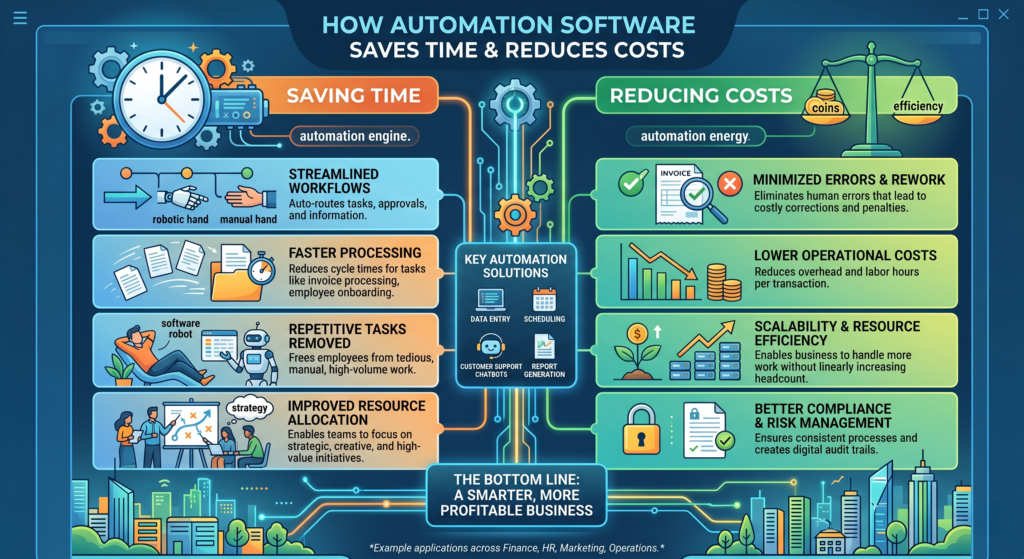
How Automation Software Saves Time
- Eliminates Repetitive Manual Tasks
One of the biggest advantages of automation software is its ability to handle repetitive tasks automatically.
Employees often spend hours performing routine activities such as:
- Data entry
- Sending emails
- Scheduling appointments
- Updating spreadsheets
- Creating invoices
- Generating reports
Automation software completes these tasks within seconds, allowing employees to focus on strategic and high-value work.
For example:
An automated invoicing system can instantly generate and send invoices to clients without requiring manual input every time.
This saves countless hours every month.
- Speeds Up Business Processes
Manual workflows often slow down business operations because tasks must pass through multiple employees or departments.
Automation software accelerates workflows by:
- Automatically assigning tasks
- Sending notifications
- Updating records in real time
- Triggering approvals instantly
This significantly reduces delays and improves workflow efficiency.
For instance, HR automation software can process employee leave requests automatically instead of relying on lengthy manual approvals.
- Reduces Human Errors
Human errors are common in repetitive tasks, especially when employees are overworked or handling large amounts of data.
Mistakes in:
- Financial records
- Customer information
- Inventory management
- Data entry
can lead to serious financial losses and wasted time.
Automation software minimizes these risks by performing tasks consistently and accurately.
As a result, businesses spend less time correcting errors and managing operational issues.
- Improves Communication Efficiency
Automation tools improve communication both internally and externally.
Examples include:
- Automated email responses
- Team notifications
- Customer support chatbots
- Appointment reminders
- Task alerts
These systems ensure timely communication without requiring employees to manually respond to every request.
This improves productivity while maintaining excellent customer service.
- Enables Faster Customer Support
Modern customers expect instant responses and quick resolutions.
Automation software helps businesses provide 24/7 support using:
- AI chatbots
- Automated ticketing systems
- CRM integrations
- Self-service portals
Customers receive faster responses, while support teams save time handling repetitive inquiries.
For example, AI-powered chatbots can instantly answer common questions related to pricing, services, or order tracking.
- Simplifies Data Management
Businesses generate massive amounts of data every day.
Managing this information manually is time-consuming and inefficient.
Automation software helps by:
- Organizing data automatically
- Updating records in real time
- Generating reports instantly
- Synchronizing information across systems
This improves decision-making and saves valuable administrative time.
How Automation Software Reduces Costs
- Reduces Labor Costs
Manual operations require more employees to handle repetitive work.
Automation software reduces dependency on large teams by automating routine processes.
Businesses can:
- Lower staffing costs
- Reduce overtime expenses
- Improve workforce efficiency
- Allocate employees to strategic tasks
This leads to significant long-term cost savings.
- Minimizes Operational Expenses
Inefficient workflows increase operational costs due to delays, mistakes, and duplicated work.
Automation software streamlines operations, helping businesses reduce expenses related to:
- Paperwork
- Administrative tasks
- Manual approvals
- Customer support operations
- Data processing
Digital automation also reduces printing and storage costs by moving processes online.
- Prevents Costly Errors
Errors in finance, inventory, or customer management can be expensive.
Automation software helps businesses avoid:
- Duplicate invoices
- Incorrect calculations
- Inventory shortages
- Compliance mistakes
- Data inconsistencies
By reducing errors, companies save money that would otherwise be spent fixing problems or compensating customers.
- Improves Resource Utilization
Automation allows businesses to maximize the productivity of their existing resources.
Instead of hiring additional staff, organizations can automate repetitive tasks and scale operations efficiently.
This means businesses can grow without dramatically increasing operational costs.
- Reduces Downtime
Manual systems are more vulnerable to delays, bottlenecks, and workflow interruptions.
Automation software ensures smoother operations by:
- Running processes continuously
- Sending automated alerts
- Tracking workflow progress
- Preventing missed tasks
Reduced downtime improves overall business performance and profitability.
Key Areas Where Businesses Use Automation Software
Marketing Automation
Marketing automation tools help businesses automate:
- Email campaigns
- Social media posting
- Lead nurturing
- Customer segmentation
- Analytics reporting
This saves time while improving marketing effectiveness.
Popular marketing automation platforms include CRM systems and AI-powered marketing tools.
Sales Automation
Sales teams use automation software to:
- Track leads
- Schedule follow-ups
- Manage customer data
- Generate proposals
- Automate pipelines
This improves sales productivity and customer relationship management.
HR Automation
HR departments automate tasks such as:
- Employee onboarding
- Payroll processing
- Attendance tracking
- Leave management
- Recruitment workflows
This reduces administrative workload and improves efficiency.
Customer Support Automation
Businesses use customer support automation for:
- AI chatbots
- Ticket management
- Automated responses
- FAQ systems
This improves customer experience while reducing support costs.
Accounting Automation
Accounting software automates:
- Invoicing
- Expense tracking
- Tax calculations
- Payroll
- Financial reporting
This improves financial accuracy and saves significant time.
Benefits of Automation Software for Small Businesses
Many small business owners believe automation is only for large companies. However, small businesses often benefit the most from automation because they typically operate with limited resources.
Automation helps small businesses:
- Save time
- Reduce operational costs
- Improve customer service
- Compete with larger companies
- Increase productivity
- Scale efficiently
Affordable cloud-based automation tools now make advanced technology accessible to businesses of all sizes.
The Role of AI in Modern Automation Software
Artificial Intelligence is revolutionizing business automation.
AI-powered automation systems can:
- Analyze customer behavior
- Predict trends
- Personalize marketing campaigns
- Provide intelligent recommendations
- Improve decision-making
AI automation goes beyond repetitive tasks by helping businesses make smarter and faster decisions.
Examples include:
- AI chatbots
- Predictive analytics
- Smart CRM systems
- AI-based workflow automation
As AI technology continues to evolve, automation software will become even more powerful.
Common Challenges in Business Automation
Although automation offers many advantages, businesses may face certain challenges during implementation.
Initial Setup Costs
Some automation systems require upfront investment in:
- Software development
- Integration
- Employee training
However, the long-term savings usually outweigh the initial costs.
Employee Resistance
Employees may fear automation could replace jobs.
Businesses should focus on using automation to support employees rather than replace them completely.
Automation allows teams to focus on creative and strategic work instead of repetitive tasks.
Integration Issues
Older systems may not integrate smoothly with modern automation tools.
Choosing scalable and compatible software solutions is essential for successful implementation.
How to Successfully Implement Automation Software
Identify Repetitive Tasks
Start by identifying tasks that consume significant time and resources.
Focus on processes that are repetitive, rule-based, and prone to errors.
Choose the Right Automation Tools
Select software solutions based on:
- Business goals
- Scalability
- Ease of use
- Integration capabilities
- Security features
Custom automation software may be ideal for businesses with unique operational needs.
Train Employees
Provide proper training to help employees adapt to new systems.
This ensures smoother adoption and better productivity.
Monitor and Optimize
Automation should be continuously monitored and improved.
Analyze performance metrics to identify areas for optimization.
Future of Automation Software
The future of automation is incredibly promising.
Emerging technologies such as:
- Artificial Intelligence
- Machine Learning
- Robotic Process Automation (RPA)
- Cloud Computing
- Predictive Analytics
will continue transforming business operations.
Future automation systems will become more intelligent, adaptive, and capable of handling complex business tasks.
Businesses that invest in automation today will gain a strong competitive advantage in the future.
Why Businesses Should Invest in Automation Software Now
Companies that delay digital transformation risk falling behind competitors who are already leveraging automation technologies.
Automation software helps businesses:
- Improve efficiency
- Reduce operational costs
- Deliver better customer experiences
- Increase scalability
- Boost profitability
Whether you run a startup, small business, or enterprise organization, automation can transform the way your business operates.
Conclusion
Automation software has become a critical tool for businesses seeking to improve productivity, save time, and reduce operational costs. By automating repetitive tasks, streamlining workflows, minimizing errors, and enhancing communication, businesses can operate more efficiently while focusing on growth and innovation.
From customer service and marketing to accounting and HR management, automation software is reshaping modern business operations across every industry.
As technology continues to evolve, businesses that embrace automation will be better positioned to compete, scale, and succeed in the digital era.
Investing in automation software is no longer just about convenience — it is about building a smarter, faster, and more profitable business for the future.