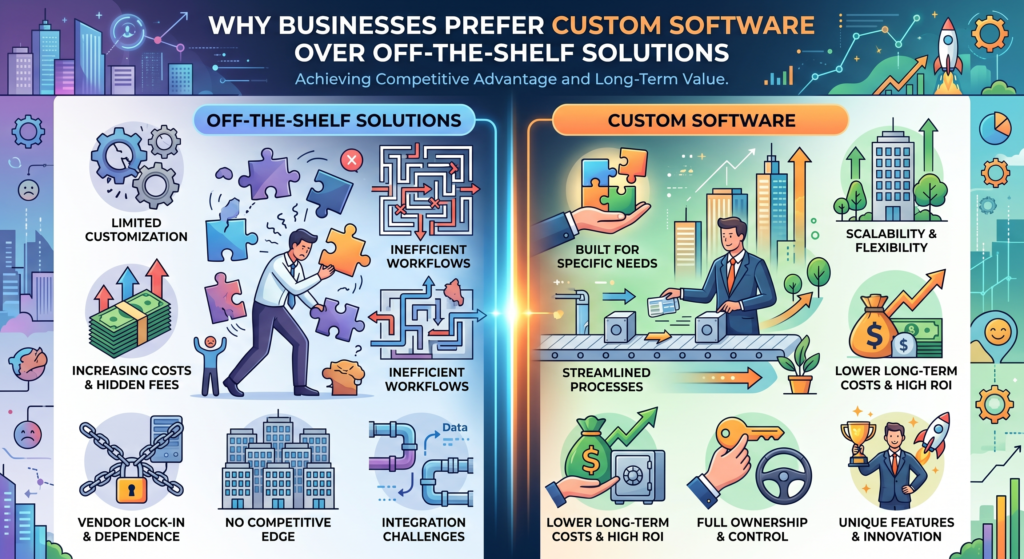
In today’s fast-paced digital economy, software is no longer just a support tool—it is the backbone of modern business operations. Whether it’s managing customers, automating workflows, handling data, or scaling operations, the right software can determine how efficiently a business grows.
Thank you for reading this post, don't forget to subscribe!One of the most important decisions organizations face is choosing between custom software development and off-the-shelf software solutions. While ready-made software may seem convenient and cost-effective at first glance, more and more businesses are shifting toward custom-built solutions tailored to their unique needs.
In this blog, we will explore in depth why businesses prefer custom software over off-the-shelf solutions, the advantages, limitations of both options, and how the right decision can significantly impact long-term success.
Understanding the Two Approaches
1. What is Off-the-Shelf Software?
Off-the-shelf software refers to pre-built applications designed for mass market use. These solutions are ready to use immediately after purchase or subscription.
Examples include:
- Microsoft Office
- Shopify
- QuickBooks
- Slack
- Trello
These tools are built for general use cases and are designed to serve as many users as possible.
Key Characteristics:
- Fixed features
- Subscription-based pricing
- Quick deployment
- Limited customization
2. What is Custom Software?
Custom software is specifically designed and developed to meet the unique requirements of a business. It is built from scratch or partially customized to align with workflows, goals, and internal processes.
For example:
- A custom CRM for a real estate company
- A tailored inventory system for a manufacturing business
- A SaaS platform built for a startup idea
Custom solutions are typically developed by a software house or development team, such as agencies like WEB Craft Innovations (as an example of a service provider in this space).
Key Characteristics:
- Fully tailored functionality
- Scalable architecture
- Business-specific workflows
- Full ownership and control
Why Businesses Are Moving Toward Custom Software
1. Perfect Fit for Business Needs
One of the biggest limitations of off-the-shelf software is that it forces businesses to adjust their operations to fit the tool—not the other way around.
Custom software solves this problem.
Benefits:
- Designed according to your exact workflow
- Matches your internal processes
- Eliminates unnecessary features
- Improves operational efficiency
For example, a logistics company may need route optimization, live tracking, and driver management—all in one system. Off-the-shelf tools rarely provide this exact combination.
2. Scalability for Future Growth
Businesses don’t stay the same. They grow, evolve, and expand into new markets. Off-the-shelf tools often struggle to keep up with this growth.
Custom software is built with scalability in mind.
Why scalability matters:
- You can add new features anytime
- System grows with your users
- Handles increasing data loads
- Supports business expansion
This is especially important for startups planning to scale into full SaaS platforms or enterprise systems.
3. Better Security and Data Protection
Cybersecurity is a major concern for modern businesses.
Off-the-shelf software is widely used, making it a common target for hackers. Once a vulnerability is found, thousands of businesses are at risk.
Custom software offers:
- Dedicated security architecture
- Unique system design (harder to breach)
- Controlled access levels
- Better compliance with industry regulations
Industries like finance, healthcare, and legal services especially prefer custom solutions for this reason.
4. Full Ownership and Control
When using off-the-shelf software, you are essentially renting the tool. If the company changes pricing, removes features, or shuts down, your business is directly affected.
With custom software:
- You own the system
- You control updates
- You decide features
- No dependency on third-party vendors
This independence is a major advantage for long-term stability.
5. Competitive Advantage
In competitive markets, differentiation is everything.
If your competitors are using the same off-the-shelf tools, they are also limited by the same features. Custom software allows you to build unique capabilities that others don’t have.
Example:
A retail business using custom software might implement:
- AI-based customer recommendations
- Personalized pricing engines
- Advanced analytics dashboards
These features can significantly improve customer experience and profitability.
6. Integration with Existing Systems
Most businesses already use multiple tools—CRM systems, accounting software, marketing platforms, and more.
Off-the-shelf software often has limited integration options.
Custom software, on the other hand:
- Integrates seamlessly with existing systems
- Uses APIs tailored to your needs
- Reduces manual work
- Improves data flow across departments
This leads to a more connected and efficient business ecosystem.
7. Long-Term Cost Efficiency
At first, off-the-shelf software seems cheaper due to low monthly subscriptions. However, costs increase over time due to:
- Per-user pricing
- Premium features
- Add-ons and upgrades
- Limitations requiring multiple tools
Custom software requires upfront investment, but:
- No recurring licensing fees
- No dependency on multiple subscriptions
- Lower operational inefficiencies
- Higher ROI over time
In the long run, businesses often save more with custom solutions.
8. Better User Experience
User experience plays a critical role in productivity and customer satisfaction.
Off-the-shelf tools are designed for general users, not your specific team or customers.
Custom software:
- Has intuitive, role-specific interfaces
- Reduces training time
- Improves employee productivity
- Enhances customer satisfaction
When software feels natural to use, adoption becomes much easier.
9. Automation of Unique Business Processes
Every business has unique workflows that generic tools cannot fully automate.
Custom software allows:
- End-to-end workflow automation
- Reduction of manual tasks
- Smart decision-making systems
- AI-powered process optimization
For example, a custom HR system can automate:
- Hiring workflows
- Employee onboarding
- Attendance tracking
- Performance reviews
10. Adaptability to Market Changes
Markets change quickly. Businesses must respond fast.
With off-the-shelf software, you are limited by vendor updates and release cycles.
Custom software allows:
- Fast updates based on business needs
- Quick adaptation to new regulations
- Feature modifications on demand
- Agile development cycles
This flexibility is crucial in industries like e-commerce, fintech, and SaaS.
Limitations of Off-the-Shelf Software
While useful, off-the-shelf software has several drawbacks:
- Limited customization options
- Subscription costs increase over time
- Vendor dependency
- Security risks due to mass usage
- Unnecessary features that slow down performance
- Lack of scalability for complex businesses
These limitations often push growing companies toward custom solutions.
When Should Businesses Choose Custom Software?
Custom software is ideal when:
- Your business has unique workflows
- You are planning long-term growth
- You need high-level security
- You want to build a SaaS product
- You require integration across multiple systems
- You aim to gain a competitive advantage
Startups, enterprises, and digital-first companies especially benefit from this approach.
Role of a Software House in Custom Development
A professional software house plays a key role in building custom solutions. They handle:
- Requirement analysis
- UI/UX design
- Development
- Testing
- Deployment
- Maintenance and support
Companies like WEB Craft Innovations (as an example of a software development service provider) help businesses transform ideas into scalable digital products.
Final Thoughts
The decision between custom software and off-the-shelf solutions is not just technical—it is strategic.
Off-the-shelf software may work for basic needs, but it lacks flexibility, scalability, and long-term efficiency. Custom software, on the other hand, empowers businesses with tailored functionality, complete control, and a strong competitive edge.
In a world where digital transformation defines success, investing in custom software is no longer a luxury—it is a necessity.