
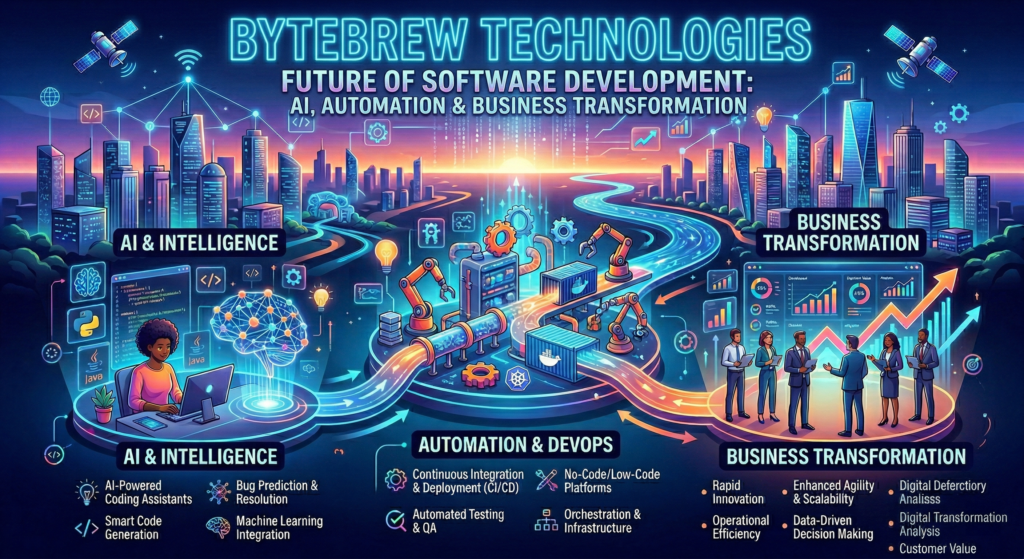
Future of Software Development: AI, Automation & Business Transformation
Thank you for reading this post, don't forget to subscribe!Introduction
The software development landscape is evolving at an unprecedented pace. What once required months of coding, testing, and deployment can now be achieved in a fraction of the time through the integration of Artificial Intelligence (AI) and automation technologies. As businesses strive to remain competitive in a digitally driven world, software development is no longer just about writing code—it is about creating intelligent, scalable, and efficient systems that drive innovation and transformation.
The future of software development lies at the intersection of AI, automation, and business strategy. Organizations that embrace these technologies are not only improving productivity but also redefining how they deliver value to customers. This blog explores how AI and automation are shaping the future of software development and how businesses can leverage these advancements for growth and success.
The Evolution of Software Development
Software development has come a long way from traditional waterfall methodologies to agile and DevOps practices. In the early days, development was a linear process, requiring extensive planning and documentation before any coding began. This often led to delays and inefficiencies.
With the rise of Agile methodologies, development became more iterative and collaborative. Teams could now respond to changes quickly, improving both speed and quality. DevOps further enhanced this by integrating development and operations, enabling continuous integration and continuous deployment (CI/CD).
Today, we are entering a new phase—AI-driven development—where machines assist in writing code, detecting bugs, and even predicting project outcomes. This evolution is not just a technological shift but a fundamental transformation in how software is built and delivered.
The Role of Artificial Intelligence in Software Development
Artificial Intelligence is revolutionizing every stage of the software development lifecycle (SDLC). From planning to deployment, AI is enhancing efficiency, accuracy, and innovation.
- AI-Powered Code Generation
Modern AI tools can generate code snippets, suggest improvements, and even build entire applications based on user requirements. This significantly reduces development time and allows developers to focus on more complex tasks.
AI-driven coding assistants analyze vast amounts of data to provide context-aware suggestions, helping developers write cleaner and more efficient code. This not only improves productivity but also reduces the likelihood of errors.
- Intelligent Testing and Debugging
Testing has always been a time-consuming part of software development. AI is transforming this process by automating test case generation, identifying potential bugs, and predicting system failures.
Machine learning algorithms can analyze past defects to identify patterns and prevent similar issues in the future. This leads to higher-quality software and reduced maintenance costs.
- Predictive Analytics in Development
AI can analyze project data to predict timelines, resource requirements, and potential risks. This enables better decision-making and more accurate project planning.
Businesses can use predictive analytics to optimize workflows, allocate resources efficiently, and ensure timely delivery of projects.
Automation: The Backbone of Modern Development
While AI brings intelligence, automation brings efficiency. Together, they form the foundation of modern software development.
- Continuous Integration and Continuous Deployment (CI/CD)
Automation enables seamless integration and deployment of code. CI/CD pipelines ensure that code changes are automatically tested and deployed, reducing manual intervention and accelerating release cycles.
This allows businesses to deliver updates faster and respond to customer needs in real time.
- Infrastructure as Code (IaC)
Automation has extended beyond code development to infrastructure management. Infrastructure as Code allows developers to manage and provision infrastructure using code, making deployments more consistent and scalable.
This reduces human error and ensures that environments are reproducible across different stages of development.
- Robotic Process Automation (RPA)
RPA automates repetitive tasks such as data entry, report generation, and system monitoring. In software development, this helps streamline workflows and free up developers for more strategic work.
The Impact on Business Transformation
The integration of AI and automation is not just transforming software development—it is reshaping entire businesses.
- Faster Time to Market
With automated processes and AI-driven insights, businesses can develop and deploy software faster than ever before. This enables them to stay ahead of competitors and meet customer demands quickly.
- Enhanced Customer Experience
AI-powered applications can provide personalized experiences, real-time support, and intelligent recommendations. This improves customer satisfaction and builds long-term loyalty.
- Cost Efficiency
Automation reduces the need for manual intervention, lowering operational costs. AI minimizes errors and improves efficiency, resulting in significant cost savings for businesses.
- Data-Driven Decision Making
AI enables businesses to analyze large volumes of data and extract actionable insights. This allows organizations to make informed decisions and develop strategies based on real-time information.
Emerging Trends in Software Development
As technology continues to evolve, several trends are shaping the future of software development.
- Low-Code and No-Code Platforms
These platforms allow users to build applications with minimal coding knowledge. They are empowering non-developers to create software solutions, accelerating innovation across organizations.
- Cloud-Native Development
Cloud computing is becoming the standard for software development. Cloud-native applications are designed to leverage the scalability, flexibility, and resilience of cloud environments.
- Microservices Architecture
Instead of building monolithic applications, developers are adopting microservices architecture. This approach breaks applications into smaller, independent components, making them easier to develop, deploy, and maintain.
- AI-First Development
In the future, AI will not just be a feature—it will be a core component of software systems. Developers will design applications with AI capabilities from the ground up.
Challenges and Considerations
While AI and automation offer numerous benefits, they also come with challenges.
- Skill Gap
The rapid adoption of AI and automation requires new skills. Organizations must invest in training and upskilling their workforce to stay competitive.
- Data Privacy and Security
AI systems rely on large amounts of data, raising concerns about privacy and security. Businesses must implement robust measures to protect sensitive information.
- Ethical Considerations
The use of AI raises ethical questions regarding bias, transparency, and accountability. Organizations must ensure that their AI systems are fair and unbiased.
- Integration Complexity
Integrating AI and automation into existing systems can be complex. Businesses need a clear strategy and the right tools to ensure a smooth transition.
The Role of Software Houses in the Future
Software development companies, like modern tech firms, play a crucial role in helping businesses navigate this transformation.
- Delivering Customized Solutions
Software houses are focusing on building tailored solutions that meet the unique needs of businesses. This includes AI-driven applications, automation tools, and scalable platforms.
- Driving Innovation
By leveraging the latest technologies, software companies are driving innovation and helping businesses stay ahead in the competitive market.
- Providing End-to-End Services
From ideation to deployment and maintenance, software houses are offering comprehensive services to ensure the success of digital transformation initiatives.
How Businesses Can Prepare for the Future
To stay competitive in the evolving landscape, businesses must take proactive steps.
- Embrace AI and Automation
Organizations should integrate AI and automation into their operations to improve efficiency and drive innovation.
- Invest in Talent
Upskilling employees and hiring skilled professionals is essential for leveraging new technologies effectively.
- Adopt Agile Practices
Agile methodologies enable businesses to adapt to changes quickly and deliver value continuously.
- Focus on Customer-Centric Solutions
Understanding customer needs and delivering personalized experiences should be a top priority.
Conclusion
The future of software development is being shaped by AI and automation, driving a new era of business transformation. These technologies are not only enhancing the efficiency of development processes but also enabling organizations to innovate and grow in ways that were previously unimaginable.
As we move forward, the integration of AI, automation, and advanced development practices will become the standard. Businesses that embrace this transformation will be better positioned to succeed in the digital age, while those that resist may struggle to keep up.
The key to success lies in adaptability, innovation, and a forward-thinking approach. By leveraging the power of AI and automation, organizations can unlock new opportunities, deliver exceptional value, and shape the future of technology.
SEO Meta Description
Future of software development with AI, automation, and business transformation. Learn trends, benefits, and strategies to stay ahead in the digital era.
Focus Keywords
- Future of Software Development
- AI in Software Development
- Automation in IT Industry
- Business Transformation with AI
- Software Development Trends 2026