
Introduction
In today’s highly competitive digital landscape, businesses are no longer judged solely by the quality of their products or services. Instead, the overall experience they provide to their users plays a critical role in determining success. Whether it’s a website, mobile application, or software platform, user experience (UX) has become a key differentiator that directly impacts customer satisfaction, engagement, and ultimately, revenue.
Thank you for reading this post, don't forget to subscribe!A well-designed user experience is not just about aesthetics—it’s about creating seamless, intuitive, and meaningful interactions that guide users effortlessly toward their goals. Businesses that prioritize UX are better positioned to attract, convert, and retain customers, leading to sustainable growth and increased profitability.
This blog explores how improving user experience can significantly boost your business revenue, the principles behind effective UX design, and how companies like ByteBrew Technologies help businesses achieve these outcomes through strategic design and development.
Understanding User Experience (UX)
User Experience (UX) refers to how a person feels when interacting with a digital product or service. It encompasses usability, accessibility, performance, design, and overall satisfaction.
A strong UX ensures that:
Users can easily navigate your platform
Information is presented clearly and logically
Tasks can be completed efficiently
The experience is enjoyable and engaging
When users have a positive experience, they are more likely to trust your brand, stay longer, and take desired actions such as making a purchase or signing up for services.
The Direct Link Between UX and Revenue
Many businesses underestimate the financial impact of UX. However, research and real-world case studies consistently show a strong correlation between user experience and revenue growth.
Here’s how UX directly affects your bottom line:
1. Increased Conversion Rates
A well-optimized user interface reduces friction in the customer journey. When users can easily find what they’re looking for and complete actions without confusion, conversion rates improve.
For example:
Simplified checkout processes reduce cart abandonment
Clear call-to-action buttons encourage engagement
Logical navigation helps users reach decision points faster
Even small UX improvements can lead to significant increases in conversions, translating directly into higher revenue.
2. Reduced Bounce Rates
First impressions matter. If users land on your website and find it difficult to navigate or visually unappealing, they are likely to leave immediately.
Good UX design ensures:
Fast loading speeds
Clean and modern layouts
Mobile responsiveness
Easy-to-read content
Reducing bounce rates means more users stay on your platform longer, increasing the chances of conversions and revenue generation.
3. Enhanced Customer Retention
Acquiring new customers is significantly more expensive than retaining existing ones. A positive user experience encourages repeat visits and long-term engagement.
When users enjoy interacting with your platform:
They are more likely to return
They develop brand loyalty
They recommend your services to others
This leads to increased customer lifetime value (CLV), which is a critical factor in long-term revenue growth.
4. Stronger Brand Trust and Credibility
A poorly designed website or app can damage your brand’s reputation. On the other hand, a polished and professional user experience builds trust and credibility.
Users tend to associate:
Smooth navigation with professionalism
Fast performance with reliability
Clean design with quality
Trust plays a major role in purchasing decisions, especially in online environments where users cannot physically interact with products.
5. Higher Customer Satisfaction
Satisfied customers are more likely to convert, return, and advocate for your brand. UX directly influences customer satisfaction by making interactions enjoyable and stress-free.
Key elements include:
Intuitive design
Minimal effort to complete tasks
Clear communication and feedback
Happy customers often lead to positive reviews, referrals, and increased revenue.
Key Elements of Effective UX Design
To fully leverage UX for revenue growth, businesses must focus on several core design principles:
1. Simplicity
Keep interfaces clean and uncluttered. Avoid overwhelming users with too many options or unnecessary elements.
2. Consistency
Maintain consistent design patterns across your platform to create familiarity and reduce confusion.
3. Accessibility
Ensure your platform is usable by people of all abilities. Accessibility improvements can expand your audience and increase revenue potential.
4. Responsiveness
With the majority of users accessing platforms via mobile devices, responsive design is essential for delivering a seamless experience across all screen sizes.
5. Speed and Performance
Slow-loading pages frustrate users and lead to drop-offs. Optimizing performance is crucial for retaining users and improving conversions.
The Role of UX in Different Business Models
E-commerce Businesses
For online stores, UX is directly tied to sales. A smooth browsing and checkout experience can significantly increase purchase rates.
Key UX strategies:
Clear product categorization
High-quality images and descriptions
Easy checkout process
Service-Based Businesses
For service providers, UX helps build trust and encourages inquiries or bookings.
Important elements:
Clear service descriptions
Simple contact forms
Strong call-to-action sections
SaaS Platforms
For software-as-a-service companies, UX determines user adoption and retention.
Critical factors:
Easy onboarding process
Intuitive dashboards
Efficient workflows
Common UX Mistakes That Hurt Revenue
Many businesses unknowingly lose revenue due to poor UX decisions. Some common mistakes include:
Complicated navigation structures
Lack of mobile optimization
Slow loading speeds
Poorly designed forms
Inconsistent branding
Identifying and fixing these issues can lead to immediate improvements in user engagement and revenue.
How UX Optimization Drives Long-Term Growth
Investing in UX is not a one-time effort—it’s an ongoing process of testing, analyzing, and improving.
Continuous Improvement Strategies:
User behavior analysis
A/B testing
Customer feedback collection
Performance monitoring
By continuously refining the user experience, businesses can adapt to changing user needs and stay ahead of competitors.
The Role of ByteBrew Technologies in Enhancing UX
ByteBrew Technologies understands the critical role that user experience plays in business success. By combining innovative design principles with advanced development techniques, the company helps businesses create digital platforms that are not only visually appealing but also highly functional and user-friendly.
Key Services Include:
Custom website development
Mobile application development
UI/UX design optimization
Performance enhancement
AI-driven solutions
By focusing on user-centric design, ByteBrew Technologies ensures that every digital product delivers maximum value to both users and businesses.
Real-World Impact of UX Improvements
Businesses that invest in UX often see measurable results, such as:
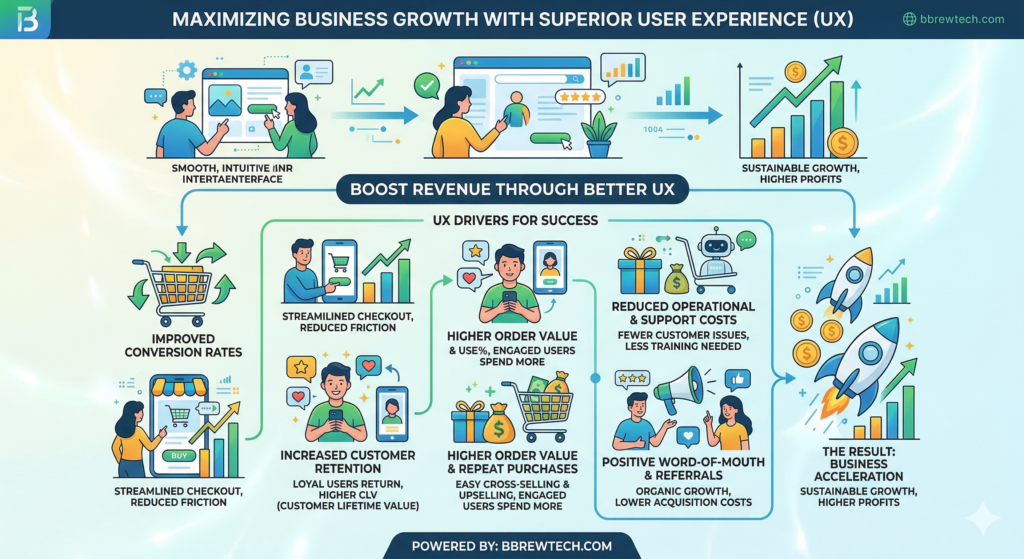
Increased conversion rates
Higher average order values
Improved customer retention
Reduced support costs
These outcomes demonstrate that UX is not just a design consideration—it is a strategic business investment.
Future Trends in UX Design
As technology continues to evolve, UX design is becoming more sophisticated. Some emerging trends include:
AI-powered personalization
Voice user interfaces
Augmented reality experiences
Minimalist and clean design aesthetics
Staying ahead of these trends can give businesses a competitive advantage and further boost revenue.
Conclusion
User experience is no longer optional—it is a fundamental component of business success in the digital age. A well-designed UX can significantly impact how users interact with your platform, influencing their decisions, satisfaction, and loyalty.
By focusing on simplicity, usability, and performance, businesses can create experiences that not only meet user expectations but exceed them. The result is increased engagement, higher conversions, and ultimately, greater revenue.
Companies like ByteBrew Technologies play a vital role in helping businesses achieve these goals by delivering user-centric solutions tailored to modern needs. Investing in UX today is an investment in your business’s future growth and profitability.
Final Thoughts
If you want to stay competitive and maximize your revenue potential, prioritizing user experience should be at the top of your strategy. Every interaction matters, and every improvement can lead to measurable business success.
A better user experience doesn’t just satisfy users—it drives results.